








Ethnic parties have tightened their hold on Bosnia and Herzegovina after the general election of October 4, with Denis Bećirović, Darijana Filipović and Željka Cvijanović set to take the three seats of the country’s rotating presidency.
Preliminary figures from the Central Election Commission (CIK), based on more than 90 per cent of polling stations, gave Bećirović of the Social Democratic Party (SDP BiH) a second term in the Bosniak seat with about 26.8 per cent of the vote.
He finished ahead of Bakir Izetbegović of the Party of Democratic Action (SDA), who conceded the seat while arguing that his party had improved on its 2022 showing.
The sharpest change came in the Croat seat, taken by Filipović of the Croatian Democratic Union of Bosnia and Herzegovina (HDZ BiH) with 48.2 per cent.
Her win ends the four-term run of Željko Komšić, elected by mainly Bosniak voters in a result HDZ BiH had long called illegitimate.
Cvijanović was returned in the Serb seat with 55.4 per cent for the Alliance of Independent Social Democrats (SNSD), ahead of Marinko Božović of the Serb Democratic Party (SDS) on 26.6 per cent.
That handed a fresh mandate to the party of Milorad Dodik, who was barred from public office last year and was not on the ballot, yet dominated the campaign and declared victory in Banja Luka.
Dodik, who had just returned from a visit to Moscow and a meeting with Russian President Vladimir Putin, told his party’s closing rally that Bosnia was dead and an impossible country.
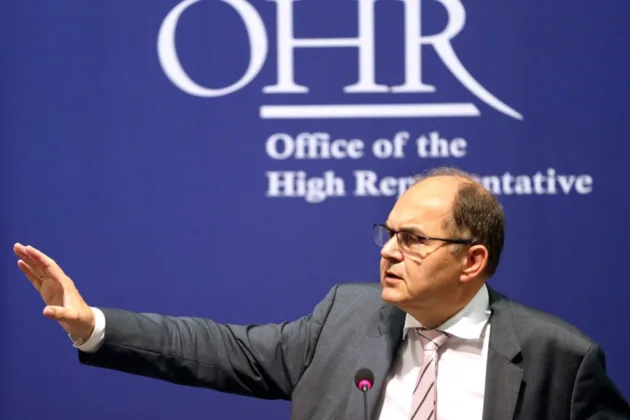
He lost the presidency of Republika Srpska, the Serb entity, after being convicted of defying the decisions of the international High Representative, a post vacated when Christian Schmidt stepped down in May after months of confrontation with the entity’s leadership.
Turnout across the two entities was about 42 per cent, a record low for a general election and well down on the 51.5 per cent recorded in 2022.
Voters also chose the national parliament and the two entity assemblies. Bosnia’s power-sharing rules mean governments are usually formed only after months of bargaining.
The presidency seats are filled separately. Voters in the Federation of Bosnia and Herzegovina may back either the Bosniak or the Croat candidate but not both, while the Serb member is chosen in Republika Srpska.
The structure dates from the 1995 Dayton accords that ended a war in which about 100,000 people died and more than two million were displaced.
Bosnia has held European Union candidate status since December 2022 and has yet to open accession negotiations, trailing Montenegro and Albania. The vote leaves in place the same blocs the European Commission has spent years asking to deliver reforms.