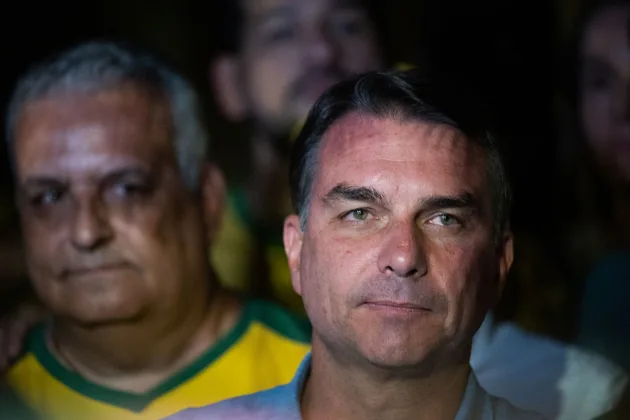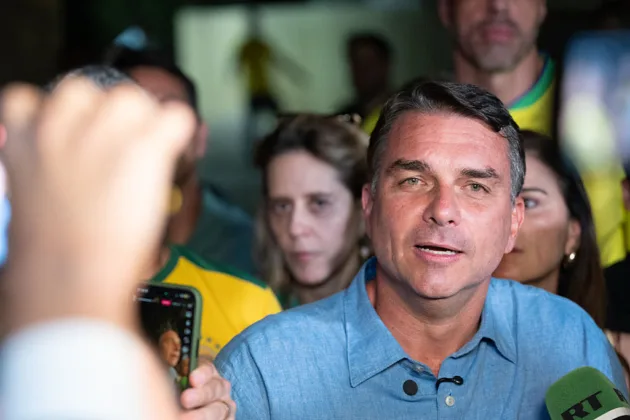








Senator Flávio Bolsonaro has finished ahead of President Luiz Inácio Lula da Silva in the first round of Brazil’s presidential election, sending the two men to a run-off on October 25. Neither reached the majority of valid votes needed to win outright.
With almost every ballot box counted, the Superior Electoral Court put the Liberal Party (PL) candidate on 47.1 per cent against 45.1 per cent for the President. That worked out at close to 56 million votes against some 53.6 million, a margin of about 2.4 million.
Bolsonaro, the eldest son of imprisoned former president Jair Bolsonaro, carried the three largest electorates of Minas Gerais, Rio de Janeiro and São Paulo. He took the last two with more than half the vote.
The outcome defied the final opinion surveys, which had put Lula da Silva narrowly in front and had pointed to a close second round rather than a first-round lead for the Right.
The PL was also on course to become the largest single force in the Chamber of Deputies and to add seats in the Senate. Whoever wins on October 25 will face a legislature tilted further to the Right than the one elected in 2022.
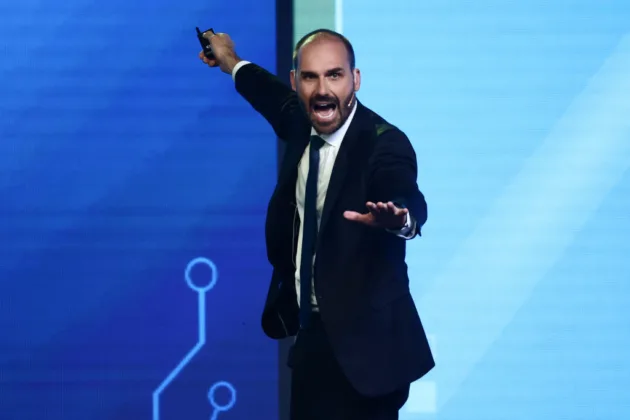
Four members of the Bolsonaro family were elected to Congress on the same day. Michelle Bolsonaro, the former first lady, won a Senate seat for the Federal District and Carlos Bolsonaro took one for Santa Catarina.
Jair Renan Bolsonaro and Renato Bolsonaro, a brother of the former president, enter the Chamber of Deputies for Santa Catarina and São Paulo respectively. Jair Bolsonaro is serving 27 years over a plot to overturn the 2022 election, a sentence Congress has already tried to cut by overriding a presidential veto.
The result lands in Brussels at an awkward moment. The trade half of the European Union-Mercosur agreement has applied provisionally since May 1, after Argentina, Brazil, Paraguay and Uruguay informed the European Commission that they had completed ratification.
The wider partnership agreement, which carries the political and cooperation commitments, has still to clear national parliaments across the bloc. Those votes are due to be taken while a Brazilian Government of unknown colour is in office.
The deal was pushed through over the objections of European farmers, who spent two winters on tractors in Paris, Brussels and Warsaw, and over resistance in the European Parliament. The European Commission has brought in a safeguard regulation alongside it, covering beef, poultry, sugar, ethanol and honey, which allows import curbs where a surge from Mercosur does significant damage to EU producers. French farm unions have dismissed those protections as token.
The bloc’s top court has rejected a Polish request to suspend the pact while Warsaw’s wider legal challenge is heard. The environmental and labour commitments the Commission extracted were negotiated with a Lula government that may not be in office long enough to apply them.
Trade in the most sensitive product has in any case stopped. The Commission struck Brazil off its list of approved third countries from September 3, banning imports of beef, poultry, eggs, honey, aquaculture products and casings over the use of antimicrobials as growth promoters. The Brazilian agriculture ministry said it would work to have the decision reversed.
The Irish Farmers’ Association, one of the loudest opponents of the agreement, called the ban “an important first step”, its president Francie Gorman said, adding that Brazilian beef should stay out until prescribing and traceability systems were in place. EU countries were Brazil’s third-largest beef market in 2025, behind the United States and China.
Bolsonaro has campaigned on a leaner federal administration, a tougher line on the courts and closer alignment with Washington, where his father’s prosecution prompted the Trump administration to impose tariffs on Brazilian goods. Lula da Silva has offered more spending on universities and health, a reindustrialisation plan and the argument that he alone offers stability.
That gap matters for the deal’s green chapter. Deforestation monitoring and the Amazon Fund, revived under Lula da Silva with Norwegian and German money, are the instruments European capitals point to when defending the agreement to their own farmers.
A win for Bolsonaro would hand that argument to the deal’s critics in the member states whose parliaments have still to ratify the political pillar, Poland and France among them. A win for Lula da Silva would leave the Commission defending undertakings it has already struggled to police.
Turnout stood at 78.9 per cent, with 1.8 per cent of ballots left blank and 2.9 per cent spoiled. Voting in Brazil is compulsory for citizens aged between 18 and 70 and optional from 16.
More than 33 million registered voters stayed at home, and both camps spent the hours after the count appealing directly to them. On a margin of 2.4 million, that pool is larger than the two campaigns’ combined room for error.