



Polish priests met by the Bug river under Isaiah’s banner of ploughshares. Polish defence planners, meanwhile, are examining whether restored wetlands on the eastern frontier could help stop Russian tanks. Between pulpit and general staff lies a common-sense ecology that Brussels has turned into a spreadsheet of emissions targets: care for a home that has to be defended.
In 1225, sick and nearly blind, Francis of Assisi composed his Canticle of the Sun, praising Brother Sun and Sister Earth. When the bishop of Assisi fell out with the town’s podestà, its chief magistrate, Francis added a verse about forgiveness and sent his friars to sing it to both men. According to Franciscan sources, the two were reconciled on the spot. On November 29, 1979, a Polish pope, John Paul II, declared Francis the patron saint of ecologists in the bull Inter Sanctos.
From October 5 to 7, priests who lead Laudato si’ groups, named after Pope Francis’ 2015 encyclical on the environment, met in Brok, a small town on the Bug in Masovia, central Poland. The meeting’s guiding theme came from Isaiah: “They shall beat their swords into ploughshares, and their spears into pruning hooks.” It is also the theme of this year’s Catholic World Day of Prayer for the Care of Creation. “When we think of the tragedy of war, our hearts always ache for its human victims,” said Bishop Tadeusz Lityński, who chairs the Polish bishops’ ecology team, as he opened the meeting. “But we must remember that, in a wider sense, it affects the whole of creation.”
Among the guests was Sławomir Mazurek, an adviser to President Karol Nawrocki and chairman of the presidential Council for Climate and Environment, and a former deputy environment minister. The conservative President is locked in an uneasy cohabitation with Donald Tusk’s government. This year his council has discussed the update of Poland’s National Energy and Climate Plan and a programme for the lower Vistula. In Brok, Father Andrzej Lubowicki urged his fellow priests to speak about creation “in the language of faith, without ideology and without party politics”.
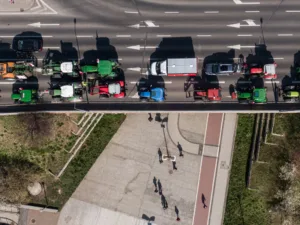
In Poland, the Green Deal is associated above all with bills. In February 2024, farmers blocked roads across the country in protest against EU Green Deal measures and Ukrainian grain imports. In December 2025, the European Parliament and the Council of the European Union provisionally agreed to postpone ETS2, the carbon market covering buildings and road transport, from 2027 to 2028, as part of a wider deal setting a 2040 target of cutting emissions by 90 per cent against 1990 levels.
The Church holds an asset in this argument that no EU awareness campaign can match: a nationwide network of more than 10,000 parishes. Lityński wants care for the environment to take root “in our diocesan and parish communities”.
One of the intellectual fathers of Polish conservation was also a National Democrat. Jan Gwalbert Pawlikowski, who from 1907 presided over the party in Austrian Galicia, published the classic essay “Culture and Nature” in 1913. A century later, Roger Scruton argued in his 2012 book Green Philosophy that environmentalism is a naturally conservative cause, rooted in oikophilia, the love of home.
An EU regulation is not a sacrament. Nor is a forest any less needed because someone has turned it into a protest banner. The American scholar Bron Taylor has described some nature-centred worldviews as “dark green religion”, the title of his 2010 book. There is no need to suspect everyone who sorts their recycling of neo-paganism.
Isaiah placed the beating of swords into ploughshares at the end of days. This year, Poland is spending about 200 billion złoty (about €47 billion), or 4.8 per cent of GDP, on defence, the highest share in NATO. Further up the Bug from Brok, for some 228 kilometres, the river forms the border with Ukraine, which the United Nations Development Programme counts among the most mine-contaminated countries in the world, with some 133,000 square kilometres — about a fifth of its territory — in need of survey and possible clearance.
Along its borders with Russia and Belarus, Poland is building the East Shield. The military invited Michał Żmihorski, director of the Polish Academy of Sciences’ Mammal Research Institute, to present a plan for using the natural environment to secure the border. He told Yale Environment 360 that “wetlands and wet forests are the best barriers against invading troops”. A defence ministry spokesperson called the natural environment in the border areas “an obvious ally” of the East Shield. Finland is weighing a similar idea. The scientists behind the proposal have called for an EU fund of €250 million to €500 million to restore an initial 100,000 hectares along the eastern flank.
The EU’s Nature Restoration Law also requires member states to restore part of their drained agricultural peatlands: at least 30 per cent by 2030 and 50 per cent by 2050. In Brussels, peatland restoration is a climate and biodiversity target. Draft national restoration plans were due with the European Commission by September 1 this year. On Poland’s eastern frontier, wetlands can also serve as an anti-tank obstacle. Yet it was only on June 17, 2025, more than three years after Russia’s full-scale invasion of Ukraine, that the European Commission’s Defence Readiness Omnibus package included guidance allowing defence activities, on a case-by-case basis, to count as contributing to social objectives under EU sustainable-finance rules.
On February 27, 2024, the European Parliament approved its first-reading position on the Nature Restoration Law by 329 votes to 275, with 24 abstentions. Six weeks later, on April 11, it called for abortion to be written into the EU Charter of Fundamental Rights by 336 votes to 163, with 39 abstentions. In Poland, the nests of the white-tailed eagle, a bird often associated with the country’s heraldic White Eagle, are protected by a buffer zone of up to 200 metres all year round and up to 500 metres in the breeding season. Can one protect an eagle’s nest and deny protection to a human being before birth?
Even Pope Francis, whose environmental encyclical greens are fond of quoting, wrote in Laudato si’ that “concern for the protection of nature is also incompatible with the justification of abortion”, and faulted some ecological movements for failing to apply the same principles to human life. On September 22, 2011, Benedict XVI told the Bundestag that the rise of the ecological movement in German politics since the 1970s “was and continues to be a cry for fresh air”. Then he added: “There is also an ecology of man. Man too has a nature that he must respect and that he cannot manipulate at will.”
The Canticle of the Sun is more than seven centuries older than the Treaties of Rome. The Church in Poland has no need to import its ecology from Brussels.
In Assisi, a single verse reconciled a bishop and a magistrate. One song will not settle Poland’s quarrel over ecology. But in Brok a priest asked for creation to be discussed without party politics, and nearer the border defence planners are looking for an ally in the wetlands. Scruton would have called it oikophilia.