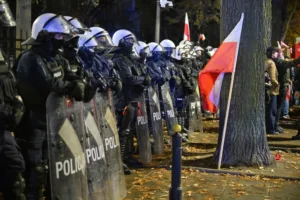





The Polish authorities have launched a special security operation deploying anti-terror police near the border with Russia’s Kaliningrad exclave, claiming that they were countering potential acts of sabotage expected between November 2 and 8.
Polish police commander-in-chief Marek Boroń briefed reporters on November 2 that the police were working with the army, border guards and intelligence on a mission led by the police that aimed at boosting security in the northeast of the country.
A special operations headquarters has been set up at National Police Headquarters in Warsaw, with the police commands in Olsztyn and Białystok, capitals of the two provinces bordering Kaliningrad, taking part.
He said that “a large group of police officers” were operational in the region, with some having been transferred from other provinces, along with counter-terror police, concentrating on securing the border area “in the light of possible events that could lead to acts of sabotage”.
Boroń further claimed that the intelligence that had triggered the operation had also come from abroad.
“It is based on information that was also provided by external agencies. We have to ensure the safety of citizens who live there but also of facilities and infrastructure,” said the police chief.
That was a reference to the activities of Russia and its ally Belarus, which have in recent years carried out a series of acts of sabotage and other so-called “hybrid actions” against Poland and other countries in the region.
The Polish government has regularly warned in recent months that Moscow is planning further provocations against eastern NATO member states, including potential border violations.
According to security sources cited by Polish radio station RMF FM, the Polish government received warnings in late October from the Military Intelligence Service (SWW) and allied intelligence agencies that indicated armed groups could attempt to breach the border from the Russian side within the coming days.
Russia’s Kaliningrad exclave, home to the headquarters of Russia’s Baltic Fleet, is strategically located on the Baltic Sea and shares borders with both Poland and Lithuania, two NATO members that are strong backers of Ukraine in the ongoing war with Russia.
During Soviet times the border between Kaliningrad and Poland was closed and Kaliningrad was called Russia’s “aircraft carrier on land”.
Since the collapse of communism and the USSR, the exclave opened up to trade and movement of people and in the 1990s, 2000s and 2010s there were moments when the exclave’s residents enjoyed visa-free travel to parts of Poland. A local border traffic scheme introduced in 2012 was suspended by Warsaw in July 2016.
But Kaliningrad has for years been under scrutiny as a potential military and espionage hub for Russia and since Russia launched its full-scale invasion of Ukraine in February 2022, cross-border traffic has been very low. Poland stopped issuing most visas to Russians, the EU suspended its visa facilitation agreement with Moscow and Warsaw warned its citizens of risks involving travel to any part of Russia.
The area has been highly sensitive in security terms because of the so-called Suwałki Gap, a narrow stretch of Polish territory about 65km wide that divides Kaliningrad from Russia’s ally Belaru. It has long been considered a potential weak spot for NATO in any direct conflict.
If Russia seized the Suwałki Gap, Lithuania and the rest of the Baltic states would effectively be cut off from their NATO allies in Central and Western Europe.
In March, a report by the Hague-based International Centre for Counter-Terrorism (ICCT) identified Poland as the primary focus of Russian sabotage operations in Europe, with 31 of the 151 Russia-linked cases it recorded since February 2022.
Those operations are alleged to have included an arson attack that destroyed Marywilska 44, one of Warsaw’s largest shopping centres, in May 2024 and an attempt in November 2025 to derail a train in eastern Poland on a line used to supply Ukraine.
In September 2025, around 20 Russian drones entered Polish airspace during a massive Russian attack on Ukraine, with some of them being shot down by NATO aircraft.
On July 30, a Russian Kh-101 cruise missile carrying a significant explosive payload entered Polish airspace from Ukraine before landing in a field in eastern Poland, about 50km from Lublin.
Suspicions have been raised, though, that the operation is cover for the mobilisation that took place ahead of the security services’ storming of the constitutional court on October 30-31, an operation in which hundreds of police were brought into the capital Warsaw.
The high police numbers were, according to the authorities, needed to prevent any attempts by demonstrators to take over the constitutional court building, but in effect were used to remove judges elected during the lifetime of the last conservative Law and Justice (PiS) government and to replace them with judges elected by Prime Minister Donald Tusk’s centre-left coalition, some of whom the opposition-aligned President Karol Nawrocki has refused to recognise. Nawrocki has refused to swear in five of the eight judges elected by the Sejm since March.
Faced with criticism from the police officers’ union and rumblings of discontent in police ranks of officers having been placed in an invidious position in a political struggle between government and opposition, the police issued a statement on October 31 “emphatically denying” that the order to mobilise police from across the country, contained in a letter dated October 29, had anything to do with the situation at the constitutional court and that it was in fact “related to the current threats regarding acts of sabotage and subversion”.
Events that took place on October 30-31 at the site of the constitutional court did, though, cause discomfort for the police, which at one stage were being ordered to stop the President and his bodyguards from entering the top court building.
Meanwhile the row over the government’s action of using security forces to take control of the constitutional court shows no sign of abating.
On November 2, Poland’s representative to the UN, Krzysztof Szczerski, became the third senior Polish diplomat to tender his resignation. On October 30-31, Poland’s ambassadors to China and Romania, Jakub Kumoch and Paweł Soloch, took the same action. Foreign Minister Radosław Sikorski has claimed the President personally urged them to step down.
Anna Korwin-Piotrowska, the judge who was elected by the Sejm with the votes of the Tusk majority and who has proclaimed herself to be the interim chief justice, though there is no legal basis for any such post as “interim chief justice”, announced on October 31 that she was convening the court’s assembly on November 3. Its stated purpose was to adopt the court’s 2027 budget, though it would also be proposed to ratify the suspension of the present chief justice Bogdan Święczkowski and his deputy Bartłomiej Sochański, whom she had suspended for one month.
She also accused the President of illegally trying to enter the court’s building in an attempt to influence judges, claiming he had struck her “with his whole body”.
When asked on November 2 by government-controlled broadcaster Radio Trójka whether the constitutional court had the right to suspend the President, she did not rule it out, saying this was one of the reasons why the court must be independent so that any such motion can be considered rather than dismissed out of hand.
In fact, the Polish constitution only allows the constitutional court, at the request of the Speaker of the Sejm, to declare the President temporarily unable to carry out his duties when he cannot notify the Speaker himself. In that case the Speaker, currently Włodzimierz Czarzasty, temporarily takes over the presidency.
The seven justices elected during the lifetime of the PiS government have said that they will refuse to attend the meeting as they claim Korwin-Piotrowska did not have the authority to convene it. Without them the assembly should not have a quorum, but allies of the pro-Tusk judges claim that since two judges are to be suspended the quorum will be only eight out of the 15 members of the court.
The European Commission has thus far backed the Tusk government over events in the top court. A spokesperson said on October 31 that the appointment of the new judges lay within the constitutional powers of the Sejm, while the government has said it is restoring the rule of law.
Most constitutional court lawyers, though, even those who have been critical of the last PiS administration, have called the government’s action illegal and one which is destructive with regard to attempts to re-establish stability in the constitutional court.