

The operation had been carefully planned. It was a Friday, the President was in the air on his way to Dakar, Senegal, and Poland was setting off for the All Saints’ weekend, when millions of families drive across the country to visit their relatives’ graves. At around 6pm, the tribunal’s president, Bogdan Święczkowski, and its vice-president, Bartłomiej Sochański, were told they had been suspended for a month.
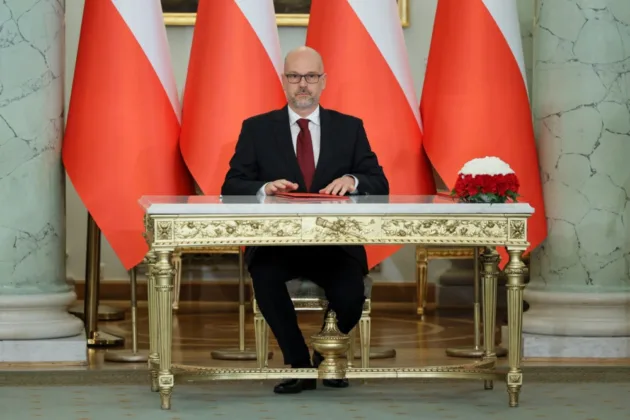
The order came from Anna Korwin-Piotrowska, elected to the tribunal this year by the governing majority. It cited Article 130 of the law on common courts, which allows a judge to be suspended for up to 30 days. Polish law requires constitutional judges to take their oath before the president of the republic. She took one in the Sejm, the lower house of parliament, instead. Under Polish law that does not make her a judge, and even if she were one, she could not simply assume control of the court. According to the tribunal’s spokeswoman, Weronika Ścibor, the new members were escorted into the building by the State Protection Service (SOP), which answers to the interior minister.
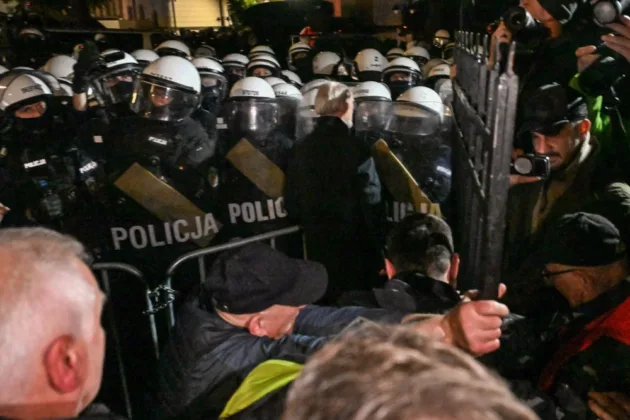
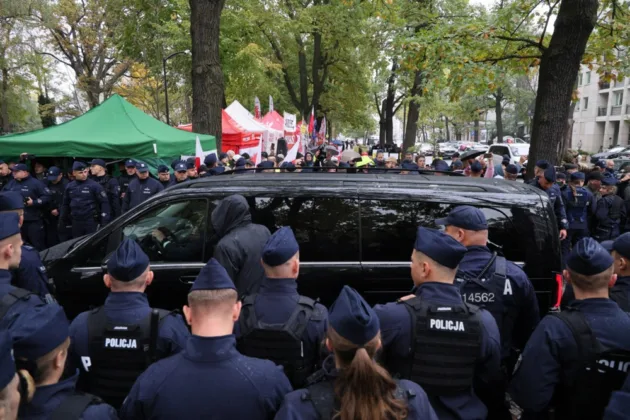
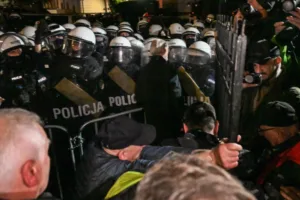
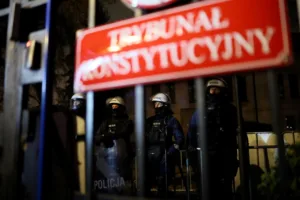
That same evening, justice minister Waldemar Żurek, who is also prosecutor general, asked the tribunal to waive the immunity of both suspended judges, filing four requests concerning Święczkowski and one concerning Sochański. He wants to prosecute them for preventing the new members elected by the governing majority, who never took their oath before the president, from taking up their duties. The president of the tribunal and his deputy now face a real risk of arrest for holding to the letter of the law, though it is their job to interpret it. A Supreme Court judge expects prosecutors to seek Święczkowski’s detention within days. Święczkowski, who has said on Telewizja Republika that he fears only God, came to the tribunal that evening and had the chain on the gate cut. Hundreds of police officers in front of the building would not let him inside. He appealed to the protesters through a megaphone: “We will not fight the police here.”
Earlier that evening, somewhere over Málaga, the presidential plane had turned round. Karol Nawrocki had been flying to Dakar; he went back to Warsaw instead. More than a million people, 1,135,473 according to the Polish press, followed the aircraft on Flightradar24 as it made its way home. During the night, as hundreds of masked, helmeted police carrying shields stood outside, thousands of people came to the tribunal, many of them answering a call from Telewizja Republika. All the opposition party leaders came too, united at last in their priorities: saving the tribunal and democracy in Poland.
Nawrocki landed shortly before 10pm. Even that was not straightforward. The conservative broadcaster wPolsce24, citing military sources, reported that the government had considered diverting his plane to an airport some 300 kilometres from Warsaw, and that the military refused. Neither the defence ministry nor the military command has commented. Shortly before 1am, the President walked through the police cordon outside the tribunal. At the door, those now claiming to be the tribunal stood in his way, among them Maciej Berek, until recently a minister and Tusk’s right-hand man. The head of state, whose inviolability is protected by the criminal code, had to push his way across the threshold. “You are not judges,” he told them. He took in with him the tribunal’s vice-president, whom the police had kept outside, and left at about 5am, calling it a “forcible takeover of a constitutional organ of the state”.
Footage of the president walking through a line of helmeted police went viral, and not only in Poland. The images instantly gave Nawrocki a different political profile: no longer just Poland’s new president, but the one who had turned his plane round to face the crisis in person. The government accuses Nawrocki of brutality. The footage does not show the president, an amateur boxer, striking anyone.
Brussels answered the following evening. A Commission spokeswoman told the Polish Press Agency (PAP) that the election of the tribunal’s eight new members “falls within the constitutional competences of the Sejm”, and recalled an interim measure issued by the European Court of Human Rights in May. On the suspension of the court’s president, the police cordon and the head of state forcing his way in, she said nothing.
This is the Commission that in January 2016 used its Rule of Law Framework for the first time, against Poland, over this very tribunal. The quarrel had begun a few months earlier, when the outgoing Civic Platform (PO) majority, the party Tusk founded and leads again today, elected five judges, two of them to seats that would only fall vacant after the next parliament met. In December 2015 the tribunal itself ruled that those two elections were unconstitutional. Brussels took an interest only after the new Law and Justice (PiS) majority and the president answered with judges of their own. In December 2017 the Commission triggered Article 7 of the Treaty on European Union, with the tribunal again at the centre. For eight years, judges chosen by the wrong, if democratically elected, majority were treated as a threat to the Union’s values. Apparently, new members escorted into the building by officers answerable to the interior ministry, through a gate from the Prime Minister’s office, raise no such alarm.
Poles have a word for a certain kind of ruler, and they do not like it: namiestnik. In the 19th century it was the title of the viceroy who governed Warsaw on behalf of the tsar. The first of them was a Polish general. A namiestnik did not have to be a foreigner. He only had to know whose favour kept him in office.
Donald Tusk chaired the European Council from 2014 to 2019 and then led the European People’s Party (EPP). He returned as prime minister in December 2023. On December 20, the management of public television, public radio and the national news agency was replaced in a single day, and the TVP Info news channel went off air. On January 9, 2024, police arrested two former opposition ministers, Mariusz Kamiński and Maciej Wąsik, inside the presidential palace, although then head of state Andrzej Duda had pardoned them. Both now sit in the European Parliament. Three days later, the national prosecutor was replaced without the president’s consent.
Brussels did not ask about any of it. On February 23, 2024, Commission President Ursula von der Leyen came to Warsaw to announce that Poland could draw on up to €137 billion in EU funds frozen in the “rule of law” dispute. Three months later, on May 29, the Commission closed the Article 7 procedure. The money came after the takeovers, not before them. Warsaw drew the obvious conclusion: nothing it did to the country’s institutions would cost it a cent.
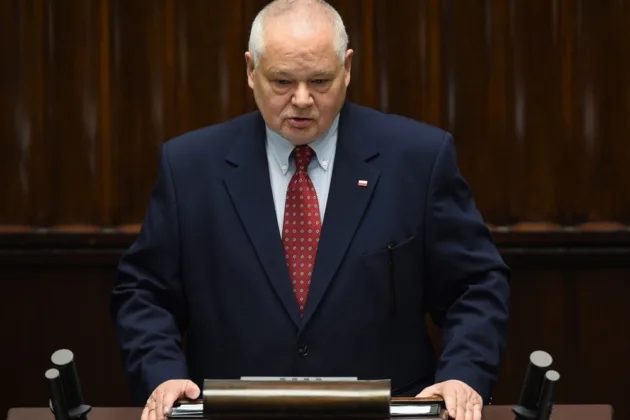
Since March 2024, the government has refused to publish the tribunal’s rulings in the official journal. An opposition MP was remanded in custody; two more now live in exile. On October 9, a Sejm committee recommended putting the governor of the central bank, Adam Glapiński, before the State Tribunal, and a vote has been announced for the second half of November. Under Polish law, the vote alone would suspend him. In January 2024 the Constitutional Tribunal ruled that such a vote needs a three-fifths majority, which the coalition does not have; the coalition says the ruling does not bind it. More than a job is at stake: the National Bank of Poland holds 673 tonnes of gold, according to its end-of-September figures, one of the ten largest official reserves in the world, most of it bought under Glapiński.
The legal cover came from Europe. In October 2021, at the request of the then prime minister, Mateusz Morawiecki, the tribunal ruled that the Polish constitution takes precedence over certain treaty provisions. In response, the Commission took Poland to the Court of Justice of the European Union (CJEU), and on December 18, 2025 Luxembourg ruled that the Polish Constitutional Tribunal does not meet the requirements of an independent court. Żurek welcomed the judgment: “This judgement obliges the state to take action.” On May 6, the Strasbourg court asked Poland, as an interim measure, to let four judges elected by the current majority take up their duties. Tusk replied at once that the state was “obliged to remove all obstacles preventing them from adjudicating”. On October 30, the obstacles were removed by the police.
A similar confrontation had already taken place in Germany. In May 2020, its Federal Constitutional Court in Karlsruhe ruled that a judgment from Luxembourg exceeded the EU’s powers. The Commission opened infringement proceedings in June 2021 and closed them six months later, after Berlin offered commitments. Nobody sent police to Karlsruhe.
Tusk’s version of October 30 is that “legally elected members of the Tribunal were attacked, and the police on the scene protected the Tribunal from the attackers”. Even organisations often cited against the previous government have challenged the legality of what happened. The Helsinki Foundation for Human Rights, which spent eight years criticising Law and Justice’s judicial reforms, said: “We see no clear legal basis for such a decision to be taken by the longest-serving judge”, and warned of a “dangerous precedent”. The First President of the Supreme Court said that “the police cannot be a tool for carrying out the political will of those currently in power”. The president of the Supreme Administrative Court wrote that the limits set by constitutional principles and respect for human dignity “have been crossed”.
Nobody pretends the tribunal is above politics. Conservatives want conservative judges and the left wants left-wing ones; Poland did not invent that. But never before in post-1989 Poland has a government brought people into the tribunal under the escort of its own security service and let them declare themselves the tribunal.
Ursula von der Leyen has not always sounded neutral about who governs the member states. Days before Italy’s election in September 2022, she warned that if things went “in a difficult direction” — “and I’ve spoken about Hungary and Poland” — “we have tools”. Italians elected Giorgia Meloni anyway. When Hungarians voted Viktor Orbán out in April 2026, she declared that “Hungary has chosen Europe”. Within weeks she was discussing the release of frozen funds with the winner, Péter Magyar.
The rule of law, in this reading, works like a loyalty clause. A government from the EPP family, fluent in the language of Brussels, can tolerate the suspension of its constitutional court’s president by someone who never took the prescribed oath, ring the building with riot police and threaten the judges with prosecution. The Commission, for its part, confines itself to noting that parliament has the power to make appointments.
More than a million people watched the president’s plane turn round over Málaga. Nobody in the Berlaymont seems to have been among them.