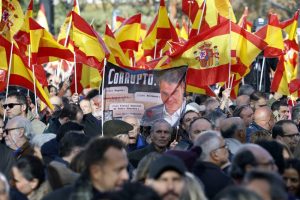








Despite a growing mountain of corruption cases and even convictions throughout the ranks of his Socialist Party, Spanish Prime Minister Pedro Sánchez has dismissed worries about corruption surrounding him as an exaggerated and politically-motivated campaign by the media.
Sánchez claimed the allegations create a “false image” of widespread graft that does not reflect reality. He spoke of “hoaxes, leaks and false information”.
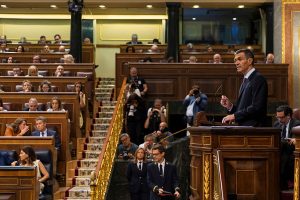
Speaking in Parliament on Wednesday during a special session called to address the string of scandals, Sánchez insisted that the cases were limited and isolated, mainly involving individuals who had already been expelled from the party.
He rejected accusations of systemic problems within his government and accused the opposition and parts of the media of orchestrating a smear operation to destabilise his administration and its political project.
“It is clear that no democracy is forever inoculated against corruption and exists where there is power, money to abuse both.”
“The difference is between those who fight it and those who protect it. Between those who raise controls or smokescreens and those who act against when illicit behaviours appear,” Sánchez said, pointing to anti-corruption measures of his own government.
Critics note these anti-corruption measures have not yet been implemented.
He said that “Spain is experiencing the best moment in the last 45 years.”
The Prime Minister’s remarks come amid mounting pressure on his minority government.
Recent weeks have seen high-profile convictions and investigations touching former senior PSOE figures, including his right-hand man and ex-Transport Minister José Luis Ábalos, who was sentenced to 24 years in jail by the Supreme Court.
Other cases involve influence peddling, bribery, and alleged networks linked to party officials close to Sánchez.
Several probes also touch individuals in his personal circle, including his wife and brother, though Sánchez himself has not been formally implicated.
Sánchez spoke about “without any doubt that the accusations respond to a pattern of dissemination of false information by media financed by the PP, press clippings and the opening of judicial proceedings that last for years.”
He accused these media, without naming them, of “lack of integrity” and the opposition of “indecency”.
Spanish judge has placed the two daughters of former prime minister José Luis Rodríguez Zapatero and his personal secretary under investigation in the Plus Ultra case, widening a corruption inquiry that already lists a former head of government as a suspect.…
— Brussels Signal (@brusselssignal) June 18, 2026
Opposition leader Alberto Núñez Feijóo of the centre-right PP sharply criticised Sánchez, accusing him of being the “nexus” connecting the various scandals and demanding his resignation.
PP spokeswoman in Congres Ester Muñoz noted that the Socialists celebrated birthdays with him [Ábalos], traveled with him, took him to Ferraz, took him to their ministries”, but turned on him when he confessed his corruption.
“The moment he began to collaborate with the justice system he became a traitor,” she noted.
Santiago Abascal of Vox said that it was obvious that Sánchez never planned to answer honestly to the questions on corruption.
“I imagine that one day he will answer them in court. If he does not do so, it is because he will have managed to steal the elections and evade the action of Justice.”
Some of Sánchez’s own parliamentary allies, expressed concern over the damage to public trust.
Even coalition partners on the left have voiced unease about the perception of impunity.
Several parties are calling for new elections.
Sánchez countered by highlighting his government’s economic record and social measures, arguing that handing power to the right would be the real threat to Spanish democracy.
He contrasted his handling of the scandals — with swift expulsions from the party — with what he described as the PP’s past tolerance of corruption during its time in office.
The many corruption charges hitting Sánchez’s Socialist-led government, weaken it as it was already reliant on fragile alliances with regional and far-left parties.
In what is being described as a potentially decisive in Spain’s biggest corruption trial, businessman Víctor de Aldama delivered explosive testimony before the Supreme Court. https://t.co/NllozqaOFu
— Brussels Signal (@brusselssignal) April 30, 2026