
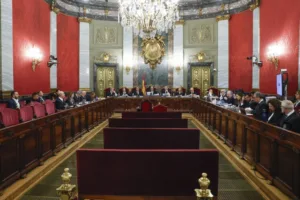




Spain’s Supreme Court has rejected a bid to stop voters using the digital version of the national identity card at the general election on November 29.
In a second ruling made public on November 24, it also turned down a complaint against cardboard boxes set up in consulates for people naturalised under the so-called grandchildren law whose vote has been suspended.
The first challenge was brought by Iustitia Europa, a small party standing for Congress and the Senate in Madrid. It had asked the court to suspend MiDNI, the National Police phone app, as a means of identification at polling stations.
On November 17 the judges asked the Interior Ministry to certify that the 61,603 QR code readers bound for polling stations had passed the required security checks. The court said the documents supplied showed they had.
It found no serious or well-founded risk that the devices could be affected by anything other than their normal operation. Suspending the app over the lack of a uniform protocol for handling incidents would be disproportionate, it added.
The Central Electoral Board (JEC) had suspended the app in March at the request of the People’s Party (PP), which demanded stronger verification guarantees. It lifted the suspension on November 5 after the ministry promised a reader at every polling station.
More than 1.75 million people have activated the digital ID, according to the ministry. The app is a national system, separate from the European Union’s planned digital identity wallet.
The second complaint came from the Association for the Defence of the Rule of Law and the Fight Against Corruption. It objected to the separate tables and boxes used to collect envelopes from those voters.
The court did not rule on the substance, saying the matter fell to the JEC. Spanish media reported that the consulate general in Buenos Aires had used cardboard boxes for these envelopes.
The court suspended the vote of those naturalised under the grandchildren law as a precaution in September and upheld that measure in October. The provision, part of the 2022 Democratic Memory Law, grants Spanish nationality to descendants of exiles.
Pending a ruling on the substance, the judges have ordered the JEC and the Central Electoral Census Office to ensure none of the 163,355 people concerned appears on the electoral roll, at home or abroad. The only exceptions are 901 people who have presented a consular certificate proving descent from exiles and anyone else who does so before polling day.
Opposition parties have accused the government of Prime Minister Pedro Sánchez of using the law to swell the electorate abroad. Overseas voters rose by more than 400,000 between the 2023 general election and July this year.