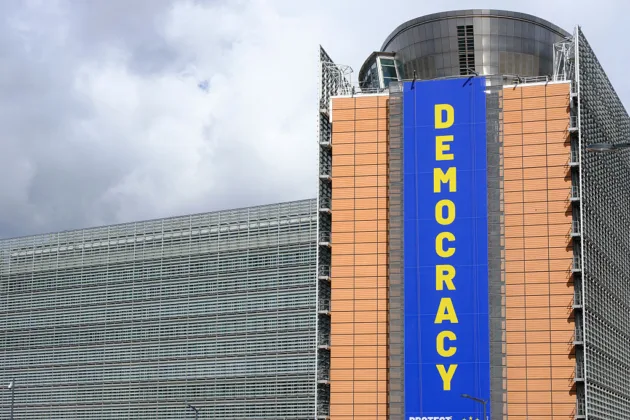






In a PR disaster, the European Commission’s headquarters in Brussels decided to shut down its air-conditioning system on the lower floors last Friday due to the ongoing heatwave, while the offices of President Ursula von der Leyen and most commissioners remained cool.
Staff at the Berlaymont building received an urgent text message at midday stating that the cooling system would be switched off “from floor 1 to 7 for the rest of the day” because of extreme weather conditions.
The 13-storey building houses around 3,000 employees on the lower and middle floors, while von der Leyen’s office is on the 13th floor and most commissioners’ offices are located on floors eight and above.
The decision triggered immediate anger among staff.
One official described the situation as “like feudalism,” while another called it a “disgrace,” according to Politico, which first reported the story.
The contrast between the working conditions of ordinary Commission employees and those of the political leadership has been widely criticised on social media and in Brussels circles as tone-deaf.
🇪🇺 Bro was asking for it … 🤣 https://t.co/Bw7K29Ac2v pic.twitter.com/sXO660DsMx
— Lord Bebo (@MyLordBebo) June 28, 2026
The incident has fed into a wider political debate across Europe about air conditioning and the European Commission was not the only institution being criticised over its cooling policies.
In France, left-leaning outlets have run pieces describing widespread air conditioning as an “environmental aberration”.
Then it came out that L’Humanité was operating in air-conditioned offices while running editorials that are broadly hostile to the technology.
On the Right, figures such as France’s Marine Le Pen have called for a major rollout of air conditioning in public buildings, schools and hospitals, arguing that it is unacceptable for people, especially the vulnerable, to suffer or die from heat.
Conservatives increasingly frame access to cooling as a basic question of public health and practical governance.
On the Left and among many environmentalists, air conditioning is often viewed with suspicion.
Critics argue that it is energy-intensive, contributes to urban heat islands by expelling hot air outside, and represents a technological fix rather than addressing the root causes of climate change through better building design, insulation and urban planning.
This divide has become particularly visible during the omega-block heatwave that pushed temperatures to record highs.
Many European hospitals and schools still lack adequate air conditioning, leading to difficult working conditions for staff and health risks for patients and children.
In several countries, schools have had to close or shorten hours, while hospitals have reported increased strain on staff and patients.
Consumer rights activists are denouncing European regulation and bureaucracy, which they say is blocking the use of air conditioning during high summer temperatures and is leading to excessive deaths.https://t.co/PJun1EDy5s
— Brussels Signal (@brusselssignal) June 23, 2026