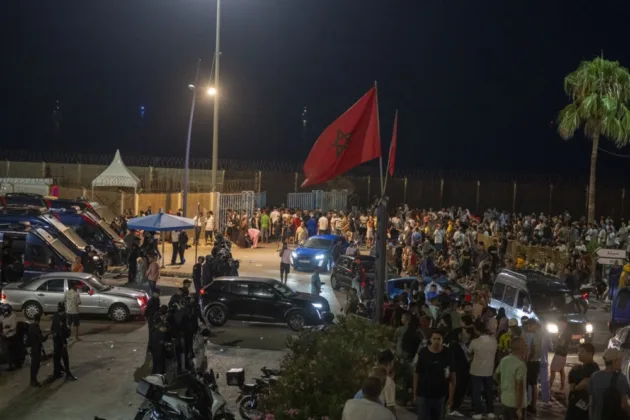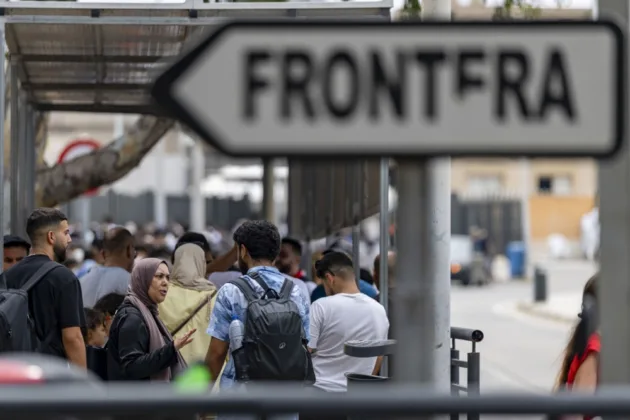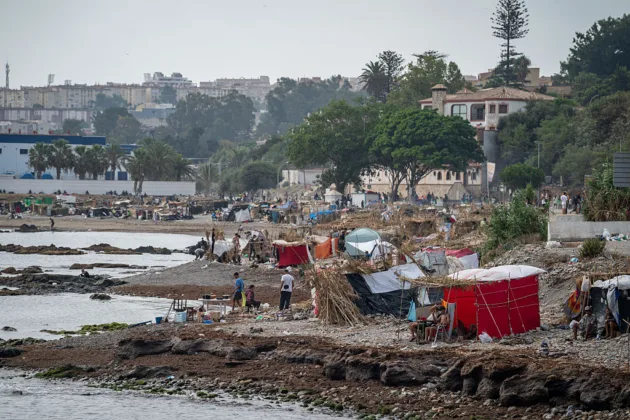






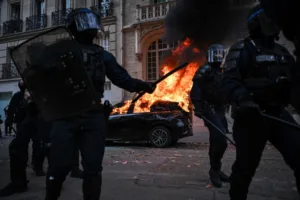




Of course it was an invasion. What happened at Ceuta on July 30 was a hybrid operation run by the Moroccan regime, and the evidence is everywhere. The pull effect of the Spanish Government’s mass regularisation and the Supreme Court ruling of July 8 were rhetorical alibis, useful for smoothing the path. They are not the substance of the matter.
The real question is what Morocco wants. Rabat has a project of national power sustained over decades. Spain has none: the only project on offer here is dissolution, internally into the morass of the autonomous communities and externally into NATO and the European Union. That is why Morocco holds the advantage.
Morocco means to become the key country of the western Atlantic, rather as Francisco Franco’s Spain was in the 1950s and 1960s: Privileged military arrangements with the United States, preferential economic treatment from Europe. It has pursued that policy for years and it is working. Within it, Morocco needs to extend its land and coastal space to gain weight, and it will do so at any price. To collect the Sahara it had to recognise Israel, and it did so to the point of making it a partner, to the delight of Washington and Tel Aviv.
The Americans have a strong interest in that association because Morocco guarantees control of a key area. First, to control what happens in Africa: Not so much to “contain jihadism”, as the propaganda has it, as to slow Chinese influence in a region full of resources. Second, because the Moroccan pivot is essential to controlling both sides of the Strait of Gibraltar. Washington will therefore never let go of Rabat.
The geopolitics of the straits matters enormously, because control of them is essential to global maritime traffic and to the world balance of power. One need only look at the havoc caused by the Hormuz crisis. The break-up of the globalist order after China’s rise has made control of the straits, and of bridge islands such as the Canaries, more necessary than ever. Spain, subordinate to NATO, has given up saying anything on the point.
Which is the other key country in the Strait of Gibraltar? Spain. Yet for years our politicians have been selling that influence to the highest bidder. The recent handover of Gibraltar, where Spain renounced any position of power, has enormously diminished our leverage. In truth only Ceuta is left, and it is natural that others should covet it.
In European policy, Morocco has for years obtained extraordinary advantages, generally with the enthusiastic support of Spain. About two-thirds of Moroccan exports now go to the EU, and its imports are overwhelmingly European too. The EU-Morocco preferential agreement makes Rabat something more than a partner of Brussels, to the great profit of European lobbies, Spanish ones included, which move their production there and collect the corresponding benefits.
Morocco has achieved all this with a policy that is aggressive and extremely versatile, and that has not shied away from espionage, extortion or any other classic instrument of irregular diplomacy. It has always been able to count on the connivance of Europe’s ruling classes, willing to look the other way. When the Qatargate scandal broke in the European Parliament and it turned out to be a Morocco-gate, the Belgian authorities decided the investigation should be conducted by the Moroccan police. Nothing has happened since.
Throughout, Spanish governments have been nothing but collaborators in Moroccan strategy, at least since the Perejil incident of July 2002, the last time Spain stood up to Morocco. Pro-Moroccan lobbies have always existed here, under Franco as well. That they should set the whole direction of foreign policy is more recent and dates from the Zapatero years. The Madrid train bombings of March 11, 2004 were decisive in that too.
There are more than a million Moroccans in Spain today, not counting illegal immigrants. Moroccans account for half the foreign recipients of the minimum living income. In Ceuta and Melilla the influx has been massive over the past 20 years. The strategy of demographic penetration has been executed with the full connivance of those in power in Spain.
Since the preferential agreement with the EU, Morocco has become Spain’s main supplier of fruit and vegetables, to the detriment of Spanish producers. The strategy of economic penetration has been executed with the full connivance of those in power in Spain.
Over the past 20 years we have favoured Morocco with substantial transfers of military material: €29.6 million in 2025, €21.08 million in 2024. The strategy of Moroccan military strengthening has been executed with the full connivance of those in power in Spain.
The Spanish Government has for the first time recognised the legitimacy of Moroccan aspirations over the former Spanish Sahara. The strategy of Moroccan territorial expansion has been executed with the full connivance of those in power in Spain.
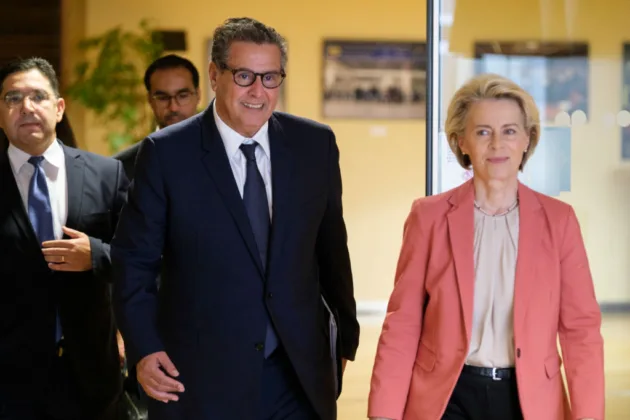
Morocco believes today, and it is hard to argue with it, that it can dispense entirely with Spanish goodwill. The best expression of that was the scene on July 30, with a large delegation of the Spanish establishment feting the Moroccan embassy at the very moment Morocco was sending its irregulars against Ceuta. It was a cruel exhibition of power.
Were there a government in Spain willing to defend the national interest, somebody would have taken note and proposed a more proactive policy, above all to hold our strategic position in military, economic and political terms against Moroccan ambitions. Instead we have smoothed the path for a rival that means to displace us. That a rival should try to beat you is normal; that you should help him, rather less so. Rabat no doubt has instruments of pressure we know nothing about.
A word on foreign policy and allies. First: An ally is not a friend. Second: Foreign policy is an extremely realistic discipline that obliges you to play with the pieces you have, and Spain’s are few. Squander them and you are lost. Put another way, were I sitting in the Pentagon I too would rather see Ceuta in the hands of a reliable ally than of one that makes eyes at China, obstructs me over the bases and never misses a chance to wave a placard at me. In foreign policy, frivolity is paid for in the end.
So what is to be done? Above all, reaffirm our military position on the Canaries-Ceuta-Melilla-Balearics axis. At the same time, use whatever instruments of pressure we have to reduce Moroccan influence in Europe and the United States. That will be impossible while we have a ruling class wholly submissive to the will of Mohammed VI, so we would have to begin there. If Ceuta falls, Melilla will fall, and after that the Canary Islands. The weaker Spain’s position, the more voracious the appetite of our rivals, whether that is Mohammed VI, Benjamin Netanyahu or anyone else.