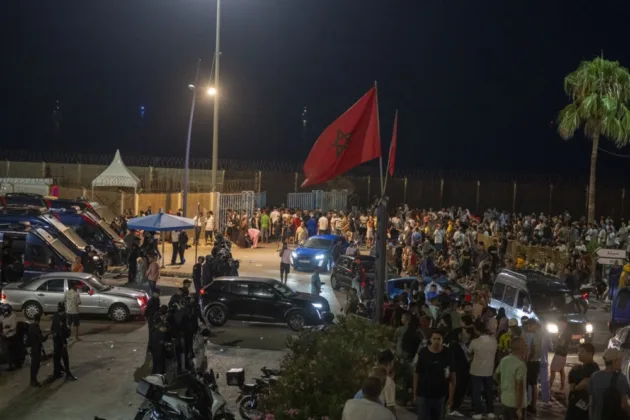









Spanish soldiers have continued to sweep the hillsides and beaches of Ceuta for migrants who crossed from Morocco on July 30, days after the Interior Ministry said the emergency had been brought under control.
Troops from the Regulares and the Spanish Legion, backed by armoured vehicles, were working alongside the National Police, the Civil Guard and the local force in a joint operation, according to the Spanish newspaper El Debate, which had a correspondent in the city.
Soldiers on central streets were directing migrants towards the frontier when they came across them, the paper reported.
Interior Minister Fernando Grande-Marlaska said on August 1 that “the situation has been almost entirely reversed”. His ministry put the number who had gone back to Morocco at 48,300 by the evening of July 31, out of about 50,000 it said had crossed since the morning of July 30.
Ceuta’s regional president Juan Jesús Vivas, of the centre-right Popular Party, put the total who entered at around 60,000, in a city of some 83,000 people. He said returns had begun satisfactorily but had to be completed, adding that “the city has still not returned to normal”, according to AP.
Estimates of how many remain diverge sharply. El Debate and the broadcaster Canal Sur reported that about 5,000 people were still scattered across the enclave, wandering or in hiding. El Español reported that sources on the ground counted several hundred, concentrated in the hills, in disused forts and in the El Príncipe district, where some have relatives.
The Centro de Estancia Temporal de Inmigrantes (temporary stay centre for immigrants), or CETI, has been overwhelmed. The facility has 512 places. Before the mass crossing it already held more than 700 residents, with hundreds more waiting outside, Europa Press reported.
Those left outside have gathered on El Trampolín beach in the El Jaral area, watched by police officers. Officers told El Debate the situation became difficult whenever food and water were handed out, because there was not enough for everyone, and that fights had broken out.
Several of those interviewed said Moroccan police had treated them roughly. One man, his arm bandaged and another wound closed with staples, told the paper: “It was the Moroccan police, they beat us and robbed us.”
Others said they had no intention of leaving. A man from Casablanca who had slept in the open for three nights told El Debate: “I don’t want to be in Morocco.”
The local outlet Ceuta Actualidad reported that migrants were being offered rooms and small premises to hide in for cash, with accounts ranging from €100 for three nights to €100 for a single night.
At least 67 people died during the crossing, Grande-Marlaska said, some by drowning and others in a crush at the breakwater. The figure rose to 72 after five more bodies were recovered along the coast. A Civil Guard association has put the toll higher.
The Justice and Home Affairs Council will hold an extraordinary videoconference on August 4, chaired by Irish justice minister Jim O’Callaghan. Ireland holds the rotating presidency of the Council of the European Union.
The meeting follows a joint letter from 22 of the bloc’s 27 heads of state and government, initiated by Italy and Denmark, calling for “coordinated action and the strengthening of external borders”. French President Emmanuel Macron, Portuguese Prime Minister Luís Montenegro and Luxembourg Prime Minister Luc Frieden did not sign.
Prime Minister Pedro Sánchez had separately written to the EU institutions requesting an urgent videoconference, while accusing some member states of acting out of prejudice and political interest. He earlier called the crossings an attack on Spanish territorial integrity.
Italy has suspended Schengen free movement with Spain for a month, introducing targeted checks on third-country nationals arriving by air and sea, after Prime Minister Giorgia Meloni threatened the measure. Finland, the Netherlands, Denmark, the Czech Republic and Sweden backed Rome. Finnish Interior Minister Mari Rantanen said Spain had “completely failed” to guard the external border, according to Efe.
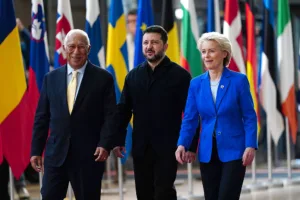
European Commission President Ursula von der Leyen called the images unacceptable and stressed that nobody had reached mainland Spain or any other part of the EU. She has asked for a lessons-learned exercise and tasked Internal Affairs and Migration Commissioner Magnus Brunner with securing further operational support, including through Frontex.
Madrid blames a Supreme Court ruling, dated June 29 and made public on July 8, which held that migrants intercepted at sea while swimming towards Ceuta and Melilla cannot be summarily handed back and must go through the ordinary return procedure. Vivas, whose request for a national emergency declaration was refused, has called for the law to be changed.
Rome has tied the surge instead to the Spanish Government’s April regularisation decree, which Madrid denies played any part. The crossings were organised for weeks in public Facebook groups.
The court had added that summary returns could apply at sea where containment elements were in place to protect the frontier line. On August 1 the Civil Guard began installing a 500-metre floating barrier at the Tarajal breakwater.