









As France suffers from the heatwave, the country’s Green Party has launched a campaign for a new form of paid leave, arguing that workers should be entitled to stay home during extreme weather events without suffering financial penalties.
The proposal, promoted by the party’s national secretary, Marine Tondelier, would create a “climate leave” of up to five paid days per year.
The measure is intended to cover periods of extreme heat, floods, wildfires, or even school closures linked to weather conditions, allowing employees to remain at home while continuing to receive their salaries.
“No one should risk their health or that of their loved ones simply to go to work,” the party states in a petition launched on June 21.
The proposal follows a model introduced in Spain in late 2024, where workers became eligible for four days of paid leave during severe weather alerts. French Greens argue that climate-related disruptions have become frequent enough to require new protections under labour law.
Right-wing critics see the initiative as another example of how climate policy is increasingly being used to justify an expansion of welfare entitlements and state intervention in everyday life.
National Rally has called for a large-scale investment programme to install air conditioning in schools, hospitals, and retirement homes. Only seven per cent of French schools have air conditioning.
Tondelier dismissed the idea that air conditioning could serve as a primary solution.
Speaking on French television, she argued that widespread installation would be financially unrealistic and ineffective without investments in building insulation.
“If you install air conditioning in homes that aren’t insulated, you won’t get very far,” she said.
The Green’s proposal has also attracted support from the hard-left party La France Insoumise (LFI).
Its national coordinator, Manuel Bompard, endorsed the idea of a specific leave entitlement during extreme weather events and argued that labour law should be adapted to the “new climatic reality”.
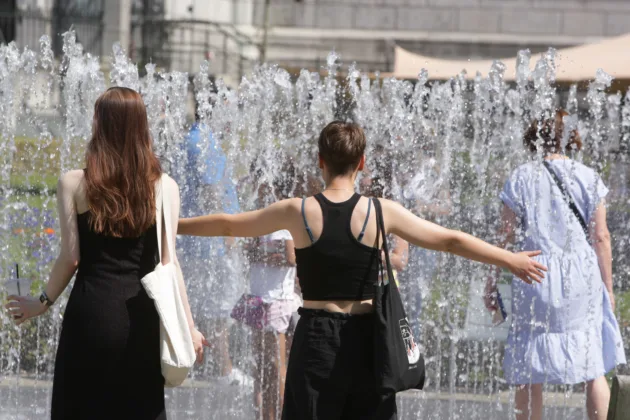
The debate comes as France fights with one of its hottest early-summer temperature in recent years.
Temperatures have climbed to 42°C in some regions. Since June 20, authorities have recorded 13 drowning deaths, many involving individuals attempting to cool off in unsupervised swimming pools, rivers, lakes, or coastal waters.