

A labour court in Rome is today hearing the case of Italian journalist Gabriele Nunziati, who is seeking reinstatement after being dismissed by news agency Nova over a question about Israel he asked during a European Commission press briefing in Brussels.
The dispute has become a high-profile press freedom case, attracting support from journalists’ associations, politicians and civil society groups in Italy and beyond.
Nunziati, a journalist in his thirties, worked as Nova’s Brussels correspondent, covering the European institutions and EU affairs. Nova is a Rome-based Italian news agency specialising in politics, foreign affairs, economics and institutional reporting, with its content widely used by Italian media outlets and public bodies.
The controversy dates back to October 13, 2025, when Nunziati attended the European Commission’s daily midday briefing. Addressing Commission chief spokesperson Paula Pinho, he referred to repeated EU statements that Russia should contribute to the reconstruction of Ukraine following its invasion.
Referring to the EU’s position that Russia should contribute to rebuilding Ukraine, he then asked: “Do you believe that Israel should pay for the reconstruction of Gaza since they have destroyed almost all its civilian infrastructure?”
Pinho described it as an “interesting question” but declined to provide a direct answer.
Two weeks later, Nova terminated its collaboration with Nunziati. The agency subsequently confirmed that the dismissal was related to the exchange in Brussels, describing the question as “technically wrong”, “erroneous” and “out of place”.
Nova argued that Russia’s invasion of Ukraine and Israel’s military campaign in Gaza were fundamentally different situations under international law, as Israel had acted in response to the October 7 attacks. The agency further said Nunziati had continued to defend the legitimacy of the question after the matter was raised internally.
The agency also stated that the video of the exchange had been widely circulated by outlets linked to Russian nationalist networks and media associated with political Islam, raising concerns about Nova’s reputation for independence and objectivity.
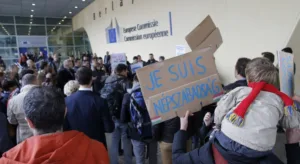
The dismissal triggered immediate backlash. Italy’s National Council of the Order of Journalists condemned the decision, arguing that no journalist should lose their job for asking a legitimate question to a public institution. Press freedom organisations and media watchdogs also voiced concern, warning that the case could create a chilling effect on reporting.
The affair reached the European Parliament, where Italian MEP Sandro Ruotolo submitted a parliamentary question to the Commission raising the same issue posed by Nunziati and publicly called for his reinstatement.
The case has also attracted international attention, with several European media outlets presenting it as a test of whether journalists can freely challenge public officials on sensitive issues related to Israel, Gaza and EU foreign policy.
Nunziati is now asking the Rome court to rule that his dismissal was unlawful and order his reinstatement. Supporters argue that the outcome could set an important precedent for press freedom, not only in Italy but also for journalists covering the European institutions in Brussels.