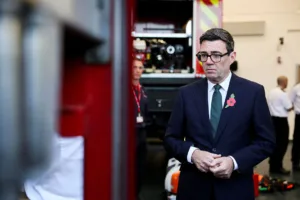
Hungary’s new Prime Minister Péter Magyar has signalled a firm confrontation with key elements of the EU’s migration policy, just weeks after taking office and securing the release of billions in frozen EU funds.
In a wide-ranging interview with the Frankfurter Allgemeine Zeitung on Wednesday, Magyar made clear that his government will not accept the relocation of illegal migrants and will continue to reject mandatory asylum procedures at the external border as foreseen by the new EU Migration and Asylum Pact (GEAS).
Such a stance was one of the main reasons that his predecessor, Viktor Orbán, was in loggerheads with the EU.
Magyar stated that Hungary will not take in any migrants without legal residence rights and will refuse to pay the associated fines.
He also criticised the so-called “firewalls” or cordons sanitaires that mainstream parties build against parties they label far right, arguing that such exclusionary tactics only strengthen those forces.
When asked whether Hungary is prepared to carry out asylum procedures at the EU’s external border as required from June 12 onward, Magyar replied: “I can only say that Hungary will not take in any illegal migrants. And we will not pay fines for it either.”
He acknowledged that Viktor Orbán had been right on migration in 2015, particularly regarding the need for strong border protection, while criticising the former prime minister for failing to build broader alliances in the EU.
“Many member states have now realised that they made wrong decisions at the time. In any case, we will protect our homeland and the borders of our homeland and the external borders of Europe”, the new Hungarian PM said.
“The migration crisis of 2015 must be a lesson for Europe. The most important task of European politicians is to protect people’s safety. I believe there are many ways to stop illegal migration and still not violate the rules of the EU. You just have to be able to negotiate.”
He said many countries are now acting like Hungary was already doing, but that the European Court of Justice did not target them with similar fines, saying that is unfair.
Magyar’s remarks mark the first clear and most open break with Brussels since his landslide victory.
While he has moved quickly to unlock frozen EU funds by promising judicial and anti-corruption reforms, he is drawing a firm red line on migration and rejecting mandatory migrant redistribution.
This stance puts the new Hungarian government on a potential collision course with the European Commission, which has been lenient toward Magyar so far in the hope of securing a more cooperative partner in Budapest.
Hungary already faces daily fines of €1 million for non-compliance with EU asylum rules, a bill that has now exceeded €700 million.
Regarding the possible win of the National Rally Party in France, he was asked about his views on cooperation with hard-right parties in Europe.
“I don’t like such pigeonholing as right-wing extremists or left-wing extremists. I don’t like ideological fights. People deserve more than politically correct speeches and the sticking of ideological labels on each other”, Magyar replied.
He said he didn’t want to interfere in the internal affairs of other member states, claiming that Orbán did, “But I have to say that I observe that some countries make mistakes in dealing with extreme parties.”
“In many countries, politicians are not honest. They don’t understand people’s fears and expectations, they don’t dare to talk openly about the problems and face them, they use a language of political correctness, and in the end they don’t understand reality itself.
“These are exactly the mistakes that are then exploited by some. It is not a solution in itself to exclude these people and these parties and lock them up behind a firewall.
“This only makes these forces stronger. In many countries, these errors have already been recognised, but not yet everywhere.”
Magyar said that “In many countries, the political, media and economic elite protect their own position and do not always respond to the real fears and problems of the people. But people don’t forget that. That’s why we need honesty, honesty and honesty again.”
He said that the European Conservatives and Reformists group (ECR) was “the natural ally of the European People’s Party”.
Regarding Russian energy, Magyar said that it was his job to ensure energy security, security of supply and the lowest possible energy prices.
“Our neighbours in the EU should understand that Hungary is a landlocked country with no access to the sea. We are still dependent on Russian oil, and we cannot change that overnight.”
He added that “when the war is over, Europe will partially revert to Russian energy sources and lift the sanctions, because what is at stake here is the competitiveness of the whole of Europe, and no one has an interest in maintaining a new economic and political Cold War in the event of future peace. To do this, of course, the war must be ended.”