

Law and Justice (PiS), the biggest of the Polish opposition parties to the centre-left government led by Prime Minister Donald Tusk, has called for Ukrainian men of conscription age who are not legally employed to be deported back to Ukraine.
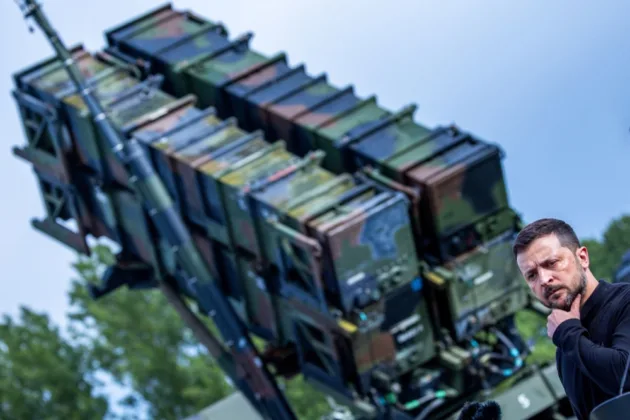
The move is yet another example of how PiS has shifted its position on Ukraine since it was in power when Ukraine suffered the full-scale invasion by Russia in 2022. At that time the PiS government led by then prime minister Mateusz Morawiecki, who left the party in July 2026, taking 40 MPs, a senator and three MEPs with him, was the most vociferous supporter of Ukrainian President Volodymyr Zelensky and Ukraine in Europe.
Between 2022 and 2023 Poland welcomed more than two million Ukrainian refugees giving them full work, welfare and health rights, became a hub for military and humanitarian aid for Ukraine and supplied hundreds of tanks and over a dozen fighter aircraft for the Ukrainian military.
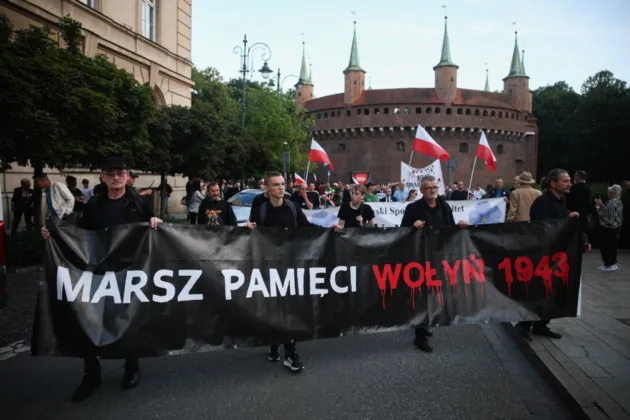
Since losing power in 2023, which was preceded by rows with Ukraine over grain imports and the lack of response by Ukraine over Polish requests for exhumation of the victims of the Volhynia massacre committed by Ukrainian nationalists during the Second World War, PiS has been moving away from unconditional support for Ukraine.
After that influx of Ukrainians in 2022 they became by far the biggest minority in Poland whose allegedly favourable treatment has recently caused irritation among Poles.
PiS’s stance is reflective of a shift in Polish society with polls showing opposition to Ukrainian membership of the EU and more negative attitudes to Ukrainians in general.
There have also been a growing number of incidents of reported hate crimes against Ukrainians, though these are always highlighted by the media, while incidents in which Ukrainians attack Poles are much less likely to be reported.
The present Tusk government, while arguing against what it sees as stigmatisation of Ukrainians, has reduced their rights to health and benefits, a move fully supported by the PiS-allied President Karol Nawrocki.
On August 6, PiS, which has seen its poll ratings slump to 16.9 per cent in an IBRiS survey for Polsat News conducted between July 29 and August 2, down 7.2 points on the previous month, held a policy convention under the banner “Towards a new government” presenting ideas it wants to put to the electorate at the parliamentary election due in autumn 2027.
“One of our government’s first, most significant decisions will be to deport men, Ukrainians of military age, who are not legally working in Poland,” announced Tobiasz Bocheński, an MEP and deputy leader of PiS. The measure would cover men aged between 25 and 60, and the party said it would build deportation centres to speed up removals.
“They will have the opportunity to fight for their homeland, so that the horrors of this war can quickly end. For Central and Eastern Europe to be secure and free, Ukraine must win.”
Bocheński denied accusations that the policy was inhumane, noting that, in 2022, when PiS was in government, “Poles, like no other nation in Europe, opened their hearts, their homes and their wallets to women, children, the elderly and disabled people fleeing Putin’s bombs”.
PiS also promised to create a new, restrictive system for foreigners, branded “Illegal Alert”, that would track each immigrant in the country by linking records held by state offices.
“Every foreigner will have their own individual account,” and if they commit any offences or fail to abide by any administrative obligations, “the information will be immediately entered into the system, and the deportation process will begin”, said Bocheński, who added that every decision on a foreigner would be conditional and reversible. In a social media post PiS declared that “the only good migration was the return of Poles from abroad”.
According to Maciej Duszczyk, deputy interior minister in the Tusk government, 95 per cent of Ukrainian men of conscription age who are present in Poland are working, a figure the ministry attributes to social insurance records. Duszczyk called the proposal unworkable and said there was in practice almost nobody left to deport.
Among the small number who are not working many, according to Duszczyk, are wounded soldiers present in Poland for treatment and rehabilitation or fathers caring for children. He also noted that the EU has already withdrawn temporary protection from Ukrainians of conscription age.
Data from Poland’s labour ministry show that around 11,100 Ukrainians were registered as unemployed at the end of June 2025, some 1.4 per cent of all registered jobseekers, and that the majority of them are women. The ministry maintains that Ukrainians are a valuable labour asset for Poland.
In the past PiS has agreed with that view with its politicians arguing that Ukrainians are culturally similar to Poles, willing to work and therefore different from potential migrants from Africa and the Middle East.
PiS’s time in power from 2015 to 2023 witnessed Poland’s largest migration wave in its history.
In every year between 2017 and 2022, Poland was the EU member state that issued the greatest number of residence permits to migrants from outside of the community.
As a result there are now over two million foreigners registered in Poland making up 5 per cent of the population. Over a million and a half of these are Ukrainians.
Interior minister Marcin Kierwiński said that when PiS was in office it had been unable to deport even those who broke the law, and was now promising indiscriminate removals.
Since taking power, the Tusk administration has increased deportations of foreigners who are in Poland illegally or broke the law while in the country. There were more than 9,000 such deportations in 2025, up from 7,200 in 2023, the last year of the PiS government.
It is the Confederation Liberty and Independence party, now polling a few points less than PiS, which has been a much more consistent critic of both Poland’s approach to Ukraine and of allowing in mass migration.
It has greeted PiS’s policy shift on the issue with scepticism. Krzysztof Bosak, deputy speaker of the Sejm and one of the leaders of Confederation, wrote on X that a foreigner residing in Poland lawfully cannot be removed, and that PiS would first have to unpick the legal framework its own government built into Polish law. He said the party had shown no sign of preparing any such legislation and that voters should judge it by its actions.
Bocheński replied that the plan was entirely possible and lawful under the regulations PiS intended to introduce alongside what he called a modern, selective immigration policy, adding that his party would carry it out with or without Confederation’s help.
Bartłomiej Pejo, a Confederation MP, was more scathing, describing the announcement as PiS lifting his party’s ideas and arguing that voters offered the original would not pick the copy.
While PiS seems to have aligned itself to Confederation’s approach on Ukraine both it and Confederation now have a rival on the right for the mantle of being the party most hostile to Ukraine and the Ukrainians.
Grzegorz Braun MEP and his Confederation of the Polish Crown, which went its own way after he was expelled from Confederation in January 2025, are in favour of a larger scale programme of deportations, oppose any more military or humanitarian aid for Ukraine and have called for “stopping the Ukrainisation of Poland” with Braun on several occasions being involved in publicly removing Ukrainian flags from public buildings. His party stood at 9.4 per cent in the IBRiS survey.
Meanwhile Morawiecki’s breakaway Development Plus grouping, credited with 7.8 per cent in the same poll, has argued for maintaining Poland’s support for Ukraine because it wants to defend the record of the last Morawiecki government and believes that regardless of present disputes over history between Poland and Ukraine, it is in Polish interests to see Ukraine survive as an independent entity.
President Nawrocki’s stance is somewhere in between these points of view with the head of state being very firm with regard to the issue of Volhynia but equally determined to oppose Russia and support Ukraine’s war effort.
On June 19, 2026, Nawrocki stripped the Ukrainian head of state of Poland’s highest honour, the Order of the White Eagle, after Zelensky approved the naming of a Ukrainian army unit after the “Heroes of the UPA”, the Ukrainian nationalist insurgent army. Zelensky, who had received the decoration from Andrzej Duda in 2023, returned it by courier.
This in turn caused a major diplomatic row which has increased tensions between Ukrainians and Poles in general.
On the face of it the Ukrainian government should welcome any move that leads to more of its military age men returning home to face the call to arms. The authorities in Ukraine have been complaining about the lack of available men to fight the war against Russia.
Though in 2025 the Ukrainians allowed more of its men to leave the country than in previous years of this war and their government has been protesting at moves made by Poland which Ukraine sees as being discriminatory against its countrymen.
It seems certain that Ukraine will be a major issue in the coming parliamentary election with no party, apart from the two parties of the left, adopting a strongly pro-Ukrainian stance.
The parties of the right and the centre are disappointed about the way Poland has been treated by the Ukrainian authorities over Volhynia and some economic matters and will likely continue to stiffen their stance in response to public sentiment that has moved against Ukraine.
Politicians from both the right and parts of the Tusk ruling coalition have gone on the record stating that unless Ukraine stops glorifying nationalists from its past it will not be able to join the EU.
The feeling among Poland’s decision-makers and analysts, especially those which are right leaning, is that Zelensky has consciously abandoned an alliance with Poland in favour of one with the west European powers such as Germany, France and the UK because he thinks that Poland is too close to the US and unable to do much to help Ukraine enter the EU.
Moreover, some believe that Ukraine wants to replace Poland as the leader of the region of countries of Central and Eastern Europe in the EU and as the most important country for the US in this part of the world. It is an ambition that has been emboldened by the success of holding off the Russian invasion and striking Russia with long-range missiles.
Those who think in that way believe that Poland may be weakening its position on the global stage as a result of its recent spats with Ukraine. Others believe that Poland still holds strong cards as the military and humanitarian hub for helping Ukraine remains on Polish soil and Ukrainian membership of the EU is not achievable without Polish consent.