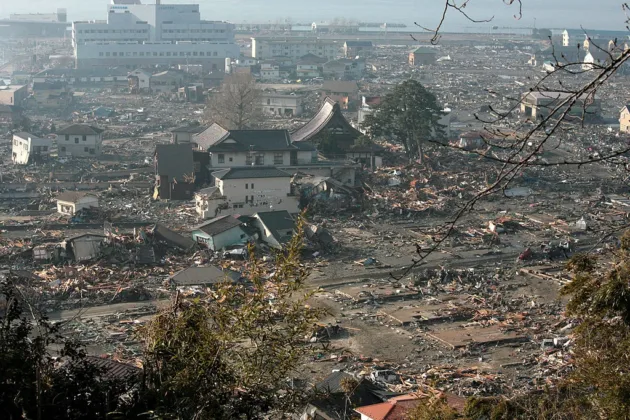





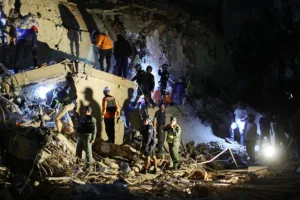

At least 188 people have died and more than 1,500 have been injured after two powerful earthquakes struck northern Venezuela, according to the country’s authorities.
The figures, given on June 25 by national assembly president Jorge Rodríguez, were revised upwards repeatedly through the day and were expected to rise further. He said 157 people remained missing.
Acting President Delcy Rodríguez, who had earlier reported 164 deaths, said at least 30 aftershocks had followed the two quakes.
The United States Geological Survey (USGS) put the first tremor at magnitude 7.2, followed about 40 seconds later by a stronger 7.5 quake. It was the most powerful earthquake to hit Venezuela in more than a century.
The coastal state of La Guaira, north of Caracas, was worst hit and declared a disaster zone, with some 200 buildings left structurally unsafe. At least 25 people died in the capital, Caracas, its mayor said.
The quakes struck during a public holiday, when many people were at home. Survivors slept in streets and squares overnight, fearing further aftershocks.
Delcy Rodríguez declared a state of emergency, closing the main airport serving Caracas, which was damaged, and suspending rail services and schools.
She announced an initial $200 million (€176 million) reconstruction fund, drawing on resources coordinated with the International Monetary Fund (IMF).
Delcy Rodríguez has governed as acting President since the capture of former President Nicolás Maduro by United States forces in January, according to international reports.
European governments moved quickly after Caracas formally requested help. Spain said it would send 54 rescuers from its Military Emergencies Unit, while the Netherlands prepared a 60-strong urban search team.
Germany offered six military aircraft and Switzerland said it would dispatch 80 rescuers and 18 tonnes of equipment. The Vatican sent €100,000 in initial aid.
Portugal confirmed that one of its nationals had been killed.
United States Secretary of State Marco Rubio said Washington was deploying rescue teams at President Donald Trump’s direction, with further offers from Brazil, Mexico and Colombia.
Opposition figures Edmundo González and María Corina Machado urged that emergency aid reach victims without conditions or intermediaries.
The European Union, the largest humanitarian donor to Venezuela, has given more than €572 million to the crisis since 2016, according to the European Commission.
The Commission has said 7.9 million people needed aid before the disaster, with Venezuelans the second-largest group of asylum seekers in the EU after Afghans.
Nearly eight million Venezuelans have left the country over the past decade, the largest displacement in Latin America’s recent history.