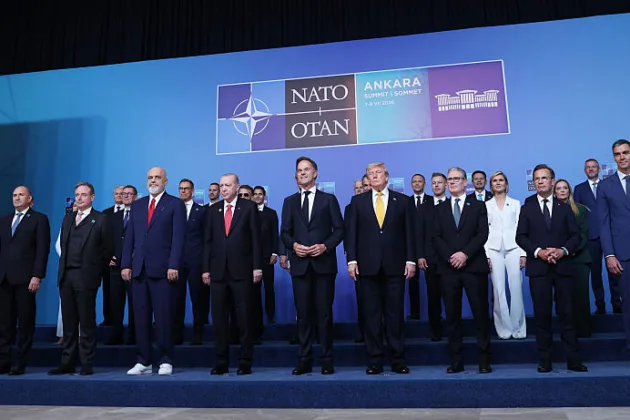


The NATO summit in Ankara produced exactly the headlines European leaders wanted: More defence spending, stronger commitments and renewed unity. Yet beneath the declarations lies a more uncomfortable reality. Europe is spending more on security while gaining little control over the strategic decisions that define it.
The pledges made in Ankara are significant. Allies committed to sustaining military assistance to Ukraine at around €70 billion annually through 2027. New defence-industrial initiatives were announced. On paper, these are signs of strength. In practice, they raise a question that European governments would prefer to avoid: Is the continent actually becoming more independent, or simply more efficient at financing a strategy it does not fully control?
Significant spending does not automatically translate into leverage. True independence requires not just financial contributions, but industrial capacity, technological control and decision-making authority. In all three areas, European governments remain dependent. Defence industries are still largely organised at the national level. Supply chains cross borders, but integration remains limited. Critical technologies still come from outside the continent. And the most important strategic decisions are still made elsewhere. European governments have confused larger defence budgets with greater strategic agency. The gap between spending and control has not narrowed. It has widened.
The United States did not create Europe’s dependency. It benefited from a dependency Europe chose not to overcome. Ankara demonstrated something European leaders have long preferred not to confront: NATO’s military effectiveness still depends heavily on American political and industrial power. Public confrontations with allies over defence spending, combined with the willingness to link security cooperation to trade and diplomatic relations, exposed a reality that decades of European security policy have obscured. The continent has not built a security system capable of operating independently. It has built a larger European contribution to an American-led system. The uncomfortable truth revealed in Ankara is that Europe is financing its own security more than ever before, but still does not define it.
The war in Ukraine has been Europe’s largest security crisis in decades. It has also exposed the continent’s structural limitations. European governments have provided significant financial and military support. They have hosted millions of refugees. They have increased defence budgets. But they have not shaped the political framework for ending the conflict. The diplomatic framework surrounding the war has largely been shaped in Washington. Major escalation decisions have continued to depend heavily on American political and military calculations. Security guarantees, when they come, will be underwritten by American power. Europe is present. It is not decisive. The paradox is stark: The closest European crisis since 1945 is being managed with the continent as a contributor, not a leader.
If Ankara produced one clear winner, it was Turkey. President Erdoğan left the summit with enhanced leverage, having secured Trump’s signal that Washington would consider restoring Turkey’s access to the F-35 programme and lifting CAATSA (Countering America’s Adversaries Through Sanctions Act) sanctions. This was not a gift. It was a result of Turkey’s long-standing strategy: Remaining useful to multiple power centres without fully aligning with any single one. Turkey controls the Black Sea straits. It maintains working relations with both Moscow and Kyiv. It has developed a domestic defence industry that gives it alternatives. Ankara’s advantage is not that it avoids dependence. It is that it has preserved multiple options. Ankara did not gain leverage through loyalty alone. It gained leverage through maintaining strategic flexibility. For Europe, this is a painful contrast. Most EU member states lack comparable room for manoeuvre. They are integrated into a transatlantic framework that offers security but limits strategic independence.
For countries on NATO’s eastern flank, proximity to the conflict has translated into greater responsibility, but not proportionally greater influence. Poland has been one of Europe’s most committed supporters of Ukraine. It has spent heavily on defence, hosted millions of refugees and positioned itself as a frontline state. Yet Warsaw has been central to the practical management of the conflict, while its influence over the broader political settlement remains limited. This is not a Polish problem. It is a European problem. The countries most directly affected by the war still have far less influence over its political direction than their geographic position would suggest.
The summit in Ankara may ultimately be remembered not for its decisions, but for what it exposed about Europe’s strategic condition. The continent is financing its own security more than ever before, but it still does not define it. This is not a failure of will. It is a structural limitation built into the way European security has been organised since the end of the Cold War. And as long as spending remains a substitute for autonomy, every new NATO summit will strengthen the Alliance while leaving Europe less capable of shaping its own future. Europe has spent the past four years proving that it is willing to finance its own security. The unanswered question is whether it is equally willing to reclaim the political authority that genuine security requires. Ankara did not expose a shortage of money. It exposed a shortage of strategic ownership.