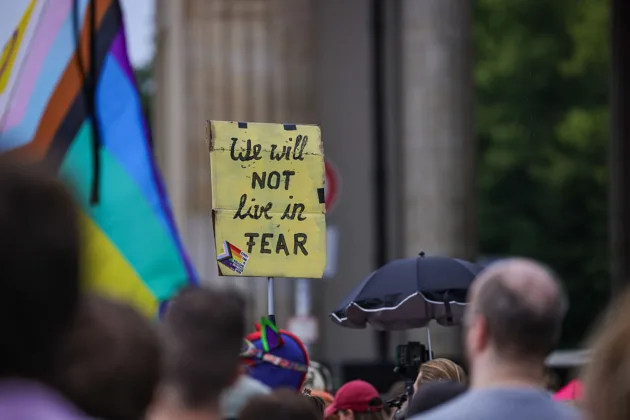




An Islamist attack on Berlin’s Christopher Street Day celebrations has drawn attention to one of the more awkward trends in European politics.
Across France, Germany and Britain, polling suggests that gay and bisexual men have been drifting towards right-wing parties, with immigration and security among the reasons cited.
A white van drove into a crowd in Berlin’s Tiergarten shortly before 10pm on July 25, killing a woman and injuring 29 people, several of them critically.
German interior minister Alexander Dobrindt told a press conference that everything pointed to an “Islamist terror attack”. Police shot dead the suspect, 21-year-old Abdul Ballout, the following evening in the Spandau district of the city.
A juvenile court had convicted Ballout in May of preparing a serious act of violence and of spreading Islamic State propaganda, handing him a suspended sentence of one year and 10 months.
THE FRENCH NUMBERS
The most detailed polling evidence of a shift comes from France.
A survey by Ifop for the magazine Têtu, published on March 11, put National Rally (RN), formerly the National Front (FN), president Jordan Bardella top among LGBT voters for the 2027 presidential election.
Bardella took 27 per cent of first-round voting intentions within that group, 10 points more than in a comparable Ifop survey in February 2022. The fieldwork was conducted online from February 1-6 among 1,137 LGBT respondents drawn from a wider sample of 10,196 French adults.
The figures cut both ways, though. RN remained proportionally less popular among LGBT voters than among the electorate as a whole, where the same survey gave the party 36 per cent.
Jean-Luc Mélenchon of La France Insoumise (LFI) recorded the sharpest increase, reaching 25 per cent, some 15 points up on 2022.
The centrist bloc of Gabriel Attal and Édouard Philippe fell to 17 per cent combined, against 22 per cent for Emmanuel Macron four years earlier. Les Républicains leader Bruno Retailleau managed 3 per cent.
Ifop also found that 56 per cent of LGBT respondents placed themselves on the Left, against 44 per cent of the wider French population.
GERMANY AND BRITAIN
German evidence is thinner and considerably less robust.
A non-representative poll run by the gay dating platform Romeo before the February 2025 federal election put Alternative for Germany (AfD) first on 27.9 per cent among 60,560 respondents.
The Greens followed on 19.9 per cent and the CDU/CSU on 17.6 per cent, with the Social Democrats on 12.5 per cent. Among 18 to 24-year-olds, AfD support reached 34.7 per cent.
Romeo conceded that manipulation could not be ruled out, since the survey link may have circulated beyond the platform. The party is led by Alice Weidel, who is in a civil partnership with a woman, though AfD opposes same-sex marriage and has campaigned against gender self-identification.
In Britain, More in Common found in polling published in March that 25 per cent of gay and bisexual men backed Reform UK, six points clear of the Greens and seven ahead of Labour.
The survey of almost 9,000 adults in England, Wales and Scotland showed the opposite pattern among gay and bisexual women, of whom 12 per cent backed Reform and 37 per cent the Greens.
Reform leader Nigel Farage told LBC that he considered it wrong for the Conservatives to have legislated for same-sex marriage without a manifesto commitment.
NOT A UNIFORM SHIFT
Spain has not followed the pattern. Research by 40dB for the LGBT federation FELGTBI+, published in April 2025, found 57.4 per cent of LGBT respondents backing progressive parties, against about 40 per cent of the general population.
The same research recorded a small rise in support for parties to the right of the Partido Popular, to just under 12 per cent. Vox leader Santiago Abascal predicted in a television interview on Cuatro in November 2025 that most Spanish gay men would eventually vote for his party, linking that to its position on immigration.
Academics have long had a term for the phenomenon. Jasbir Puar coined “homonationalism” to describe the alignment of gay rights claims with restrictive migration politics in the United States after the September 11 attacks.
Its European precursor was the Dutch politician Pim Fortuyn, who was openly homosexual and argued that Islam threatened social liberalism. He was murdered during the 2002 election campaign.
LGBT campaign groups reject the reading that the polling reveals a durable realignment. Critics point out that Reform pledged to overhaul the Equality Act, and that RN opposed the 2013 law legalising same-sex marriage in France.
Supporters of the parties concerned counter that those objections address the past rather than the present.
Where that leaves the European Right is unclear. Turnout data from More in Common suggests the shift may matter more than the raw percentages imply: 59 per cent of gay and bisexual men said they were certain to vote, against 53 per cent of heterosexual men.
For now, both readings of the data remain live. Either the numbers reflect a temporary protest vote that would unwind if the perceived threat receded, or they mark a structural change driven by migration and public order.