


Germany, once the country of efficiency and engineering wonders, has finally run out of its social and reputational capital. In what is truly beginning to look like a remarkably hot summer, the German government recommends putting wet rags and buckets of ice in front of a ventilator, but – under no circumstances – should you consider installing an AC unit. This is, by the way, the same Germany that just two years ago wanted to force every home owner to install a heat pump. You get it: Air conditioning is banned in summer, but mandated in winter.
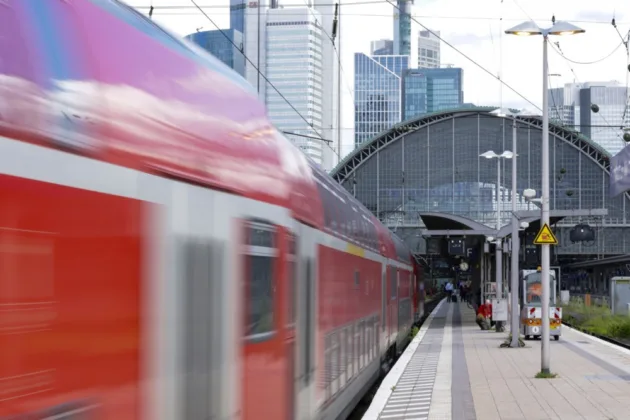
But it does not end here: Germany, which once taught the world what punctuality meant, can no longer reliably run its own railway, and we are not talking about the occasional late train. In the first half of 2025 the Deutsche Bahn lost €760 million due to only about six in ten long-distance trains arriving on time. If you want to imagine what traveling via train means in Germany today, the substacker Eugyypius paints quite the picture: “The ICE from Berlin to Hamburg is fully packed. All toilets are out of order. The bistro is closed as is one carriage due to do broken AC. People sit on the floor. The emergency exits are locked. Displays aren’t working. We’ll be stopping for a toilet break at the next station.”
If I would be Chancellor Merz, such stories would worry me more than any new poll showing the AfD surging ahead, because even the most ardent CDU supporter might lose his nerve if he can never make it to work in time due to incompetently run infrastructure.
If it should ever happen, the return of fascism will not be caused by any right-wing populist movement but by a population fed up with the feeling that nothing works anymore. A sense of chaos and disorder will almost always lead to the rise of authoritarianism, so yes, making trains run on time matter quite a bit. The growing feeling of a loss of order and reliable state institutions is driving the politics of the whole continent. The voters drifting to the AfD in Germany or the FPÖ in Austria are said to have embraced nationalism and nativism which is true, but it is happening for good reasons: What pulls them towards nationalism and tradition is not the doctrine so much as the promise of order folded inside it.
Rightly or wrongly, and perhaps as much nostalgia as fact, these things still carry the memory of a settled country that once was, or is believed to have been, a place where the streets were safe and one had the impression that the daily business of governance was in capable hands. This kind of order is the return they are reaching for: Trains being on time, schools conveying an education, streets that are getting safer and all of this held together by a sense of belonging, that this order is not the result of some spontaneous act of nature but the result of centuries of political evolution. People are voting, in the end, for the oldest political good there is, the one a state must supply before it can supply anything else, which is order. The first purpose of politics has never been utopia but order. Despite the appeals of the romantic anarchists, human beings in fact cannot abide chaos. We want rules, even if only to cheat, and no society can ever last on anarchy. Since we are not the wasp or the ant, born fitted to a hive, human order has to be built and created by us.
Let me be clear: None of this is a hunch, on the contrary. It is one of the better-evidenced findings in political psychology. Karen Stenner’s work on what she calls the authoritarian dynamic shows that the urge to demand strong authority is a latent predisposition rather than a fixed character flaw, switched on by what she terms normative threat: Rising crime, civil unrest, a loss of confidence in institutions, the sense that the shared rules no longer hold.
Add the parallel literature on compensatory control and the picture becomes even more complete. When people feel they are losing control and predictability of their surroundings, they reach for external systems that promise to supply it and reject those they hold responsible. In other words, if more and more people start to view democracy as a synonym for dysfunctionality, it is only a matter of time until they will turn against it.
History is blunt about where an unmet demand for order goes. Weimar Germany, as Tom Holland and Dominic Sandbrook put it on their podcast, The Rest is History, ran through some twenty governments in fourteen years, and “without the weakness of the Weimar Republic, there is no Third Reich.” The brownshirts recruited the lost young men of a traumatised country with exactly what the republic could not offer, “a belt, a shirt, excitement, belonging.” Then comes the part the insult-throwers forget. Once the Nazis held power and their own stormtroopers were still brawling, the disorder turned from asset to liability, and in the summer of 1934 Hitler had the SA’s leaders shot.
The German public, by and large, approved. “A lot of people,” Holland and Sandbrook note, “deeply resented the SA, the bullying, the street violence. They thought they were thugs, like jumped up football hooligans. And finally, the Führer has cracked down on them.” It was perfectly judged, they add, for the middle-class Germans who “want a quiet life. They want order.” The consent was real, and it was bought with order, not doctrine. The same holds true for Mussolini and all the other fascists (or variations thereof) that sprung up in Europe after World War One. The leadership of these movements might have been deeply ideological, but the appeal to the masses was the promise of order.
This pattern, however, is not peculiar to fascism nor has it disappeared, yet it remains easy to miss. Take, for example, Vladimir Putin who arrived as an unknown, yet quickly earned the reputation of being a “new broom” that will clean up after a decade in which ordinary Russians had watched the rouble collapse, the state carved up by oligarchs with no one, it seemed, in charge. He brought the oligarchs to heel, the richest of them despatched to a labour camp and the rest to London, and delivered, according to Holland and Sandbrook, “some degree of economic stability after the chaos of the 90s.”
The same pattern holds in El Salvador, where Nayib Bukele suspended a long list of liberties, gaoled more than ninety thousand people and cut the murder rate in what has been one of the deadliest countries on the planet to barely a hundred a year. His approval sits near 85 per cent, and this month Colombians elected a man promising to do the same. For a mother in San Salvador who can finally let her children walk to school, the trade of liberty for safety has not felt like a bad one, and I believe that what holds over there would also hold over here.
It also explains who is making the opposite case, and why the argument has split the West along a new fault line that is not so much about Left and Right as it is about who enjoys and who is deprived of order. The ideological framing of all this by the mainstream media and the ruling parties remains that the real problem is the bigotry of people who want borders and policing. Yet this framing is loudest in the places where disorder is felt the least: The university seminar, the editorial conference, the professional suburb or the gated community.
The American philosopher and economist Thomas Sowell spent a career on the observation that the people who make a society’s decisions are often the ones most insulated from their results. A credentialed class that can buy its way out of disorder, into the safe district and the private school, meets crime and rapid change as an abstraction to be theorised and a moral attitude to be displayed, not as a fact of daily live. These are, in Rob Henderson’s phrase, luxury beliefs, convictions that confer status on the people who hold them while the costs fall on the people who do not.
That is the real engine of the realignment which we are experiencing as the “rise of the populist Right”. The working class, which lives with the disorder, has moved towards whoever promises to end it, while the educated elite, which pays none of its price, has moved towards the ideology that flatters it.