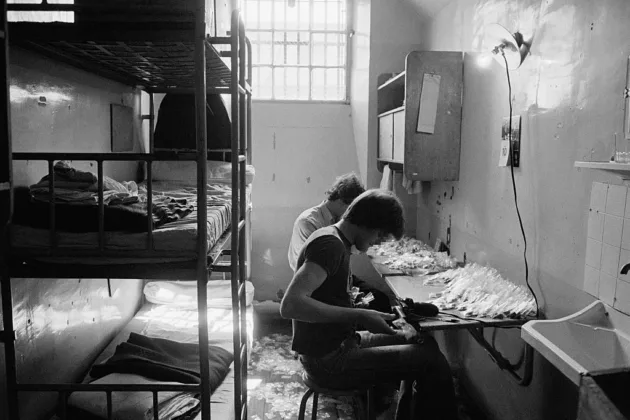






The number of inmates held in French prisons has climbed to a record 88,829, according to justice ministry figures, deepening a chronic overcrowding crisis in one of Europe’s most saturated penal systems.
The figures, dated June 1 and published on July 1, marked an increase of about 4,400 prisoners on the same point a year earlier, a rise of 5.2 per cent.
France’s prisons offered 63,237 operational places, up just 1.1 per cent over the year. The overall occupancy rate stood at 140.5 per cent.
The pressure was sharpest in remand centres, which hold people awaiting trial or serving short sentences. There the density reached 173.2 per cent.
A shortage of beds left 7,608 inmates sleeping on mattresses on the floor, a rise of 32.1 per cent on June 1, 2025.
The strain has not fallen evenly. In the Paris region the occupancy rate reached 163.7 per cent, ministry figures showed, and some individual facilities have run at more than 250 per cent.
The trend has been relentless. A Senate budget report found that, by October 2025, 72 per cent of detainees were held in facilities running above 150 per cent of capacity, with overall density having risen from 114.3 per cent at the start of 2022.
A SYSTEM AT BREAKING POINT
France’s inspector general of detention centres, Dominique Simonnot, denounced the conditions as a prison catastrophe in her annual report at the end of May. She described a crush that breeds fatigue, tension and violence and leaves guards unable to keep order.
Prison officers and governors have repeatedly warned that the system is close to collapse. The Observatoire international des prisons, a campaign group, says the inmate population has risen by more than 10,000 in two years, and argues that building extra cells has historically been matched by more prisoners rather than less crowding.
Industrial action has added to the pressure. About 22 per cent of penal facilities were hit by strikes at the end of April, according to the ministry, with staff unions warning of a system on the brink.
The United Nations Subcommittee on Prevention of Torture (SPT) cautioned in late May that the overcrowding breached detainees’ fundamental rights and could amount to inhuman or degrading treatment. Its visiting delegation described overcrowding as among the most urgent problems it had seen.
The Council of Europe, a 46-member human rights body separate from the EU, had warned in late January against a drift towards the warehousing of prisoners. France has also faced repeated censure at the European Court of Human Rights, which condemned its detention conditions as degrading in a landmark 2020 ruling.
WHO IS BEHIND BARS
Most detainees are serving short sentences or awaiting judgment, with those convicted of the gravest offences a minority. Justice ministry data show the main categories include violence, theft, drug offences, sexual assault and homicide, and roughly a quarter of inmates are held on remand.
Foreign nationals are sharply over-represented. Official figures put them at about 23 per cent of detainees in late 2025 and nearly 30 per cent of those awaiting trial, against roughly 7 per cent of France’s population — more than three times their share. The ministry no longer publishes a breakdown by nationality, and France records no data at all on the ethnicity or race of prisoners, which its republican model bars the State from collecting.
The imbalance has become a staple of right-wing arguments for tighter immigration enforcement, with a Council of Europe survey this year ranking France’s prisons the most crowded in the EU. Older figures pointed to Algeria, Morocco, Romania and Tunisia as the largest groups, though researchers caution that the data do not by themselves explain the trend.
BUILD, NOT RELEASE
The French Government has resisted calls to adopt a prison-regulation mechanism, used in countries such as Germany, that caps occupancy by releasing detainees early. Reports in the spring suggested justice minister Gérald Darmanin was weighing such a scheme, though he has since ruled it out.
Darmanin has instead pledged to build new places and to outlaw floor mattresses within 18 months of any law taking effect. He has also promised 3,000 additional places in modular prisons, which the ministry says cost about €200,000 a place, roughly half the price of a conventional cell, and can be built far more quickly.
The minister set out plans in January for a national trajectory to bring occupancy down to 150 per cent by 2030 and then 130 per cent by 2032, with the tightest limits in remand centres. The proposals form part of draft legislation still making its way through parliament.
Construction has repeatedly fallen short of promises. President Emmanuel Macron pledged to build 15,000 new cells under a plan launched in 2018, though only a fraction have so far been delivered.
Darmanin’s political room for manoeuvre looks narrow. His separate reform to speed up criminal trials was thrown out in committee at the National Assembly in June, a reminder of how contested his wider justice agenda has become.
That leaves building and tougher sentencing as the government’s main answer to the record numbers, with no provision for the early-release scheme that reformers have pressed for.