




Jens Spahn has resigned as leader of Germany’s conservative parliamentary group after fathering a child through a surrogate mother in the United States, a practice his own party has fought to keep banned at home.
The chairman of the Christian Democratic Union (CDU) and Christian Social Union (CSU) group in the Bundestag stepped down on July 18 following days of pressure from within his own ranks. He and his husband, journalist Daniel Funke, had announced on July 15 that they had become parents to a son, Georg, born to a surrogate in the United States.
Surrogacy is prohibited in Germany under a 1990 law, though it is not illegal for Germans to raise a child born through the arrangement abroad. The CDU reaffirmed its opposition to legalising the practice at a party conference in February, when Spahn’s surrogate was already pregnant.
Spahn had long resisted any loosening of the rules. As health minister in 2020 his department rejected a bid to legalise altruistic surrogacy, and in a 2015 article for the magazine GQ he wrote that he could not warm to the idea of a paid pregnancy.
Critics accused him of hypocrisy, arguing that he had used abroad an option he was unwilling to grant others at home. The party branch in Brilon, Chancellor Friedrich Merz’s home town, had publicly called for him to go, warning that his choice sent a damaging signal about the party’s credibility.
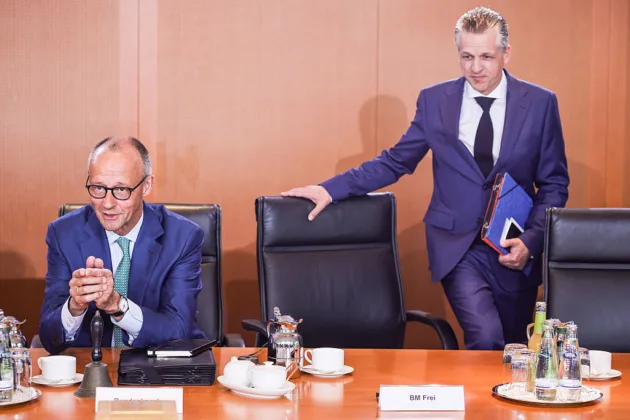
German Chancellor Friedrich Merz, who leads the CDU, welcomed the resignation as correct and unavoidable, and said credibility was the most valuable asset in politics. He had reportedly concluded that Spahn could no longer remain in post.
In his resignation letter, Spahn said that starting a family with his husband had become incompatible with his political office. He added that the strain between his private choice and the expectations of the role had grown greater than he had anticipated.
The controversy has come at a delicate moment for the ruling conservatives, who face difficult state elections in September in Saxony-Anhalt, Berlin and Mecklenburg-Western Pomerania. In Saxony-Anhalt the right-wing Alternative for Germany (AfD) is hoping to secure its first state premiership.
Spahn was not the first senior CDU figure to face scrutiny over surrogacy, with fellow MP Hendrik Streeck and his husband announcing the birth of a son the same way in April. Merz has since suggested he could reshuffle his cabinet as he moves to steady the party.