



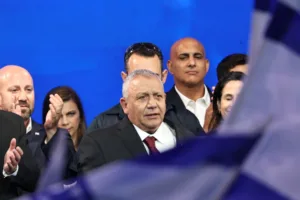

Israel’s opposition leaders have held their first joint meeting since the October 27 general election to build an alternative to Prime Minister Benjamin Netanyahu’s government and avoid a return to the polls.
The talks, staged today in Herzliya, central Israel, brought together Gadi Eisenkot of Yashar, Naftali Bennett and Yair Lapid of B’Yachad, Yair Golan of The Democrats and Avigdor Lieberman of Yisrael Beytenu.
Eisenkot, a former chief of staff of the Israeli military, leads the second-largest party in the Knesset with 21 seats. The other three parties in his bloc have now said they would recommend him to President Isaac Herzog to form the next government.
Lieberman confirmed his backing yesterday, a key move that improved Eisenkot’s chances of receiving the mandate. He also said he would support Lapid as Knesset speaker.
Before the meeting, Lieberman said another election had to be prevented and insisted a stable government could be formed quickly without Ra’am and the Joint List. The two Arab-led parties won 19 seats between them, their best result on record, leaving them holding the balance of power.
Lieberman, who served as defence and foreign minister in governments led by Netanyahu, has also ruled out a minority government relying on their outside support.
That stance clashes with Golan, who has urged the opposition to govern with Arab backing. He met Joint List leaders Yousef Jabareen and Ahmad Tibi earlier the same day, their first contact since the vote.
According to a statement from The Democrats, the three discussed coordinating their factions and using the parliamentary majority to replace Netanyahu’s government. They agreed to keep working together with the aim of forming what they called a “change government”.
Entering the Herzliya talks, Lapid urged the bloc to act quickly. “We are facing a grave and dangerous attempt to undermine the election results,” he said, according to The Times of Israel.
He was referring to Netanyahu’s allegations of voter fraud. Israel’s Central Elections Committee has rejected a Likud request to delay certification and said the vote was conducted properly.
After the meeting, Bennett pledged that his party would mobilise all its efforts to help Eisenkot form a government as soon as possible.
The final results are due to be formally presented to Herzog on November 4, after which he would begin consultations with every party that won seats.
Likud finished first with 27 seats against Yashar’s 21, after both camps claimed victory on election night. Netanyahu’s bloc holds 53 seats and Eisenkot’s 48, leaving both short of the 61 needed for a majority.
Netanyahu has since said he is open to a “broad national government” under his leadership.