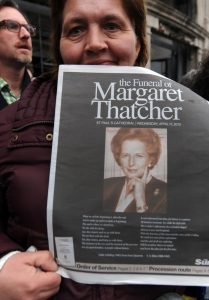







The early statements of the new British Prime Minister Andy Burnham confirmed the worst fears that the death spiral of Britain’s relevance in the world and even basic capacity of self-government is accelerating. His assertion that all of Britain’s current problems are traceable to the evils of Thatcherism is a resounding and irrefutable statement of his own monstrous inability to execute the great office into which he has just been inducted successfully. For younger readers, Margaret Thatcher was elected in 1979 at a time when in the six months preceding election day, virtually everyone in Britain except the members of Parliament and the royal family had been on strike at some point. State-owned corporations such as the airlines, railways and steel industry were all haemorrhaging losses. Strikes became so widespread that in London rubbish went uncollected for weeks on end. The top personal income tax rate was 98 per cent on investment income and 83 per cent on earned income, the country was effectively under daily audit from the International Monetary Fund, and there were tight restrictions on how much cash Britons could take with them when they left the country on holiday.
Thatcher privatised almost everything, including the airports; British Airways became generally recognised as the world’s best airline and one of its most profitable. The tyranny of union shop stewards capriciously calling out their workforces on any pretext or no pretext at all was sharply curtailed. The top personal tax rate was cut to 40 per cent, and although unemployment temporarily tripled, it then entered into a sharp dive. What amounted to an economic miracle occurred and was accompanied by a firm and consistent conduct of foreign policy that expelled the Argentinians from the Falkland Islands, which they had invaded, causing the collapse of the military dictatorship and the reintroduction of democracy in Argentina. Margaret Thatcher succeeded, as she promised, in putting “great” back into Great Britain. She and President Ronald Reagan worked closely and effectively to bring the Cold War to a satisfactory conclusion and she played a major role in mobilising international support for the expulsion of Saddam Hussein from Kuwait, counselling President George H.W. Bush: “Remember, George, this is no time to go wobbly.”
Margaret Thatcher became the first prime minister since before the First Reform Act of 1832 to win three consecutive general elections, which began to extend the election franchise to a significant number of citizens. It is indicative of her remarkable success that it took the Labour Party three full terms to undo the progress which she wrought, and which her successor John Major more or less maintained. The 13 years of Labour Party government under Tony Blair and Gordon Brown very gradually dismantled Thatcher’s achievements. The Labour Party had never before managed even two consecutive full-term victories because it generally did not take more than one term for it to squander whatever level of solidity the Conservatives had managed to build up. The previous Labour prime ministers, Ramsay MacDonald, Clement Attlee, Harold Wilson and James Callaghan could never get more than one full-term and only Attlee and Wilson managed that.
The only factor that creates the notional possibility of a member of the Labour Party being prime minister after the next British election is the extraordinary and unprecedented flame-out of the Conservatives. When they finally did wrestle power back from Labour in 2010, the steadily more horrifying succession of David Cameron, Theresa May, Boris Johnson, Liz Truss, Rishi Sunak, all thrown out by the British voters or their own parliamentary colleagues, has reduced the Mother of Parliaments to an imitation of the Knesset of Israel. The latest polls show Reform UK, whose leader Nigel Farage is temporarily out of parliament since resigning his Clacton seat on July 7, 2026 as part of a gesture to try and shake off suggestions of financial impropriety, the governing Labour Party, the Conservatives, all between 19 and 23 per cent and the completely superfluous Liberal Democrats and the even more redundant as well as militant Greens at 11 to 13 per cent, according to YouGov polling published on August 3, 2026, with splinter and separatist parties including the old IRA and the followers of Dr Paisley in Ulster, the Scottish separatists, the Welsh nationalists, holding 1 to 3 per cent each. If an election today confirmed those numbers, a three- or four-party coalition, the ultimate spavined pantomime horse, would be required to patch together a ministry.
In the mid-1990s it was thought that an “ever closer European Union” and a surging Japan were in a thundering three-way race with the United States for the economic and political leadership of the West. Japan is stagnant, losing population, with a national debt of about 230 per cent of its GDP and a currency shored up by a US Treasury intervention in late July 2026. Britain has departed the European Union but is unfulfilled and floundering, and the EU itself is an over-socialised, overregulated, stagnant mockery of the proud claims of a few decades ago that Europe was returning to a place of world leadership. It then had a GDP comparable to that of the United States; today it is about 70 per cent of it.
But most startling, worrisome, and poignant, is that the sceptred Isle of Great Britain which gave the world the English language, the common law, the parliamentary system and a globe-girdling empire, is coming perilously close to fumbling itself into irrelevance: A fall from the highest ranks of national prestige and importance as profound as that of Turkey or Spain or pre-Maoist China. The British empire was long financed by the reprehensible harvesting of opium in India and selling it in China, but it was ultimately a civilising influence and it produced the United States, Canada, Australia, Singapore, Hong Kong and other successful jurisdictions. The implications of its possible demise as a serious country are very sobering and the new prime minister offers no reason for optimism.