






Thieves have emptied most of the Treasure of Villena, one of Europe’s principal Bronze Age gold hoards, from the Museum of Villena (MUVI), a small museum in Alicante province, southeast Spain, in the early hours of August 27, 2026.
Officials said the smash-and-grab raid lasted about four minutes.
A sports-centre alarm sounded at 5.16am on the other side of town, which investigators suspect was triggered by the gang to confuse the police. The museum alarm followed at 5.20am. By 5.24am the gang had gone in two vehicles with some 9kg of gold.
Villena mayor Fulgencio Cerdán said they had taken “most of the treasure” and that the gold alone was worth about €1.7 million. The historical loss, he added, was beyond price.
The hoard was found in 1963 by the archaeologist José María Soler in a vessel buried in a dry riverbed.
It dates to about 1000 BC.
The collection held 59 objects, chiefly gold bowls, bracelets and bottles, with silver, iron and amber among them. Together the pieces weighed almost 10kg, some 9kg of it 23.5-carat gold.
According to the Museum of Villena, researchers consider it the most important set of Bronze Age gold tableware, comparable only to the treasures of the royal tombs of Mycenae in Greece.
The Guardia Civil, Spain’s gendarmerie, said several people arrived in more than one vehicle, forced a window after failing to open a reinforced rear door and knew what they wanted.
Cameras recorded hooded figures.
Three of the four historic crowns of the Virgin of the Virtues, the town’s patron, and the Child went as well. The fourth, a crown of the Child, was dropped on the way out. The theft came days before Villena’s annual Moors and Christians festival, held in the Virgin’s honour from September 4.
Left behind, the mayor said, were three silver vessels, a bracelet and part of a ceremonial staff.
Alicante Guardia Civil commander Colonel Francisco Poyato said investigators had “all the images”.
A similar smash-and-grab at the provincial museum in Albacete, about 100 kilometres away and a month earlier, also targeted gold: Four hooded raiders took more than 200 gold coins in about 90 seconds. It was the third such raid in Spain this year: On April 25 Badajoz’s provincial archaeological museum lost the 149 gold coins of the Villanueva de la Serena hoard. None of the pieces has been recovered.
Officers are treating the cases separately but have not ruled out a link.
On the afternoon of the same day, two men smashed a display case in opening hours at Vienna’s Museum of Applied Arts (MAK) and took a Van Cleef & Arpels diamond necklace from the Glanzstücke (Showpieces) exhibition.
Police said the suspects entered as ordinary visitors, broke the glass and fled. One man carried a hammer, the other a bladed weapon. No one was hurt.
The piece is described as a royal necklace of 673 diamonds, more than 200 carats, once worn by Queen Nazli of Egypt at her daughter Fawzia’s wedding to the future Shah of Iran, Mohammad Reza Pahlavi, in 1939. It sold at Sotheby’s in New York in 2015 for about $4.3 million (€3.7 million).
The museum confirmed a theft and would not discuss the inquiry. Officers released a description of two men in dark clothes. The necklace has not been recovered.
On August 24, 2026, three days before the twin raids, Europol published a report on museum crime, Changing tactics, changing targets, that described a turn towards gold, jewels and objects that can be melted or recut, and towards speed and force rather than the old specialist thief. Gold prices have risen sharply, up about 85 per cent in two years according to Reuters. Melted metal leaves little for a detective to follow.
The agency said traditional crews with a single boss and a craft had given way, in many cases, to short-term teams hired through social media.
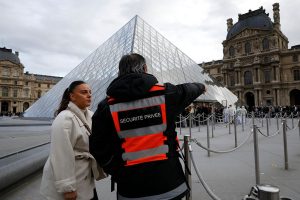
It named the Louvre raid of October 19, 2025, as the type specimen. Thieves used a furniture lift, broke a window of the Galerie d’Apollon in opening hours, smashed cases and left in minutes with jewels valued at about €88 million, among them pieces linked to Empress Eugénie. Suspects have been charged. Apart from the empress’s crown, dropped and damaged in the escape, the jewels have not come back.
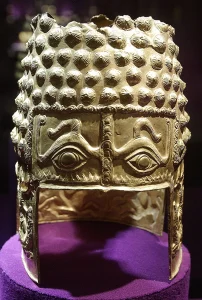
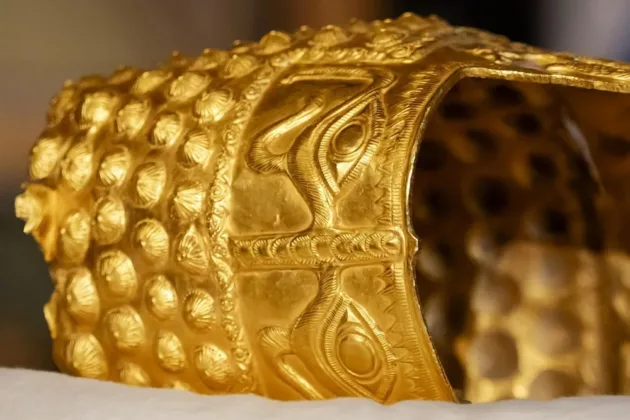
Europol also cited the January 25, 2025, blast at the Drents Museum in Assen, in the northern Netherlands, where a gang blew a door and took the 2,500-year-old Dacian Golden Helmet of Coțofenești and three royal gold bracelets on loan from Romania.
Brussels Signal reported the recovery of the helmet and two bracelets on April 2, 2026, after a 14-month Dutch-Romanian inquiry and a court agreement with three suspects. One bracelet is still missing.
A council spokesman called the job “super-fast and super-professional” and said the museum’s alarms had worked. The MUVI, opened in May 2024, had CCTV but no permanent guards. Cerdán said it had passed every required inspection.
Whether the pieces stay intact for a collector or go into a furnace is the question that now matters more than the melt value. Once gold of that date is recast, Europe loses another priceless piece of historic art.