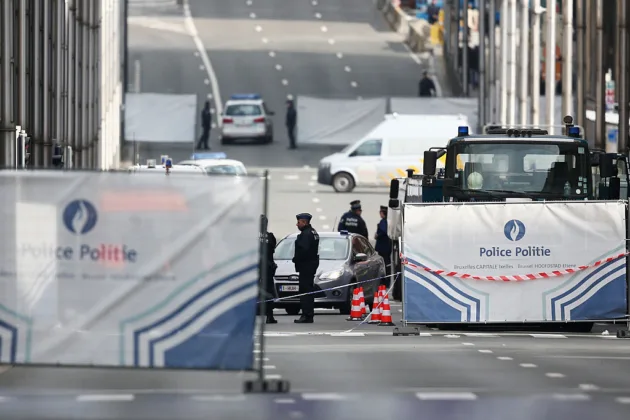







Brussels is once again grappling with a sharp escalation in gun violence, as a cluster of shootings over three consecutive days, including an attack with an automatic weapon on a police station, has left residents and officers in Brussels’ southern police zone on edge, as what local police describe as a territorial struggle between drug gangs continues to escalate.
At about 9pm on August 24, shots were fired from an automatic weapon at the junction of Rue Gustave Defnet and Rue du Monténégro in Saint-Gilles.
Customers of a nearby pizzeria fled for cover. No injuries were reported and the shooter escaped.
It was the third day running that gunfire had been heard in the municipality and the sixth shooting incident recorded in Brussels in a matter of days.
Earlier the same day, at about 2.40am, another person was injured in a shooting on Chaussée de Forest, near Jacques Franck square.
Two suspects were arrested nearby.
During the same night a man was found shot in the lower leg on Avenue Jean Dubrucq in Molenbeek-Saint-Jean. He was taken to hospital and was not in a life-threatening condition.
On the morning of August 23 at around 7am a stray bullet struck the window of a house on Rue Fontainas, again near Porte de Hal.
The occupant, who was still in bed, escaped unharmed but said she had been badly frightened. Her bedroom was later sealed for forensic examination.
The previous evening, August 22, at around 9.15pm, a man was shot in the leg at the same junction, known as Place des Deux Bancs. His injuries were not life-threatening.
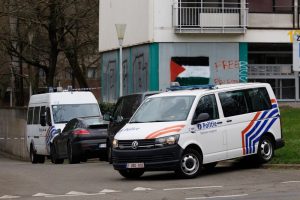
The first shooting of the series took place during the night of August 21-22, when two masked men in black opened fire on the police station on Demosthenestraat (Rue Démosthène) in Anderlecht.
One used a Kalashnikov while the other filmed. They then fled on an electric scooter.
At least 12 bullet impacts were found in a glass door.
No one was injured. The station was closed at the time and nobody was inside, the police said.
Jurgen De Landsheer, chief of the Brussels-south police force covering Anderlecht, Saint-Gilles and Forest, has described the recent violence as a territorial struggle between drug gangs.
In a 2024 interview with Bruzz, he said the Peterbos estate in Anderlecht generated between €30,000 and €80,000 a day, triggering fierce competition for those spots with violence, threats and intimidation.
“The police serve and protect the population, but have now become the target themselves,” De Landsheer said. “This is a red line that has been crossed.”
Extra security measures would be taken, but operations against the drug networks would continue.
Public prosecutor Julien Moinil has said he has yet to receive the resources he requested, and that shootings are organised from inside prison using mobile telephones that circulate freely.
Julien Moinil, Brussels’ Chief Prosecutor, was put under police protection following threats from the city’s criminal drug underworld. https://t.co/Bw177Y80AE
— Brussels Signal (@brusselssignal) July 8, 2025
Saint-Gilles mayor Jean Spinette, of the Parti Socialiste (PS), has linked the shootings and recent car fires to rival gangs trying to reclaim dealing spots as the summer holiday ends and both customers and dealers return.
He has repeatedly called for more federal resources, including additional investigators for the judicial police.
The latest cluster comes against a wider backdrop of high gun violence, with federal police figures for the first seven months of 2026 already outpacing the record year.
Brussels Minister-President Boris Dilliès, of the Mouvement Réformateur (MR), called the events “a further warning to Brussels” and insisted organised crime would not be allowed to take over the city.
Interior minister Bernard Quintin has said the violence is a targeted response by the drug underworld to police pressure, and that officers must not allow themselves to be intimidated.
He told public broadcaster VRT that he had already sent 77 extra officers to the Belgian capital and was looking to send more, though this was not easy because they required specific experience.
Investigations into all the incidents remain open.
As Brussels Signal has reported, the networks recruit minors and migrants without legal status as street dealers, lookouts and gunmen, paid small sums and easily replaced.
Control of the trade itself, particularly in neighbourhoods such as lower Saint-Gilles, is more commonly exercised by established local family networks of migrant background that manage the territories, supply lines and higher-level organisation.
The fact that low-level amateurs now use fully automatic weapons is an extra cause of concern.
Brussels is experiencing a relentless surge in severe violence, marked by a high number of shootings, prompting the public prosecutor to raise the alarm. https://t.co/mLUAhELKMm
— Brussels Signal (@brusselssignal) August 13, 2025