





Spain’s largest National Police union has said the 091 emergency line in Ceuta is taking more than 200 calls a day, around 10 times the volume recorded before tens of thousands of people crossed illegally from Morocco on July 30.
Javier Otero, spokesman for the union Jupol, told El Español that 20 to 30 calls a day was the normal level in the Spanish city on the North African coast, rising at weekends.
He dated the change to what he called the invasion of more than 80,000 people, and said the present volume had left officers overwhelmed.
Jupol national spokeswoman Laura García gave the same figure for the 091 line on August 12 and put the number of public order officers available at 60 per shift out of 180 deployed. She said the immigration unit in Ceuta had received six extra officers and the forensics unit none.
The weekend of August 22 produced a run of incidents that police unions have linked to the continuing presence of migrants in the city.
At about 9am on August 22 a 20-year-old woman walking to work between the Morro and Miramar Bajo areas was robbed at knifepoint of a bag holding money, her identity papers and her passport. She told the Ceuta newspaper El Faro that she had not left the house without fear since.
Early on August 23 three young people were approached in the El Edén district as they walked to an underground car park. One was pulled to the ground as a man tried to snatch her bag.
She told El Español that officers had declined to register a complaint because they were too stretched to take it.
At about 4.30am the same day an off-duty Guardia Civil officer was set upon by at least five men near a petrol station on the Avenida Cañonero Dato. He refused to hand over money and was punched and kicked before his attackers fled towards the port, where a patrol found them hiding on a stairway.
The Unified Police Union (SUP) said three Moroccan nationals had been arrested and that an entry on that scale without adequate control was bound to create serious security problems. It said the city could not be expected to treat robberies, brawls, sexual assaults and attacks on officers as normal.
Business owners describe the same pattern. Gema Molina, who has run the El Capote restaurant for 15 years, said evening trade had fallen further than during the pandemic.
She said customers on the terrace were approached for money and that some of those refusing became aggressive. Restaurants on the seafront were worst affected and several operators were now closing hours early.
Jupol and the civil service union CSIF said on August 20 that reinforcements sent from the mainland were sleeping seven or eight to a military module, with one fan and no air conditioning. Both described the position in the city as one of organisational and security collapse.
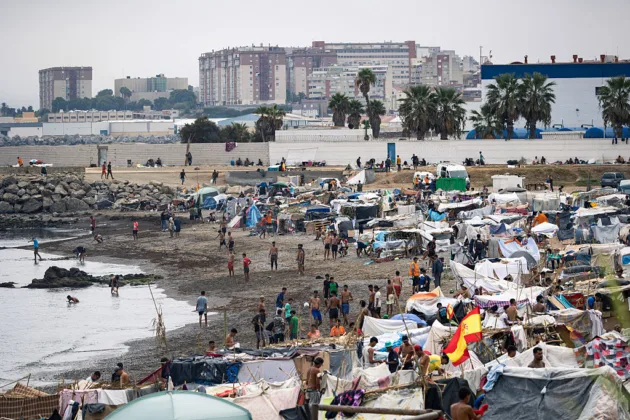
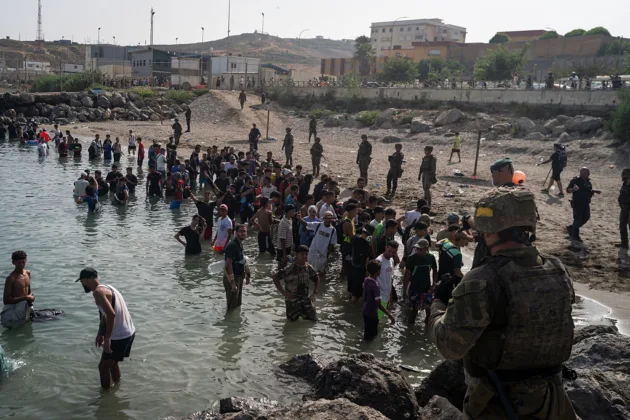
Interior Minister Fernando Grande-Marlaska put the number who entered on July 30 and 31 at about 72,000, of whom some 70,000 returned to Morocco within days. Government sources have since begun to use a figure closer to 80,000, the estimate Ceuta President Juan Jesús Vivas has given from the start.
The city’s own establishment of more than 1,000 National Police and Guardia Civil officers was overwhelmed on the day of the crossing, and Madrid sent about 350 reinforcements in the first hours.
On August 13 Grande-Marlaska announced a further 65: 45 from a prevention and reaction unit for street policing and 20 from the immigration and borders brigade to speed up returns. He put the number still in the city at around 5,000 adults, with 1,898 minors identified.
Ceuta’s government disputes that count and estimates that between 8,000 and 11,000 remain in a city of about 84,000 people.
Local officials have linked the surge to a Spanish Supreme Court ruling of July 8 barring the summary return of migrants intercepted at sea, on the grounds that open water does not amount to the physical containment a border fence provides. Police associations warned at the time that the judgment would act as a pull factor.
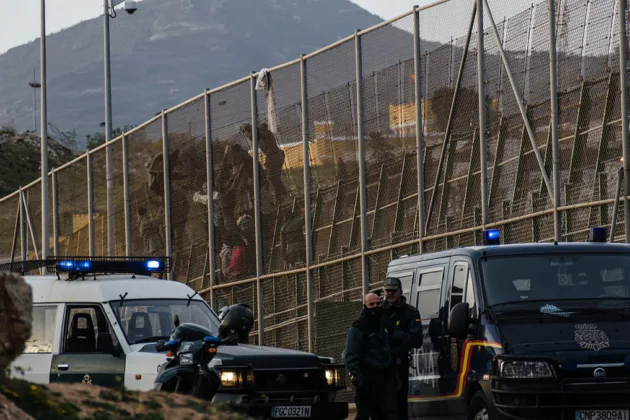
Ceuta and Melilla are the only land borders the European Union shares with Africa.
The Guardia Civil has confirmed 15 rapes in Ceuta since the crossing, a figure the Health Ministry has disputed.
The High Court of Justice of Andalusia said the city’s courts had by mid-August processed three sexual assault cases against Moroccan migrants who arrived on July 30. Two of the accused were remanded in custody and one was ordered to be expelled.
A fourth man, who entered a flat and got into the bed of a sleeping Ceuta woman, was also ordered to be expelled, on a trespass charge.
Nearly four weeks on, the unions say the city is policed by officers who cannot answer every call.