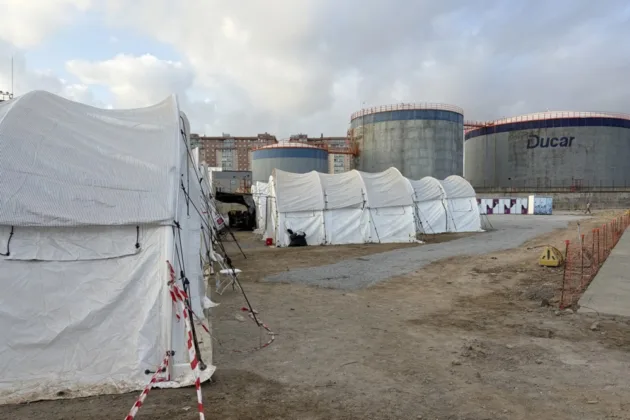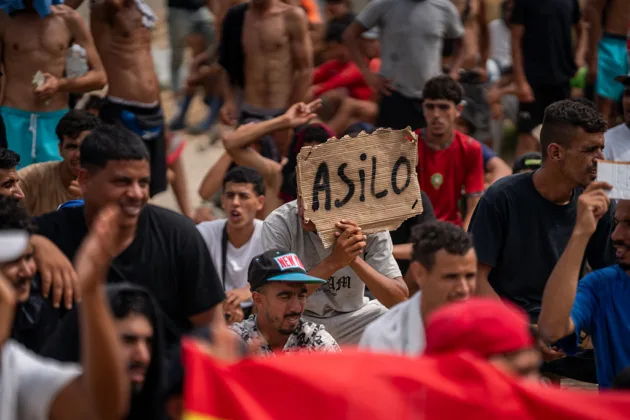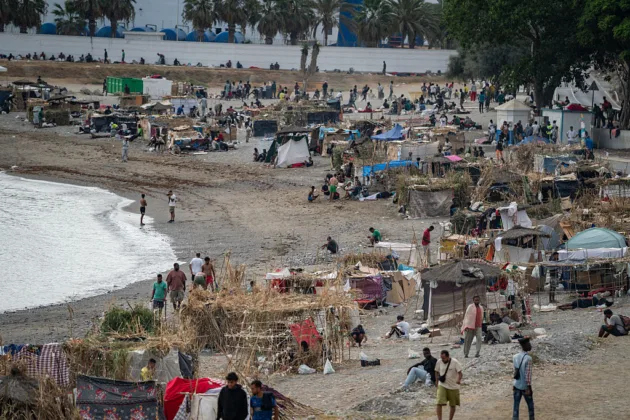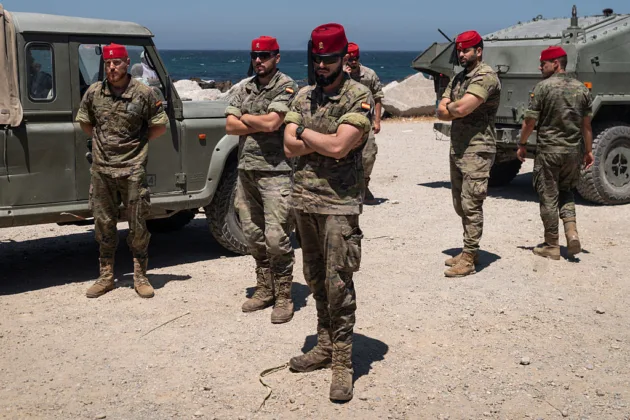





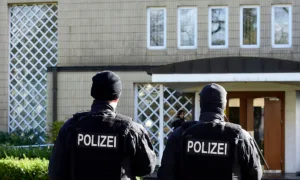






Riot officers have formed a line across El Trampolín beach in the Spanish enclave of Ceuta to keep residents away from a migrant camp, firing warning shots into the air on the evening of August 26.
Several dozen demonstrators reached the edge of the settlement, pulled down tents and threw belongings into the sea. Police kept them off the main stretch of sand, where migrants gathered on a breakwater behind the cordon.
The camp has stood since the mass entry of July 30. Ceuta’s government has asked Madrid to remove it and Vox has demanded the same.
Officers moved more than 1,200 people off the beach on August 20 to clean it. Hundreds returned within hours and the settlement was rebuilt.
Force has now been used at the site on consecutive days. On August 25 police charged and fired rubber bullets to disperse migrants during a Red Cross food distribution.
The march that preceded the beach confrontation drew more than 2,000 people. It began in the O’Donnell district, outside the military hospital, and grew as it moved on the Government Delegation, where the state’s crisis committee was meeting inside.
Demonstrators carried Spanish and Ceuta flags and called for the removal of the migrants and the resignation of the government delegate, Miguel Ángel Pérez Triano. It was the second such protest in two days in a city of about 84,000 people.
Later that night hundreds of residents left their homes near the Coronel Fiscer barracks and walked towards a disused flour mill in the Sardinero district. Riot units were deployed near Benítez beach as tension rose again.
The mill was one of the sites earmarked in a royal decree approved on August 25, which also listed five covered municipal sports centres, the military hospital and a car park. The measures were to run to December 31.
Ceuta President Juan Jesús Vivas said the city had not been consulted and would use every legal means to stop the sports centres being used.
Ángel Víctor Torres, the territorial policy minister coordinating the response, said after the crisis committee met on August 26 that the sports centres would be taken out of the decree at its next update.
The unrest follows the mass crossing of July 30, when Spain’s interior ministry initially put arrivals at about 50,000 and later revised the figure sharply upwards. Some 69,500 people were sent back to Morocco within four days and at least 72 died on the Spanish side.
Those crossings prompted Italy to threaten the suspension of Schengen arrangements with Spain and led the European Commission to offer Frontex support at the European Union’s only land frontier with Africa.