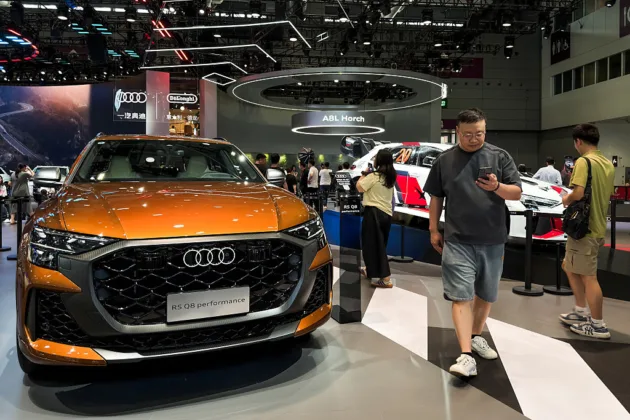






Audi has begun legal proceedings against Auto China, a German parallel importer that was selling two electric models built for China under an Audi sister brand written in capital letters and without the four rings.
The cars are the E5 Sportback and the E7X, developed with SAIC Motor for young, tech-minded Chinese buyers and never listed for official sale in Europe.
A company spokesman told Automobilwoche that Audi had “initiated legal proceedings against the importer and will rigorously enforce its rights.”
Both models have since vanished from Auto China’s website. The importer has not said whether that was at Audi’s request.
AUDI, in block capitals, is a China-only EV brand.
The cars sit on a joint platform with SAIC, plug into China’s digital ecosystem and look different from the global e-tron range.
Auto China bought them in China, completed EU type approval and registration, and offered a two-year warranty through independent workshops.
In August it advertised an E5 Sportback from about €59,980 and an E7X Flagship at €72,900 — roughly double the Chinese list price, yet still cheaper and better than some German-built Audi EVs of similar size after shipping and duties.
An imported E5 Sportback undercuts Audi’s own S6 Sportback e-tron, which starts at €99,500 and makes less power (543 hp against the Chinese car’s 776). The E7X at €72,900 undercuts an SQ6 e-tron from €93,800.
This year, the E5 even won the China Car of the Year title.
Audi says the vehicles did not leave China through an authorised channel and that official dealers outside China cannot service them, because they count as “non-Audi vehicles”.
Buyers, it argues, would be tied to the grey importer for parts and software.
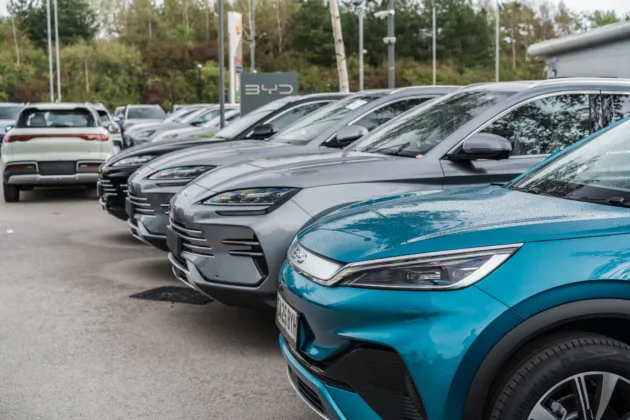
Auto China already brings in other China-only models (Xiaomi, Zeekr, Jetour, Huawei) by the same route.
Parallel trade is legal when a brand itself has put a product on the European market.
Volkswagen has already won a Hamburg court order this year against grey-imported ID. models, including destruction of seized cars.
Audi has not published the exact legal grounds of its own case.
China already has evolved into a different market. Buyers expect their EV’s to work like a phone — HarmonyOS, HyperOS or SkyOS tied to maps, payments and voice — with lidar, full-width screens and AI driving as standard, not extras.
BYD sent about 200 over-the-air updates in 2025; Volkswagen sent five.
Chinese firms can put a new model on an existing platform in under two years; European programmes still take three to seven.
Audi’s own people say a single global car no longer works and that separate diagnostic tools, software support, spare parts and repair procedures are needed between Europe and China.
China being able to export cheaper, better German cars to Germany and the need for lawsuits to block it is yet another illustration of how deep the problems are for German car manufacturing, observers note.
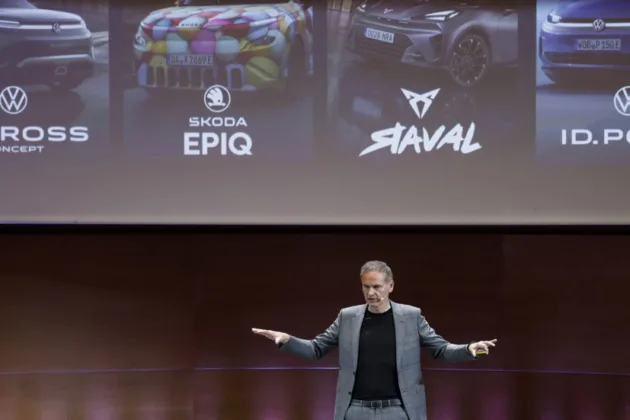
Europe’s biggest carmaker, Volkswagen Group, has presented dismal 2025 annual results.
Today, the company – which includes brands such as VW, Audi, Porsche, Seat and Skoda – announced it will cut 50,000 jobs in Germany until 2030 to regain efficiency. https://t.co/GaRExTKcqV
— Brussels Signal (@brusselssignal) March 10, 2026