
Azerbaijani President Ilham Aliyev has described the European Parliament as “a den of corrupt officials”, escalating his criticism of European institutions over their positions on Azerbaijan, Karabakh and the Armenia-Azerbaijan peace process.
Aliyev made the remarks on September 15 in Baku while meeting participants in international conferences, including Organization of Turkic States secretary-general Kubanychbek Omuraliev and religious leaders attending the seventh meeting of the organisation’s council of Muslim religious boards.
“I say this with full responsibility: the European Parliament is a den of corrupt officials. Millions of dollars in suitcases were found at the home of its vice-president, and they covered it all up, as if it had never happened,” Aliyev said.
He was referring to the Qatargate scandal, which erupted in December 2022 and involved former European Parliament vice-president Eva Kaili. Belgian investigators seized large amounts of cash during searches linked to the investigation.
The Parliament voted 625 to one to remove Kaili from the vice-presidency two days after her arrest.
“Her name is known; she is a female deputy from Greece. How many years have passed since then? Has any measure been taken against her? No. Has she been held accountable? No. She was released,” Aliyev said.
Kaili spent four months in pre-trial detention and was then held under house arrest until May 2023. She remains charged with corruption, money laundering and participation in a criminal organisation, denies all wrongdoing and has yet to come to trial.
The dispute between Baku and European institutions is rooted in the Karabakh conflict. The region is internationally recognised as part of Azerbaijan and was historically inhabited by both ethnic Armenians and Azerbaijanis.
Following the Soviet collapse, Armenian forces took control of most of the territory. UNHCR estimated that about 620,000 Azerbaijanis were displaced from areas affected by the conflict between 1991 and 1994.
“For 30 years, we raised our voice in all European organizations, trying to convey the truth,” Aliyev said on September 15, accusing European institutions of failing to sanction Armenia. “Why don’t you impose sanctions on it? This is, therefore, double standards.”
Azerbaijan regained control of Karabakh in the 2020 war and a one-day offensive in September 2023. More than 100,000 ethnic Armenians subsequently fled to Armenia, ending the region’s decades-long Armenian administration.
The return of the Armenians who fled Karabakh, together with the preservation of Armenian cultural heritage, has now become a major point of contention between Baku and the European Parliament.
The Parliament has called for the protection of Armenian cultural, religious and historical sites amid allegations by international organisations that Armenian churches, monasteries and other cultural monuments in Karabakh have been destroyed, altered or stripped of their Armenian identity.
In its April 30, 2026 resolution, it also backed the right of displaced Karabakh Armenians to a “safe, unimpeded and dignified return” under international guarantees. So far, though, there has been no return of the Armenians who fled the region in 2023.
Another dispute concerns Armenian detainees.
“When we fully liberated Karabakh in September 2023, eradicated separatism and arrested the separatists, four months later the Council of Europe imposed sanctions against us,” Aliyev said on September 15.
He was referring to the Parliamentary Assembly of the Council of Europe’s January 2024 decision not to ratify the credentials of Azerbaijan’s parliamentary delegation, effectively preventing its members from participating in the Assembly.
The European Parliament has separately condemned what it calls the “unlawful detention” and “sham trials” of Armenian detainees. In March 2025, it referred to 23 Armenian prisoners, and demanded their immediate and unconditional release. The Parliament cited concerns over due-process guarantees and alleged inhumane or degrading treatment.
Campaigners now put the number held in Baku at 19. Azerbaijan’s foreign ministry says those detained are not prisoners of war but people convicted or accused of serious crimes, including terrorism, sabotage and war crimes.
The dispute now extends directly to the peace process. Following Azerbaijan’s military victories, Armenian Prime Minister Nikol Pashinyan’s government made a peace agreement and normalisation with Baku a central foreign-policy priority. Yerevan has recognised Azerbaijan’s territorial integrity and moved away from its previous claims concerning Karabakh, steps that Baku has presented as acceptance of its core demands.
The two sides initialled the text of a peace agreement at a White House summit on August 8, 2025, but it remains unsigned. Baku links signature to Armenia amending its constitution to remove what it says are territorial claims, a process Yerevan has tied to a referendum expected in 2027.
At the same time, Armenia has received substantial political and financial backing from the EU and other Western partners. The EU is Armenia’s largest donor and has committed a €270 million Resilience and Growth Plan for 2024-2027, comprising €200 million in grant assistance and €70 million in investment grants.
Under the EU’s Global Gateway strategy, the investment portfolio is expected to mobilise more than €2.5 billion. In 2025, the European Commission also announced a second €202.5 million instalment, while in June 2026 it disbursed a further €34 million to help Armenia mitigate the impact of Russian trade restrictions.
Aliyev nevertheless argues that the European Parliament is working against the peace process. In a May 4, 2026 video address to the European Political Community summit in Yerevan, he said that the Parliament “instead of supporting the peace process, prefers to sabotage it”. Aliyev claimed that the Parliament had adopted 14 resolutions critical of Azerbaijan between May 2021 and April 30, 2026, and complained that its latest resolution had been adopted just four days before the summit.
That April 30 resolution, though, explicitly welcomed progress in the Armenia-Azerbaijan peace process and supported “the further consolidation and institutionalisation of peace”. At the same time, it reiterated the rights of Karabakh Armenians, including protection of their identity, property and cultural heritage and their right to a “safe, unimpeded and dignified return” under international guarantees. It also called for an international assessment mission and the release of Armenian detainees held by Azerbaijan.
Baku’s response went beyond rhetoric. On May 1, 2026 the Milli Majlis suspended cooperation with the European Parliament in all areas and ended Azerbaijan’s participation in the EU-Azerbaijan Parliamentary Cooperation Committee. In his September 15 remarks Aliyev went further still, saying the Parliament was made up of “these Islamophobes”.
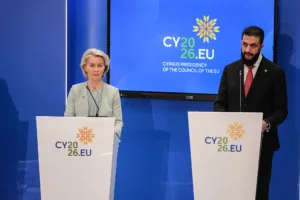
Despite the increasingly sharp rhetoric from the European Parliament, Azerbaijan remains an important strategic partner for the EU. The relationship is particularly significant in energy. During her July 18, 2022 visit to Baku, Commission President Ursula von der Leyen described Azerbaijan as a “crucial energy partner” and said the EU was seeking to diversify away from Russian gas.
The energy agreement signed during the visit aimed to expand the Southern Gas Corridor and increase Azerbaijani gas supplies to the EU, helping compensate for cuts in Russian supplies. It set a target of at least 20 billion cubic metres a year by 2027. Azerbaijani presidential envoy Elchin Amirbayov said in May that deliveries to the EU reached 12.5 billion cubic metres in 2025.