


The Christian Democratic Union (CDU) leadership has rallied behind Chancellor Friedrich Merz at a crisis meeting in Berlin today, after the party suffered the worst regional election result in its history.
The CDU took just 4.9 per cent in Mecklenburg-Western Pomerania, northeast Germany, on September 20, falling below the 5 per cent threshold needed to enter the state parliament. Its previous worst regional showing was 9 per cent in Bremen in 1951.
Alternative for Germany (AfD) won the state with 38.2 per cent, more than double its 2021 score, beating the Social Democratic Party (SPD) of Minister-President Manuela Schwesig into second place. The victory came two weeks after the AfD’s landslide in Saxony-Anhalt on September 6.
On the same day in Berlin, Die Linke topped the poll with 25.7 per cent, ahead of the CDU on 18.8 per cent, according to the state election authority.
Arriving at party headquarters, CDU deputy leader Karl-Josef Laumann said the leadership stood behind the Chancellor. He added that it was essential to make clear the government would remain in office.
Family minister Karin Prien, also a CDU deputy leader, struck a more critical note. She told broadcaster Deutschlandfunk the results showed her party lacked empathy for people’s concerns and that the Chancellor knew he would have to change.
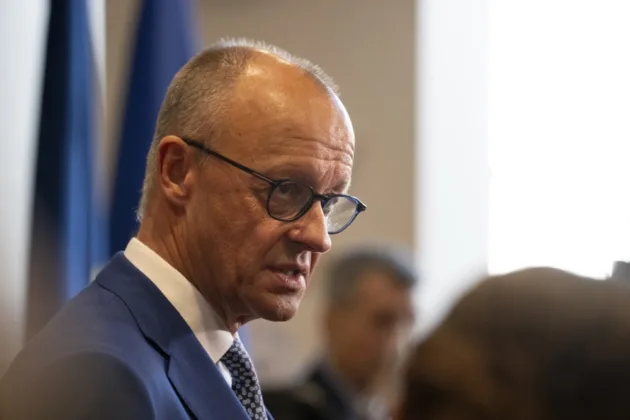
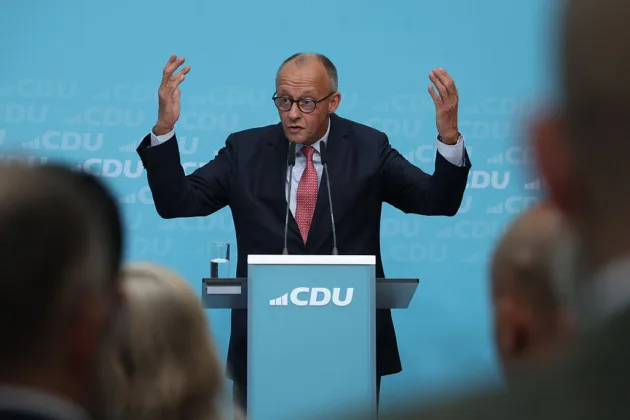
Merz had described the Mecklenburg-Western Pomerania result as a disaster on election night. After the meeting, he told reporters he would stay on and press ahead with his reforms, saying the task demanded backbone and patience.
The changes to the economy, healthcare and welfare, seen as crucial to reviving Germany’s sluggish economy, have proved deeply unpopular. They have fuelled calls for his resignation.
Matthias Miersch, Bundestag group leader of the SPD, Merz’s junior coalition partner, said the reforms currently amounted mainly to cuts. He told public broadcaster ARD they had to be implemented, but with empathy.
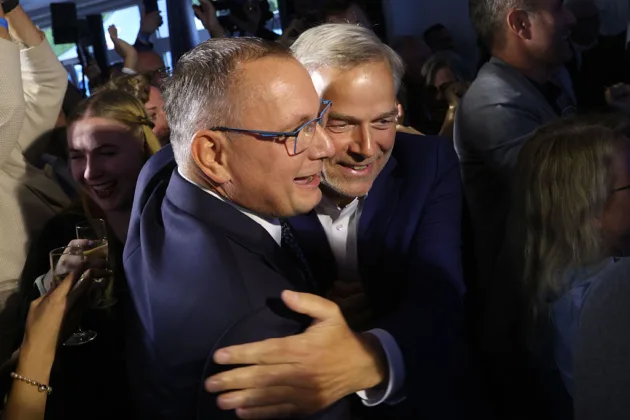
AfD co-leader Tino Chrupalla told broadcaster ZDF the Chancellor’s statement was feeble and called on him to resign.
Despite its win, the AfD is unlikely to govern in Schwerin as the other parties refuse to work with it. Its lead candidate, Leif-Erik Holm, told broadcaster NDR he believed the party could govern but that it did not look likely for now.
In Berlin, the result has opened the way for a three-party coalition of Die Linke, the Greens and the SPD. Die Linke’s lead candidate Elif Eralp, a 45-year-old lawyer of Turkish origin, is seeking to become the party’s first mayor of the capital.
The Greens have said they are willing to negotiate, while the SPD’s position remained unclear. Turnout rose sharply in both states, to 78.1 per cent in Mecklenburg-Western Pomerania and 74.2 per cent in Berlin.