








Three nationalist parties have declared a right to decide their own constitutional future outside the United Kingdom and have placed that future inside the European Union.
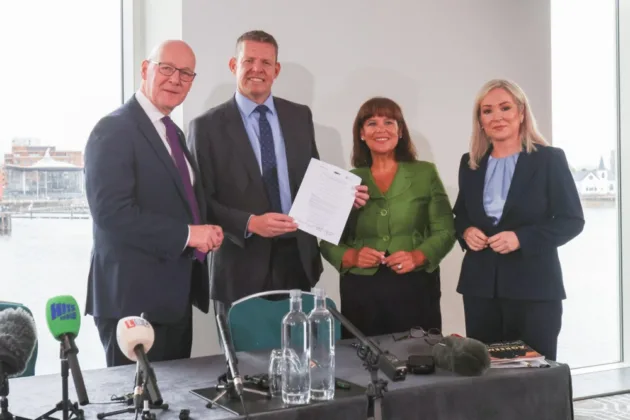
Leaders of the Scottish National Party (SNP), Plaid Cymru and Sinn Féin signed a memorandum of understanding in the Welsh capital on September 14. They met in their capacity as party leaders rather than as members of their respective governments.
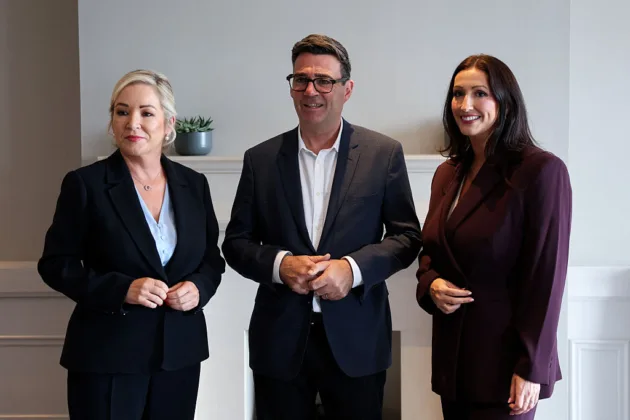
SNP leader John Swinney, Plaid Cymru leader Rhun ap Iorwerth and Sinn Féin vice-president Michelle O’Neill were joined by the party’s president, Mary Lou McDonald. Swinney and ap Iorwerth are the first ministers of Scotland and Wales, while O’Neill holds the same office in Northern Ireland.
It is the first time all three devolved administrations have been led by parties committed to leaving the UK. The memorandum called on the British Government to “prepare for, plan and facilitate constitutional change” in each jurisdiction.
“The future of our nations belongs in the European Union,” the text said.
The agreement also set out ambitions for cooperation on the economy, energy and international affairs, while accepting that the three parties hold different constitutional positions and that each nation would move at its own pace. It said Brexit had damaged their economies and described Europe as “our common home”.
The SNP and Plaid Cymru are the largest parties in the Scottish Parliament and the Senedd for the first time since devolution began in 1999. Sinn Féin has been the largest party in the Northern Ireland Assembly since 2022.
The European clause is the part of the document that would land in Brussels, though it raises questions the memorandum does not answer.
Before Brexit, the argument turned on whether a territory breaking away from a member state could stay inside the bloc. The European Commission held consistently that it could not.
That dispute is now settled by default. The UK left the EU on January 31, 2020, so Scotland and Wales would be applying as new states from outside the single market rather than seeking to remain within it.
Article 49 of the Treaty on European Union requires an applicant to be a European state, to respect the bloc’s values and to win the unanimous agreement of every member state. Spain, Cyprus, Belgium and Romania each have domestic reasons to be wary of a precedent that rewards secession.
Northern Ireland is a different case in law. Were a border poll to pass, the territory would enter through unification with Ireland, an existing member state, on the model of German reunification in 1990. That route needs no accession treaty and no unanimity, which is why Dublin rather than Brussels remains the decisive capital in that scenario.
The Cardiff meeting came two days after US President Donald Trump told reporters in Dublin that he would “love to see it unified”, adding that reunification would happen eventually.
The remarks, made alongside Irish Prime Minister Micheál Martin, broke with decades of American neutrality and drew immediate criticism from unionists, who argued that the constitutional future of the territory is a matter for its own voters rather than for London, Dublin or Washington.
O’Neill said the intervention showed that the unity debate was very much alive.
Martin has struck a more cautious note, arguing that any settlement must rest on the British-Irish relationship, the North-South link and relations between the two traditions in Northern Ireland. He accused Sinn Féin of reaching back to the politics of the 1970s.
McDonald said she hoped the Irish Government had heard the message from Washington and urged Martin to step up preparations for a border poll.
For all the choreography in Cardiff, the three parties cannot deliver referendums on their own.
The SNP wants a second vote after the 2014 ballot, in which Scotland voted to stay in the UK. Successive British governments have ruled out an early rerun. Plaid Cymru seeks Welsh independence over a longer horizon and ap Iorwerth has ruled out pressing for a referendum now.
Sinn Féin wants a border poll, which under the 1998 Good Friday Agreement can be called only by the British government’s Northern Ireland minister, and only when a majority in the territory appears likely to favour joining the Republic of Ireland.
Prime Minister Andy Burnham, who took office in July, said in August that a unity referendum was “off the table”, prompting a sharp response from Sinn Féin and a partial retreat in parliament. Asked again on September 9, he told MPs he saw no majority public support for a poll and that there would be none until that changed.
A spokesperson for his Downing Street office said the Prime Minister “believes strongly in the Union” and would rather ease pressure on household finances than engage in constitutional debates.
Polling in Northern Ireland still shows a comfortable majority for remaining in the UK, though the gap has narrowed since Brexit pushed the border question up the agenda.
The memorandum therefore changes the political weather rather than the legal position. It gives the three parties a shared vocabulary, a shared grievance and, for the first time, a shared destination.
Whether the EU wants that destination filled is a separate question, and one no institution in Brussels has shown any appetite to answer.