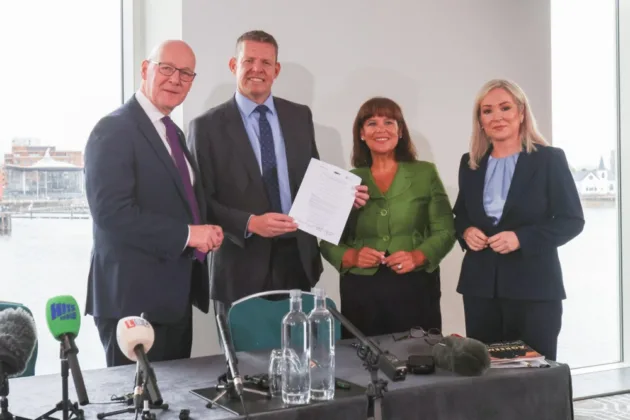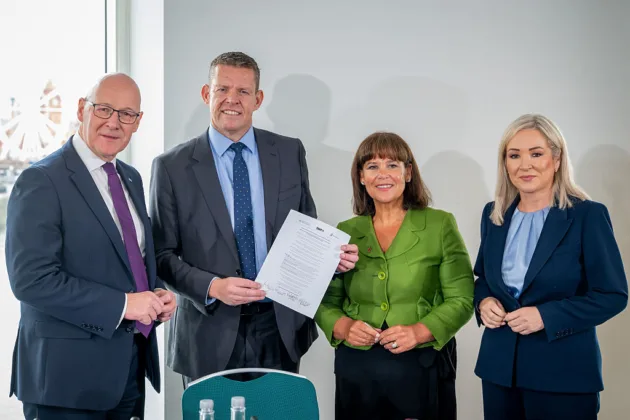








The leaders of the parties governing Scotland, Wales and Northern Ireland have met in Cardiff to sign a joint declaration demanding the right to hold referendums on leaving the United Kingdom.
Scottish National Party (SNP) leader John Swinney, Plaid Cymru leader Rhun ap Iorwerth and Sinn Féin vice president Michelle O’Neill put their names to a memorandum of understanding in the Welsh capital on September 14. All three hold the post of First Minister in their respective administrations but attended as party leaders, a distinction that lets them make a case their official roles do not stretch to.
Sinn Féin President Mary Lou McDonald, who leads the opposition in the Irish parliament, also took part.
The document covers the economy, energy, Europe and international cooperation alongside self-determination, according to The Telegraph, which first reported its contents.
It is the first time all three devolved administrations have been led by parties committed to leaving the UK, and the first time they have pooled that position in writing.
Devolution itself was a late and narrow settlement. Welsh voters rejected an assembly by roughly four to one in 1979 and approved one in 1997 by fewer than 7,000 votes, while the Good Friday Agreement of 1998 built Northern Ireland’s institutions on the principle that its status could only change by consent.
The 2026 elections rearranged that landscape. Plaid Cymru took 43 of 96 seats at the Senedd election on May 7 and now governs as a minority, ending a century of Labour dominance in Wales, while the SNP remained the largest party at Holyrood, where the Scottish parliament voted in May to call for a fresh independence referendum.
The declaration carries no legal force. The UK Supreme Court ruled in 2022 that Edinburgh cannot call a referendum without the consent of the UK Government, while the Good Friday Agreement leaves any border poll to the British minister responsible for Northern Ireland, who must first judge that a majority is likely to back unification.
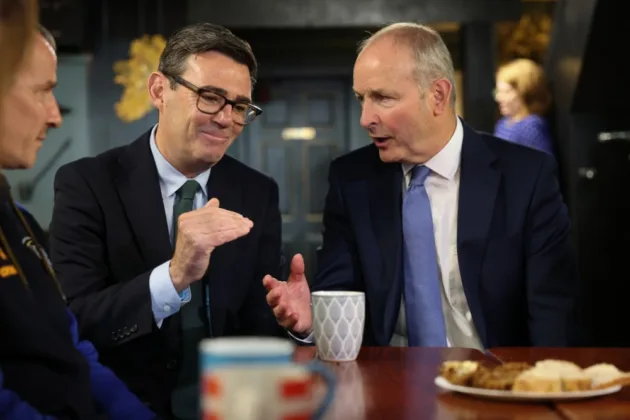
Prime Minister Andy Burnham told MPs on September 9 that a second Scottish vote could proceed if there were clear public consensus for one. In a letter to Swinney the following day he hardened that line, writing that a referendum was “off limits” for the time being.
Burnham argued there was no agreement in Scotland on holding such a vote and no clear basis for saying a majority in Northern Ireland wanted to separate from the UK. Swinney replied that the Prime Minister risked being remembered as “the last prime minister of the United Kingdom”.
The signatures conceal very different timetables. Ap Iorwerth has said there will be no Welsh independence referendum during a first Plaid Cymru term and no serious talk of one before 2030, with a standing commission drafting a white paper in the meantime.
Swinney is working to a much tighter schedule, having argued that Scotland needs independence before the next UK general election, expected in 2029, and citing the prospect of Nigel Farage’s anti-immigration, anti-EU Reform UK taking power in London.
Sinn Féin is bound by a test it does not control, since polling in Northern Ireland has not yet shown the majority the border-poll threshold requires. A party source said Irish unity was “not a distant aspiration”.
The three parties also agreed that their nations belong inside the European Union, with Scotland and Wales joining as new member states and Northern Ireland entering through unification with the Republic.
That is the least developed part of the text. A new state would apply under Article 49 of the Treaty on European Union, which requires the unanimous agreement of the 27 member states and ratification by each of them, and successive Commission presidents have said there is no automatic succession for a territory that leaves a member state.
Wales complicates the case further. It voted to leave the EU in 2016 by 52.5 per cent, the only one of the three nations where a majority backed departure.
Irish unification is the outlier because it would not be an accession at all. The Republic is already a member state and Northern Ireland would enter through its territory, a route with a precedent in German reunification, which Brussels absorbed in 1990 without opening negotiations.
The summit followed a visit to Dublin by US President Donald Trump, who said on September 12, standing beside Taoiseach Micheál Martin, that he would “love to see” Ireland unified. Washington has traditionally kept out of the question.
Democratic Unionist Party (DUP) leader Gavin Robinson said Northern Ireland’s constitutional future was for its own people to settle. Downing Street said its position had not changed.