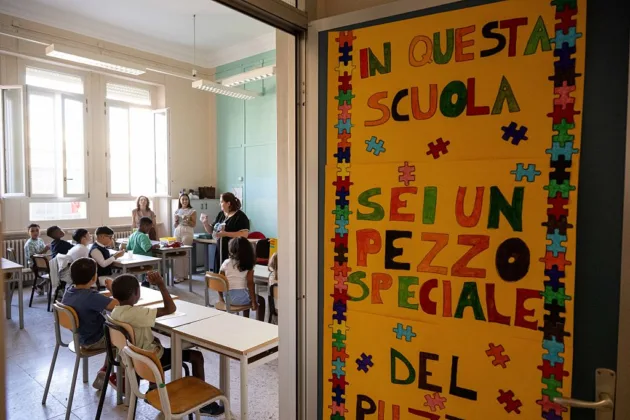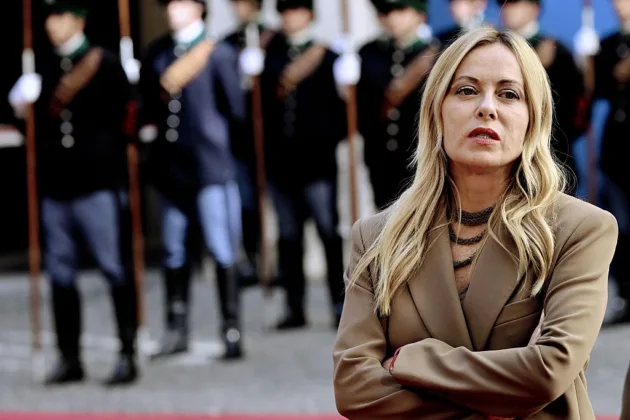





Italian Prime Minister Giorgia Meloni has announced plans to limit the number of foreign students in individual classrooms and ban the wearing of burqas and niqabs in schools, placing language acquisition and integration at the centre of her government’s approach to education.
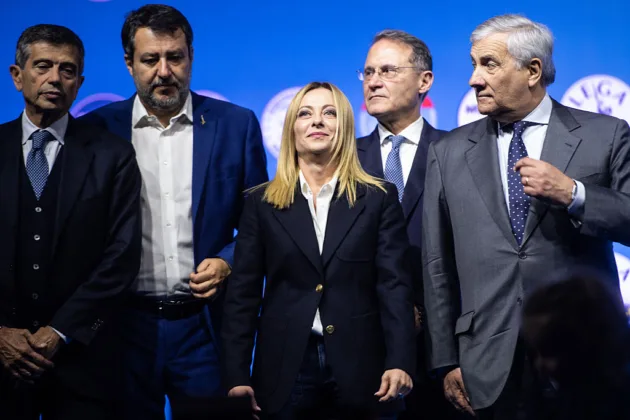
Speaking on September 20 at Fenix, the national festival of Gioventù Nazionale, the youth wing of her Brothers of Italy party, in Rome, Meloni said a government measure would soon be presented to the Council of Ministers. The proposal would establish a maximum number of foreign students per class, although she did not specify the exact limit.
The planned measures would also require parents of foreign students experiencing serious difficulties integrating into the Italian school system to learn Italian.
Meloni defended the initiative by arguing that excessive concentrations of students who do not speak Italian can undermine integration and create difficulties within classrooms.
“It cannot happen that in an Italian classroom, Italian children are the ones who feel pushed into a corner because they have become the minority.
“Calling all of this ‘integration’ is another lie, a convenient lie for those who live by ideology, for those who lecture us from their drawing rooms and then send their own children to schools where this problem does not exist.
“Not for us. For us, anyone who comes to Italy and wants to build their future here must learn our language, know our culture and respect our rules.”
The proposed measure explicitly includes a ban on burqas and niqabs in schools. Meloni also said that “at school, one goes with one’s face uncovered”, arguing that no one should be able to decide that a young woman must conceal herself in the name of a real or presumed tradition.
“Equality between men and women is not negotiable. Not in our streets, not in our schools,” she said.
A cap already exists on paper. Under a 2010 ministerial circular signed by then education minister Mariastella Gelmini, pupils without Italian citizenship should not “as a rule” exceed 30 per cent of those enrolled in each class.
The limit has gone largely unenforced in areas with large immigrant populations. Education minister Giuseppe Valditara had announced his intention to turn it into law, with regional school offices coordinating the distribution of pupils.
The measures would still require formal government approval and parliamentary consideration before becoming law. Under the reported procedure, legislation approved by the government would need parliamentary approval within 60 days.
The text could reach the Council of Ministers as early as September 25.
The proposals come as Italy’s schools reflect the country’s changing demographic composition. According to data published by Fondazione ISMU (Initiatives and Studies on Multi-ethnicity) on September 2, 2026, concerning the 2024-25 school year, Italy had 931,323 students with non-Italian citizenship, representing 11.6 per cent of the total school population.
The share was highest in primary schools, at 13.7 per cent. More than a quarter of these pupils attended schools in Lombardy, northern Italy.
This figure does not include a growing number of students who hold Italian citizenship but have foreign backgrounds. The government argues that some of the integration and language difficulties addressed by the new measures can also affect pupils from immigrant families who have acquired Italian citizenship.
More broadly, ISMU estimated that 5.898 million foreign citizens were present in Italy on January 1, 2025, including 5.371 million registered residents. It put the number of those in the country irregularly at 339,000.
Regarding religious affiliation, ISMU estimated that Muslims accounted for 31 per cent of foreign residents on July 1, 2025. In a release published on July 10, 2025, it had put their number at about 1.7 million on January 1, 2025, the first time they exceeded 30 per cent of foreign residents.
A year earlier, ISMU had estimated the figure at about 1.6 million.
The figures therefore show an increase in the estimated Muslim population among Italy’s foreign residents within a year. At the same time, religious affiliation is not routinely recorded in Italian school statistics, meaning the ISMU figures cannot be used to determine how many Muslim pupils attend Italian schools.