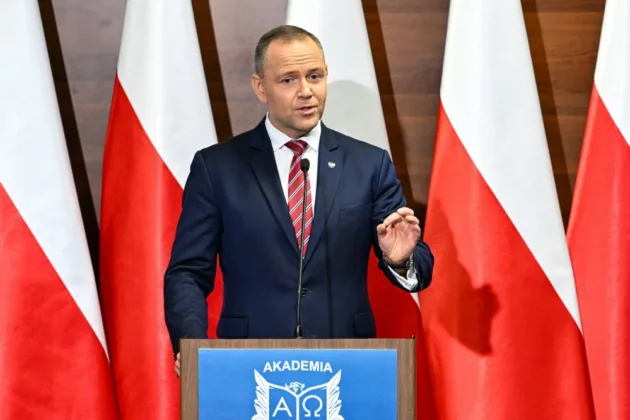


Poland’s Prime Minister Donald Tusk has addressed the media ahead of the regular weekly cabinet meeting on September 15 to react to a story published in the Financial Times (FT) of the same day.
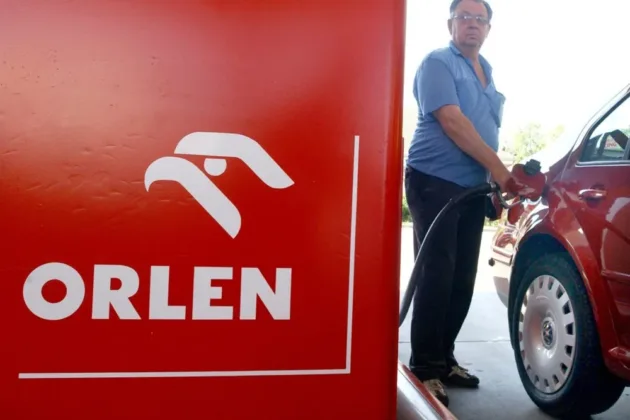
It reported that a $230 million (€199 million) advance from Poland’s State-owned fuel giant Orlen vanished into a web of middlemen and cryptocurrency wallets for Venezuelan oil that was never loaded onto tankers.
Tusk said that it was a great pity that at a time “when hundreds of articles in the western press have been praising Poland for its economic performance we have this embarrassing material published in the Financial Times“.
He called the affair a shame before the whole world and said he would ask the prosecutor general to brief ministers on the state of the Orlen investigations.
The Polish PM then pointed an accusing finger at the last Law and Justice (PiS) government on whose watch the alleged scandal took place saying that “once again we have information about PiS people being involved in shady crypto-currency dealings and causing a loss to the exchequer”.
He was alluding to a separate investigation into whether the cryptocurrency exchange Zondacrypto financed politicians and foundations on the Right while parliament was working on a bill to regulate the crypto-asset market.
Prosecutors are examining payments to a foundation linked to Konfederacja MP Przemysław Wipler and, in witness evidence read out by Tusk in parliament on September 4, alleged transfers to a foundation associated with former PiS justice minister Zbigniew Ziobro. Both men deny wrongdoing and PiS says its own amendments would have restricted Zondacrypto’s activity in Poland.
Tusk said that the matter was being investigated by public prosecutors and the Warsaw Regional Prosecutor’s Office later said its investigation covers “not only the transaction itself, but also the purchase of cryptocurrency using funds transferred by the Orlen.”
Polish foreign minister Radosław Sikorski who serves in Tusk’s coalition government also reacted to the FT report by pointing directly at the previous government.
“Information in respected media about dodgy dealings under Morawiecki [last PiS PM Mateusz Morawiecki-ed.] and Obajtek [former CEO of Orlen Daniel Obajtek who since 2024 is an MEP for PiS-ed.] brings us no credit,” he wrote on X.
The deal revealed by the FT dates to late 2023, during the final weeks of Poland’s PiS government. The contract was signed on November 29, 2023, two weeks before Tusk’s current government took office on December 13, 2023.
It was handled by Orlen Trading Switzerland (OTS), a subsidiary established to expand Orlen’s international oil trading as Poland reduced its dependence on Russian crude following Moscow’s full-scale invasion of Ukraine in 2022. The unit was given a credit line of $600 million (€520 million).
According to the FT, the Venezuelan venture took shape around the 2023 Abu Dhabi Formula 1 Grand Prix, where Orlen sponsored a racing team. OTS chief Samer Awad met Hannon founder Kam Ho “Alex” Tse on a yacht and asked him to source Venezuelan crude for the Polish company. Tse was 25 at the time.
In November 2023, OTS agreed to buy six million barrels of Venezuelan Merey 16 heavy crude oil for $345 million (€299 million) from Hannon International, a small Dubai-based trader founded about two and a half years earlier. Delivery was due in three tranches by December 19, 2023.
Within five days, OTS transferred a $230 million (€199 million) advance payment without demanding guarantees or security in return.
The timing initially appeared favourable because the United States had temporarily eased sanctions on Venezuela, giving traders an opportunity to buy discounted oil.
Years of sanctions had, though, pushed Venezuela’s state oil company, PDVSA, towards USDT, a cryptocurrency token designed to maintain a value of approximately one US dollar.
According to the FT, Hannon turned to a series of intermediaries to secure the oil. In Venezuelan capital city Caracas, brokers were handed USB drives containing digital keys that gave access to cryptocurrency wallets holding tens of millions of dollars’ worth of USDT.
Meanwhile, three supertankers chartered for Orlen waited off the Venezuelan coast but none of the six million barrels covered by the original contract was loaded. A separate attempt later secured about 500,000 barrels of fuel oil.
OTS, by then under new management, terminated the contract in March 2024 and Orlen is pursuing arbitration to recover the advance. Hannon says it acted only as an intermediary buying with cryptocurrency on OTS’s behalf and does not hold anything close to that sum.
Polish authorities have estimated that total losses connected with the transactions undertaken by OTS covering a total of transactions rather than just the failed Venezuelan venture amounted to around $420 million (€364 million), or some 1.6 billion złoty.
This estimate includes the advance payment, shipping and demurrage costs, legal expenses, and other expenses attributed to mismanagement by the company.
Polish prosecutors have thus far indicted three former Orlen and OTS executives over three oil contracts that investigators say caused losses of around $378 million (€328 million). The indictment was filed at the Warsaw district court on August 7 over contracts signed between August 21 and December 21, 2023, and the three men face up to 25 years in prison. The strand concerning Awad was severed into separate proceedings.
The former CEO of Orlen Obajtek has denied personal responsibility for individual OTS transactions and told the FT that the appointment of former OTS chief Samer Awad had followed the company’s normal procedures and verification process.
Obajtek has also told Polish media that the transaction took place right at the end of his reign in Orlen but that it was his successors who came into office in January 2024 who were responsible for non-completion of the contracts. He was dismissed as chief executive with effect from February 5, 2024.
“Ask my successors about what happened as I don’t have the documentation to hand. Let them explain why the transaction was stopped and the people in the company we established let go before they could complete their business.”
Samer Awad also denies wrongdoing. He was detained in the United Arab Emirates in January 2025, but a local court rejected Poland’s request to extradite him and Polish prosecutors are continuing a separate case concerning his alleged role in the matter. Warsaw has since renewed its extradition request.
Daniel Obajtek was a local mayor of a small municipality in southern Poland, Pcim, who became the head of Orlen in February 2018 and during his highly visible reign expanded the company to international markets and by acquiring a rival domestic oil company Lotos and merging with Polish gas giant PGNiG, both completed in 2022. By 2023 Orlen was listed among Europe’s 50 largest companies.
The company under his stewardship concentrated on eliminating the need to purchase Russian oil by entering into a deal with Saudi Arabian Aramco, as well as developing renewable energy sources, but was also involved in a controversial takeover of Polska Press in 2021, which owns an array of local newspapers and portals.
The fact that Orlen was ready and willing to financially back projects which were close to PiS hearts and interests meant that the new Tusk government was never likely to keep Obajtek as CEO of the company and during the election campaign Tusk said that it was likely that he would be prosecuted.
Tusk certainly kept his word in that regard with prosecutors producing charges against Obajtek for allegedly funding surveillance of the liberal opposition during PiS’s time in office and alleged violations of the country’s press law and irregularities in the filing of tax returns. He denies wrongdoing and has called the proceedings political.
This campaign has continued despite Obajtek being elected MEP in 2024 with prosecutors filing requests for his European Parliament immunity to be lifted. Members voted to lift it in April this year and a third request, over his tax declarations for 2020, followed in May.
Prosecuting officials and managers who were in office during PiS’s reign has been a consistent feature of Tusk’s rule, as he had promised during the 2023 election campaign and the Polish PM is signalling that he wants to maintain this right until polling day in the next parliamentary election due in the autumn of next year.
None of the prosecutions have as yet resulted in a verdict but have kept PiS on the defensive defending its officials and record in government at a time when they would rather have been putting pressure on the government about scandals the Tusk administration has presided over in the health service, flood relief and allegations of corruption involving Tusk’s party officials.