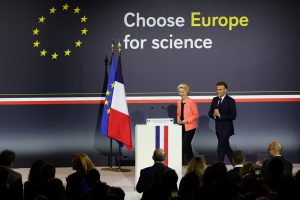





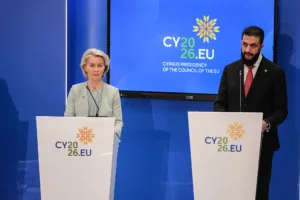

On August 27, 2026, in Paris, European Commission President Ursula von der Leyen told French employers gathered at the annual conference of MEDEF, the French business federation, that Europe must deploy artificial intelligence (AI) “throughout the economy. In our factories. Our laboratories. Our hospitals. Our energy networks. Our transport. And our public services.”
That same day, prosecutors in Warsaw formally opened an investigation into a public grant behind Poland’s national branding project, one of whose documents carries the fingerprints of a chatbot.
Brussels has been generous with the future tense. In February 2025 von der Leyen launched InvestAI, promising to mobilise €200 billion for artificial intelligence, including €20 billion for European AI gigafactories, with the aim of making Europe “an AI continent”. The first call for gigafactory sites drew 77 proposals across 60 locations in 16 member states, and a second was launched this summer.
In September 2025 she told the European Parliament that “a European AI is essential for our future independence”, and a month later the Commission adopted the Apply AI Strategy, mobilising around €1 billion to push the technology into healthcare, energy and public administration. In Paris the doctrine was compressed into two words: Produce and deploy.
None of this is absurd. But every deployment plan has a second half that nobody puts in a speech.
Producing a model is an industrial question. Deploying one inside a public administration is a question about who reads the output, who checks it, and whose name goes at the bottom. On the first half Brussels has an investment target. On the second it has an adjective. What that costs is visible in three cases from one member state.
Poland is replacing its scattered promotional efforts with a single national brand strategy, to be presented in December 2026 and in force from January 2027. Two documents matter, and the row in Warsaw keeps confusing them.
The first is a 26-page report called Polaków portret własny (Poles’ Self-Portrait), produced in November 2025 by a private foundation, the Marka Polska Think Tank, and led by Barbara Mróz-Gorgoń, a marketing professor from Wrocław, southwest Poland. Eight months later, on July 31, 2026, she was appointed a secretary of state and government plenipotentiary for the promotion of Poland’s brand.
Poland’s Ministry of Sport and Tourism, which had given the foundation a grant of 200,000 złoty (€47,000) for broader work on tourism strategy, denies that this report was covered by the contract.
Then people read it.
The report places Katowice in the “northern centre” of the country. Katowice is the capital of Upper Silesia, the old coal and steel basin, some 290km south of Warsaw and 50km from the Czech border. Sebastian Meitz of the Sobieski Institute, a member of the opposition Law and Justice (PiS) party, whose analysis on the platform X on August 20, 2026 set off the row, observed that whatever the point of reference had been, it was probably not a map of Poland.
The young generation, the report announces, speaks fluent English at a rate of 95 per cent, “not infrequently also German, French or Mandarin”. No source is given for the 95 per cent and none exists.
Elsewhere the nation is diagnosed with “impostor syndrome at a national level” and with “Stockholm syndrome — a paradoxical love of the homeland”. The footnotes run 1, 2, 3, and then jump to 41, and then to 517. One sentence in the Polish text begins with the English word “Despite”, a fragment of another draft in another language, left standing in a document about national identity.
Then there are the Nobel Prizes, and here it is worth remembering what the document was for. It exists to sell Poland. Anyone given that brief reaches for every laureate the country can plausibly claim, because they are the asset on the shelf.
This report credits Poland with five — fewer than the count on any criterion anyone uses. The narrowest, laureates who wrote in Polish or held Polish citizenship, already gives seven. Widen it by a single step, to those born on Polish soil, and the list grows by a long line of Polish Jews: Isaac Bashevis Singer, born at Leoncin near Warsaw; Shimon Peres, born at Wiszniew, now in Belarus; Menachem Begin, born at Brześć, today Brest; and after them Roald Hoffmann, Georges Charpak, Tadeusz Reichstein, Andrew Schally, Albert Abraham Michelson.
How many belong in a Polish total is a real argument, conducted for decades across borders that moved twice within one lifetime. A promotional document has every incentive to make the largest case it can defend. This one produced the smallest, and produced it by accident.
Nobody suggests the omission was deliberate. A machine asked for a round number supplied a round number, and no human being at any stage asked whether it was right. Automated carelessness does not need an intention in order to shorten a country’s history by the part that is hardest to remember. It only needs nobody to check.
The second document is the strategy itself, 156 pages, squarely within the commissioned work, and the place where the numbers live. It proposes an implementation budget for 2026-2028 — structures and pilots, then global campaigns, then scaling and “AI systems” — which its own summary puts at roughly €120 million to €157 million.
That ceiling does not survive addition. The annual bands and cross-cutting costs, at their maxima, come to about €165 million. The floor reconciles, the top does not, and nothing explains the gap. Beneath the headline totals there is no costing, no unit price and no justification — a nine-figure programme of public money set out in a few dozen words of category headings.
Whether the discredited report fed the strategy analytically is not established, and the ministry says the two are separate. But both come from the same project, the same team and the same eight months in which nobody appears to have read either closely. A model will write the strategy, the budget table and the press release announcing both. The one thing it cannot do is want the money to be spent well.
On June 25, 2025 the Polish finance ministry published its Green Bond Framework together with an external second party opinion from Morningstar Sustainalytics — the standard procedure by which a sovereign issuer has an outside firm confirm that its green programme means what it says. Five days later Poland priced a euro issue including a 12-year green tranche worth €1.25 billion.
Inside that opinion, Poland’s 2023 gross domestic product appears as $800 million.
The World Bank puts Polish output that year at roughly $812 billion (€751 billion): The reviewer was wrong by a factor of a thousand. Eight hundred million dollars is not the output of a European state. It is roughly what the International Monetary Fund expects this year from São Tomé and Príncipe, an island republic of about 235,000 people.
The real Poland passed a trillion dollars of nominal output for the first time in 2025, sits on the edge of the world’s 20 largest economies arguing publicly about which side of the line it is on, and is lobbying to turn its G20 guest pass into a permanent seat. That country was described, in the documentation accompanying a sovereign bond sale, as one of the smallest economies on earth.
The same document quotes the European Union’s 2030 emissions target in the version superseded in December 2020, a 40 per cent cut that was raised that month to at least 55 per cent, and one of its live hyperlinks still carried the tracking parameter utm_source=chatgpt.com — a fingerprint left by whoever fetched the link, never wiped. That does not prove a chatbot wrote the text. It proves nobody looked at the link before it went out, which here is the same problem.
And consider what the sentence should have done. A published document describing the issuer as a $800 million economy argues, on its face, against buying the issuer’s paper. States of that size do not place 12-year money in billion-euro tranches.
Nothing of the kind occurred. The bonds were placed five days later without incident, because a second party opinion assesses a green framework rather than a sovereign’s creditworthiness, and no investor was pricing anything off that number. Which is exactly what makes the episode instructive. The figure sat in an official publication, flatly contradicting the transaction it accompanied, and was inert — because the reading it presupposes was done by nobody, on either side of the trade.
The third case has nothing to do with any government, which is why it is the most useful. On June 23, 2026 the Naczelny Sąd Administracyjny (Supreme Administrative Court), Poland’s highest court for tax and administrative disputes, heard an appeal against the refusal to suspend enforcement of a value added tax (VAT) decision worth about €50,000.
The taxpayer’s professional representative supported his pleading with three of that court’s own decisions, cited by file number. The court looked them up. All three numbers belonged to real decisions — issued on other dates, about other questions, containing none of the propositions attributed to them. In all three, the appeal had in fact been dismissed.
Judge Sylwester Marciniak wrote, in my translation, that the unreflective use of AI tools by a professional representative must be assessed most critically (I FZ 104/26). The court added that a client who pays for legal services is entitled to expect the highest standards of professionalism, and that it was hard to find any in work a non-lawyer could have produced with the same tools.
The word doing the work is unreflective. The court did not ban language models or declare the algorithm an enemy of law. It addressed the ethics of a paid professional resting a filing on material he had not verified. The appeal was dismissed and the client did not get his stay.
Notice what separates this case from the other two. Here somebody was named and answerable — and the error was caught and set out in a published ruling. That is not an argument against the technology but for knowing whose name is on the page.
Nor is any of this a Polish speciality: Deloitte refunded part of a A$439,000 (€245,000) fee to an Australian government department in 2025 over a review containing non-existent studies and an invented judicial quotation, having acknowledged using GPT-4o.
The easy conclusion here is the wrong one. A well-designed system can do things no European administration currently does: Sort thousands of consultation responses that today are counted rather than read, flag collisions between a draft law and the statutes in force, search 20 years of case law, translate a Union document in minutes.
The condition is access to the right data and verification by a human being. Remove the second and the machine will confidently supply a 21st year of case law, exactly as it did in I FZ 104/26. The models in all three cases behaved within their well-known limitations, in the hands of people who treated a plausible paragraph as a finished one.
This is where the Commission’s position becomes hard to defend — though not for the reason usually given.
The European Union has not exempted the users of artificial intelligence from its rulebook. The AI Act regulates deployers as well as providers. Article 26 obliges those using high-risk systems to ensure competent human oversight, public authorities are within its scope, and Article 99 backs the whole Act with fines of up to 3 per cent of worldwide turnover for breaches of the deployer duties and up to 7 per cent for the practices prohibited outright. Anyone claiming Brussels regulates the builders and ignores the operators has not read the Act.
The problem is narrower, and worse. Article 50, in force since August 2, 2026, already requires a deployer to disclose that text has been artificially generated where it is published to inform the public on matters of public interest — a description that fits a national branding strategy exactly. But the obligation falls away “where the AI-generated content has undergone a process of human review or editorial control and where a natural or legal person holds editorial responsibility for the publication of the content”.
Read that twice. Europe has written the precise thing all three of these cases lacked — a human review and a named person answerable for the result — and has written it as an escape from a labelling duty rather than as a duty of its own. You may skip the disclosure if somebody checked. Nobody is ever required to be that somebody. And the duty that does exist concerns provenance, not accuracy: A ministry that labels its strategy as machine-assisted has complied in full, whatever the document says about where Katowice is.
Meanwhile the heavy end of the Act has been retreating. Regulation (EU) 2026/1744, in force since July 27, 2026, deferred the high-risk obligations to December 2, 2027 and August 2, 2028, in a simplification package justified by the need to reduce recurring administrative costs for companies. In Paris von der Leyen put that wider drive at some €17 billion a year in savings, with a target of cutting administrative burdens by a quarter for all companies and by 35 per cent for smaller ones by 2029.
Within two years of passing the law, the Union has conceded that what it wrote for the people building the technology was too heavy to apply on schedule. In those same two years it wrote nothing about the ordinary paperwork of its own administrations.
What is missing is not another risk tier. It is one sentence: That a document produced with public money and published in the name of a public authority must state whether it was made with machine assistance, and must name the official who verified its facts before publication. Turn Article 50’s exemption the right way up and it is already half written.
It would not have caught all three cases here, and the exception proves the point. The lawyer’s filing was governed by professional rules, and those rules worked, because he had a name and a court to answer to. It is the public documents that passed through institutions in which nobody was obliged to sign.
That reform needs no gigafactory, no €200 billion and no summit in Paris, and it imposes nothing on anybody building anything. It is one line in a procurement template and one line at the foot of a report.
Europe’s problem is not a shortage of technology and not a shortage of money. It is institutional thoughtlessness, and the absence of any point in the process at which a named human being answers for what leaves the building — an administration that has not yet learned to operate a chatbot, writing the rules for everyone who has. Produce and deploy, the President said. Until somebody adds “and read it”, the continent will keep scaling its own carelessness at a speed no previous generation of officials could have managed.