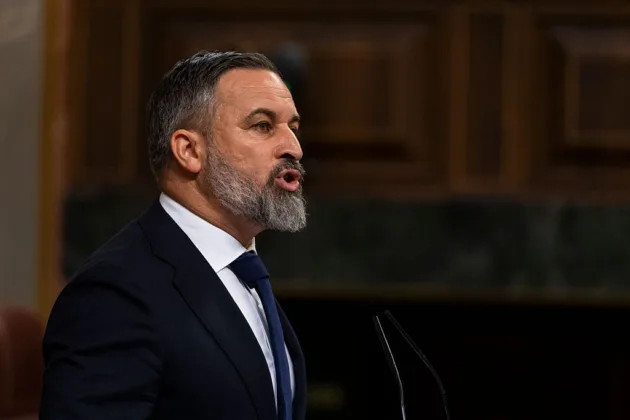









Vox leader Santiago Abascal has urged Spanish voters to stay alert and to distrust the opinion polls pointing to a right-wing majority at the general election on November 29.
Speaking on October 5 to Espejo Público, a morning programme on Antena 3, hours after Prime Minister Pedro Sánchez called the vote, Abascal said the contest would be highly uncertain whatever the surveys showed. He said he had learned not to count on a victory before it was delivered.
He drew the comparison with 2023, when polls also pointed to a comfortable majority for the People’s Party (PP) and Vox, and Sánchez went on to assemble a governing majority with his parliamentary allies.
The arithmetic of that election explains the caution. The PP took 137 seats and Vox 33, six short of the 176 needed for an absolute majority in the Congress of Deputies, and Sánchez returned to office with the support of Sumar, the Catalan and Basque nationalists and Bildu.
Abascal called on supporters to cast their ballots at the polling station rather than by post, saying he trusted nothing at present. Postal ballots in Spain are administered by the Electoral Census Office through Correos, the State postal operator, and their use reached a record in 2023.
Under Spanish electoral law, applications to vote by post must be lodged with the census office up to ten days before polling day and the ballots returned shortly afterwards. His appeal therefore lands at the opening of that window rather than at its close.
He has repeatedly suggested that postal voting, the naturalisation of immigrants and the citizenship route for descendants of Spanish emigrants known as the grandchildren law could distort the result, though he has produced no evidence of fraud.
The surveys he is warning against have been consistently favourable to his party. A 40dB poll published in September, the first of the legislature to put the right-wing bloc above 50 per cent, gave the PP 32.4 per cent and Vox 17.8 per cent.
That figure would be close to a doubling of the 12.4 per cent Vox took in 2023, when the party lost 19 of the 52 seats it had won four years earlier. Its recovery in the polls has been built largely on immigration and housing.
On what went wrong three years ago, Abascal said Sánchez and the PP had both worked to demonise his party. He added that the PP had treated the election as won, discussing pacts and ministries before polling day and demobilising its own voters.
He described his relationship with PP president Alberto Núñez Feijóo as cordial and businesslike, saying the two agreed on part of the diagnosis but probably not on the remedies.
The parties govern together in four regions: Extremadura, Aragón, Castilla y León and Andalusia, where their coalition was sealed in July. Those arrangements have not always held, as Vox withdrew its regional ministers from five coalition governments in July 2024 over the distribution of unaccompanied migrant minors.
That precedent will matter if the result on November 29 again obliges the two parties to negotiate. Abascal gave no detail on what Vox would ask in exchange for supporting a PP government, saying only that the two diverged on the remedies.
The sequence he describes also sets a standard that is difficult to meet. A right-wing bloc that polls above 50 per cent and still falls short of a majority in Congress would, on his account, have been beaten by complacency rather than by the electorate.
He then returned to Ceuta, saying Spaniards would go to the ballot box with the city invaded. He has called Sánchez the candidate of Morocco and treats the mass crossing of July 30 as the proof, arguing that the Spanish Government failed to defend the border, to return those who entered illegally or to confront Rabat.
Immigration is set to be central to the campaign on the Spanish right, and the two parties are competing for the same voters on it. The PP has hardened its own position on border control and residence requirements since the summer.
Abascal also pointed to the corruption investigations surrounding the Socialists, the Adamuz rail disaster of January 18 and the 2024 floods in the Valencia region. Taken together, they form the case he intends to put over the next eight weeks: that the administration has failed in security, in infrastructure and in public integrity alike.
Both halves of his message on October 5 push in the same direction. A supporter told the result is not yet secured is a supporter more likely to queue at a polling station, and a PP denied the presumption of victory is a weaker partner in whatever negotiation follows.