
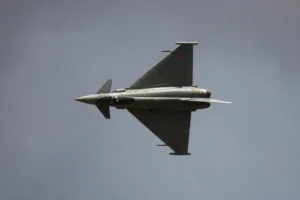


Airbus has said it could join the British-Italian-Japanese consortium building a next-generation fighter jet, four months after the collapse of the rival Franco-German programme in which it represented Germany and Spain.
Airbus chief executive Guillaume Faury told a media call on October 28 that joining the Global Combat Air Programme (GCAP) was a “potential” solution, although there were others. He said the German Government was in contact with other countries over possible partnerships.
Faury said Airbus was working closely with Berlin and Madrid on the future of the next-generation fighter, which he said had to be built in Europe and for Europe. “And we want to be part of that solution for Europe,” he said.
He added that the decision was one for governments to take, ideally in the near future.
France and Germany scrapped the manned fighter at the heart of the Future Combat Air System (FCAS) on June 8 after years of deadlock between Airbus and France’s Dassault Aviation over the division of work and the design of the aircraft. The project, launched in 2017 and joined by Spain in 2019, had been estimated to cost around €100 billion.
Dassault is now pressing ahead alone with the French state on a successor to its Rafale jet.
GCAP brings together the UK, Italy and Japan, with BAE Systems, Leonardo and Mitsubishi Heavy Industries as industrial leads. The three countries have already committed more than €4.7 billion ($5.5 billion) to the jet, which they aim to have in service by 2035, and Canada joined the programme as an observer in July.
British Prime Minister Andy Burnham said on October 8, after meeting German Chancellor Friedrich Merz in Berlin, that the UK was open to Germany joining GCAP. Merz has since confirmed during a visit to Japan that Berlin is weighing a role in the programme, Reuters reported.
Leonardo chief executive Lorenzo Mariani said in July that any country wishing to join GCAP would have to do so by the end of 2026. Japan, which needs the aircraft to replace its ageing F-2 fleet, has been reported to be wary of any newcomer delaying development.
A tie-up with Sweden’s Saab remains the main alternative for Airbus. Six Spanish defence companies, including Indra and the Spanish arm of Airbus, offered in June to help build a new European combat aircraft and said they would prefer a wider multinational effort.
The search for partners comes as Europe’s reliance on American military hardware is under scrutiny. The head of the German air force, Lieutenant General Holger Neumann, warned in July that Germany had no home-grown alternative to the United States on advanced combat aircraft.