





The European Commission has proposed a major overhaul of the European Border and Coast Guard Agency (Frontex), granting the Warsaw-based body unprecedented operational powers to coordinate deportations across the European Union and tripling its available personnel footprint.
Under the draft legislation unveiled on October 27, the Commission seeks to elevate Frontex from a supportive monitoring and coastguard outfit into the EU’s central hub for executing returns of individuals without legal residence.
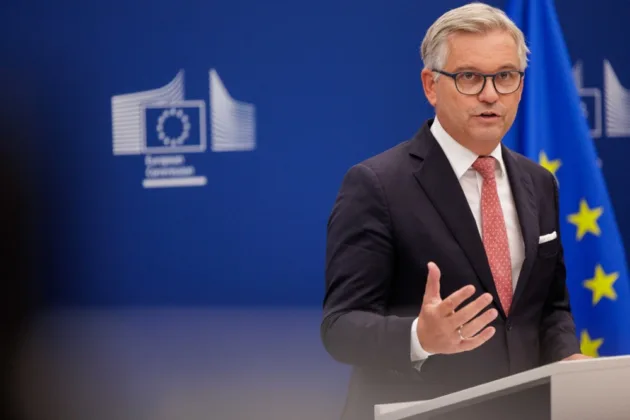
It was presented by European Commission Executive Vice-President Henna Virkkunen and Magnus Brunner, Commissioner for Internal Affairs and Migration.
Virkkunen spoke of a “new era” for Frontex.
She said: “If the Union wants secure borders, effective returns and credible crisis response, it needs superior situational awareness, faster information flows, stronger interoperability and better operational data management.”
Brunner said Frontex should deal with “everything from A-Z” around the topic of migration in the future.
“We can only uphold our freedoms if we protect our external borders effectively. That is why today, we propose a stronger Frontex. We must act before an event becomes a crisis; and it must be us to decide who can enter the EU, who can stay, and who must leave.”
The centrepiece of the package is the creation of a dedicated “EU Return Coordination Centre” within the agency.
This centre would oversee the expulsion process across its entirety, ranging from pre-departure identification and voluntary return counselling to chartering deportation flights and managing post-arrival reintegration programmes in countries of origin.
The mandate would also allow Frontex to organise returns directly between third countries, subject to bilateral agreements and, the Commission said, to fundamental rights and international standards.
This would allow officers to return illegal migrants before they attempt the crossing over the Mediterranean to Europe.
To execute the expanded remit, Brussels proposes expanding Frontex’s operational capacity to roughly 30,000 officers, against the 10,000 set as its target under the 2019 regulation.
This would be achieved by establishing a new 17,000-strong “European border and return reserve” made up of national guards who remain stationed in their home member states but can be mobilised rapidly during border emergencies or targeted return drives. The rest would come from doubling the agency’s own statutory staff and from the 7,000 officers already seconded by member states.
“Europe will always stand up for the protection of its borders. Europe decides who comes to our Union and under what circumstances,” European Commission President Ursula von der Leyen said, pitching the proposal as an answer to shifting migration dynamics and public pressure across member states.
The reform also includes measures intended to detect migratory surges earlier, spurred by recent mass crossing attempts in the Spanish enclave of Ceuta, on the North African coast, where thousands crossed from Morocco at the end of July.
These feature a new digital monitoring centre in Warsaw, tasked with scanning social media platforms for smuggling networks and disinformation, alongside a rapid-deployment crisis unit. The agency would also obtain “trusted flagger” status, obliging internet providers to give priority to its requests for the removal of illegal content linked to border-security risks. Deployment of the quick reaction force would be decided by the Frontex executive director at the request of a member state facing an emergency.
The proposal reflects a push by Brussels to address one of the EU’s persistent enforcement bottlenecks, the low rate of effective returns for rejected asylum seekers. Brunner put that rate at above 30 per cent this year, against about 20 per cent in 2025.
It accompanies a separate proposal to digitalise return, readmission and reintegration procedures, intended to support the new Return Regulation, which entered into force on October 16.
The initiative has, though, already drawn pushback from progressive lawmakers and human rights organisations, who argue the shift comes at the expense of independent accountability.
Italian MEP Cecilia Strada, of the Partito Democratico, said the plan would turn the agency into a copy of US President Donald Trump’s Immigration and Customs Enforcement (ICE). She objected to returns organised between third countries, which she described as “an unprecedented level of discretion”.
Campaign groups made similar arguments. The Transnational Institute described the reformed agency as a surveillance infrastructure and deportation body, while Equinox warned of a growing overlap between Frontex and Europol and of a weakening of the agency’s data-protection rules.
The legislative package will now head to the European Parliament and the Council of the European Union for formal negotiations, where member states seeking stricter external border enforcement are expected to clash with critics over funding, oversight and state sovereignty.
The European Commission has set out plans to make Frontex able to put officers on a crisis border within 24 hours. https://t.co/Mdg5tGE7Yl
— Brussels Signal (@brusselssignal) September 30, 2026