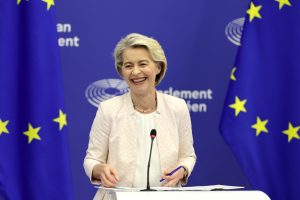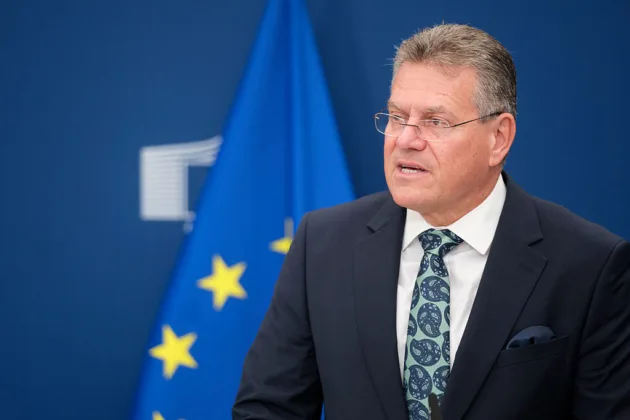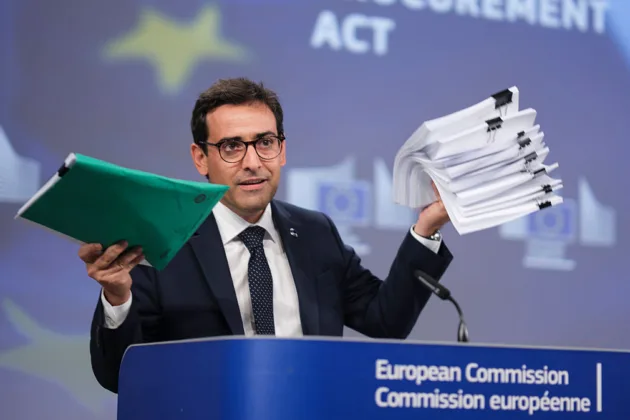
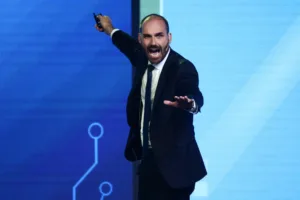


In a talk in Brussels, Ex-Commissioner and CDU nestor politician Günther Oettinger sounded highly critical for the economic policies of the European Commission under Ursula von der Leyen’s presidency.
At the event, organised by German media outlet Table.Talk and the Representation of the Free State of Bavaria to the European Union, the former Commissioner for Energy, digital economy and society, budget and HR between 2010 and 2019 said he was unhappy about the green policies dominating the Brussels agenda.
While acknowledging that the Commission had it’s merits in coordinating the responses on Covid and showed strong continued support for Ukraine, he stressed that the European economy and industry have suffered under seven years of von der Leyen.
Oettinger said it appeared that the EC President “doesn’t care about the economy”.
He stressed that in the last decade, the GDP of China has grown strongly, while the US remained stable, but the GDP of Europe dropped.
He said that Brussels was quick to promote green policies, but not the economy.
According to Oettinger, it was very difficult for company leaders to meet with Commissioners, unlike in Europe or the US, where it was very easy.
Asked by the moderator, Markus Grabitz, if there was any improvement in the second mandate of von der Leyen, Oettinger replied “Climate is important, but not the only thing.”
The former Commissioner noted that Berlaymont had promised a one in, one out approach in its omnibus packages, indicating better, less burdensome, standardised and more streamlined regulation.
Instead, it only delivered four in, one out and had continued to create regulation and especially has added huge reporting requirements.
Brussels did not succeed in cutting the excessive red tape around its economy, and it was a real problem, especially for the small and medium enterprises.
Unfortunately, he said, Germany has supported this trajectory.
Part of the problem, according to Oettinger, was the political front, where in case of a collision between climate and the economy, “politics should take the lead”.
Speaking about political leadership, Oettinger noted that former Commission Presidents José Barroso and Jean-Claude Juncker had an entire team work together, while now, under von der Leyen, Commissioners were working under von der Leyen, concentrating the power.
She selected less colourfull people around her and as a result of said concentration, the Commission doesn’t do much.
Oettinger also didn’t like the power struggle with Kaja Kallas, High Representative of the European Union for Foreign Affairs and Security Policy.
He said there were too many political fights, calling them “a waste of energy”.
Asked on how to stop Europe falling further behind, he noted that some progress was already being made, and that Europa has some strong assets, but that more needed to be done to make the EU less dependent on the rest of the world.
He called for a more common sense approach, suggesting that many countries won’t have the infrastructure for electric vehicles in the foreseeable time and Europe can continue to make combustion cars for them.
Oettinger also said that Europe won’t save the tropical forests via multilateral treaties.
Slapping protective tariffs on Chinese cars would be difficult as well, as countries make different types of cars across the EU, giving some incentives to keep Chinese cars out, while others had incentives to export their cars to China.
Another problem was the energy costs in Europe being way too high, including due to a lack of fracking.
Europe had also been to slow on the creation of an online platform economy, wanting to safe the shops in city centres, but leaving the online market to be dominated by American and Chinese giants.
Regarding the budget he said the ask of the Commission, over €2 trillion was too much. He said that a more modest €1.5 trillion was acceptable.
Though Oettinger admitted that European farmers needed subsidies to survive, he suggested to keep the subsidies in check by freezing them and said that there was no need for centralising the subsidies, as von der Leyen has demanded in her new budget plans.
Oettinger said that Germany should pressure Brussels more and that regions should stay important in Europe.
However, he also said that the revenues from ETS should go to Brussels.
Oettinger is a relevant voice for Brussels. Next to his long career in Brussels Before Brussels, he was Minister-President (state premier) of Baden-Württemberg (2005–2010), one of Germany’s most important and economically strong states.
The CDU politician has over 30 years experience in German politics and was close to Angela Merkel.
Günther Oettinger, who formerly served as the European Commissioner’s digital economy tsar, is reported to have become a consultant for Shein despite the online retailer facing several accusations regarding its working practices. https://t.co/6kmcuFEzH7
— Brussels Signal (@brusselssignal) August 21, 2024