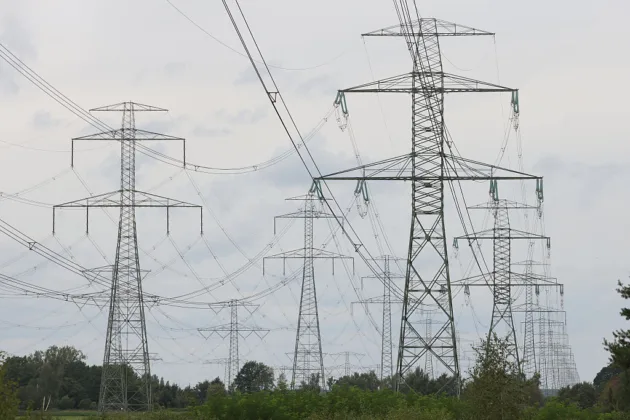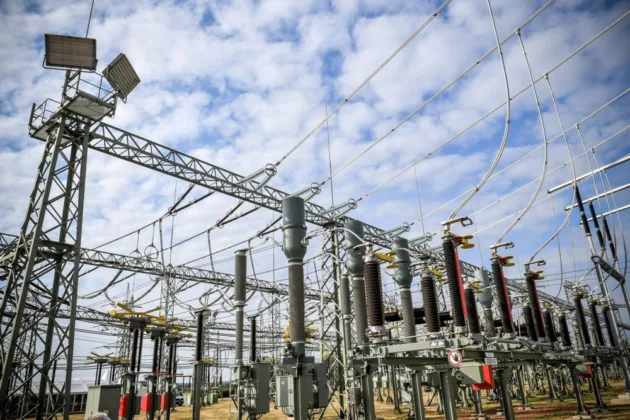






Improvised explosive and incendiary devices have been used against power lines at the Preilack substation in Brandenburg, eastern Germany, which feeds electricity from the nearby Jänschwalde lignite plant into the grid.
Police were alerted around 8am on September 1 after damage to a line.
Bomb-disposal teams found several homemade devices; at least one detonated, others did not. Nobody was hurt and there was no lasting blackout.
Grid operator 50Hertz said unidentified perpetrators damaged several lines; supply was interrupted only briefly.
It said the damage was attempted with homemade projectiles resembling shop-bought fireworks rockets, and that further projectiles which had not been launched were recovered at the site.
The installation, at Turnow-Preilack in the Spree-Neiße district, is a 380-kilovolt node in the extra-high-voltage network.
The Jänschwalde lignite-fired power plant ranks as one of the major brown coal plants in Germany, with a capacity of 1,500 megawatts, spread across three units.
It is due to close entirely at the end of 2028 under Germany’s coal phase-out law.
Plant owner LEAG called it “an attack” on the substation and said a unit at Jänschwalde suffered a technical failure, which it is checking for a link. The company identified the affected unit as Block B.
“The worryingly high frequency of such incidents shows that we must resolutely protect our infrastructures,” Brandenburg’s Minister-President Dietmar Woidke said.
He thanked the emergency services on site as well as the employees of the substation and power plant who had prevented worse through “their quick and prudent action”.
Reports that the site was shelled with rockets, published by the Märkische Allgemeine Zeitung citing security and company sources, go beyond what police have confirmed. Officers have described only small homemade devices.
The State criminal police office in Brandenburg has taken over. The site, about 100 kilometres southeast of Berlin, lies close to the boundary with Saxony.
At the request of the Frankfurter Allgemeine Zeitung, the police said on the afternoon of September 1 that traces were still being secured on site. “No information can be given about the background at this time.”
It is still unclear who is behind the attempted attack, and no group has claimed responsibility. Police have named neither a suspect nor a motive.
Recent attacks on German electricity infrastructure have come from more than one direction. In January this year suspected left-wing extremists set fire to high-voltage lines near a power station in southwest Berlin, cutting supply to about 45,000 households and more than 2,200 businesses, hospitals and care homes for days.
The find landed on the same day the federal government is set to blame Russia for the failed drone strike at Leipzig/Halle airport.
Interior minister Alexander Dobrindt and foreign minister Johann Wadephul were due to set out the findings on the evening of September 1. Bild reported that investigators had traced the operation to a Russian intelligence service, though the Government said on August 31 that a formal attribution would follow only once the investigation had closed.
On August 4 a drone carrying explosives was found on the apron beside Ukrainian Antonov freighters used for military cargo; it did not go off.
Further drones and traces of military explosive were later recovered nearby. Like today, a successful detonation could have caused a far more serious incident.
Berlin’s Governing Mayor Kai Wegner (CDU) has come under intense criticism after it emerged that he was playing tennis during a major power outage, despite publicly claiming he had been working “day and night” in the office to manage the crisis. https://t.co/gtBuTUgmC6
— Brussels Signal (@brusselssignal) July 8, 2026