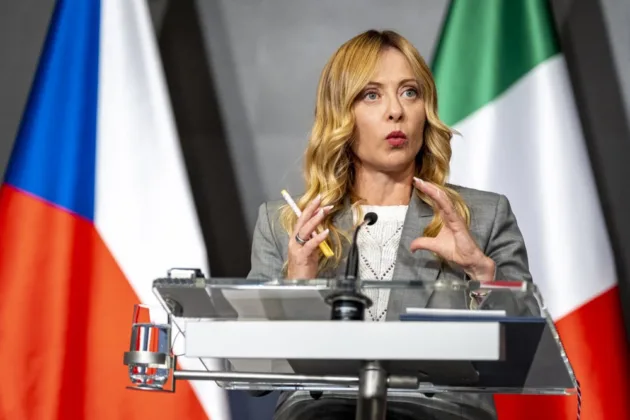

Italy’s cabinet has approved the draft 2027 budget law, an expansionary package of tax cuts and spending increases worth around €26 billion.
Signed off on October 28, the package is larger than the €23.5 billion outlined in the draft budgetary plan sent to Brussels in mid-October.
To help finance the measures, the government of Prime Minister Giorgia Meloni plans to raise taxes on banks, insurers, energy companies and the gaming industry.
This is the last full budget under Meloni, and her fifth, before national elections due next year.
The package is projected to lift Italy’s budget deficit to 3.4 per cent of GDP in 2027, above the European Union’s 3 per cent ceiling, from an expected 2.9 per cent in 2026.
By 2028 it should decline to 3.2 per cent, and to 2.3 per cent in 2029, according to the government’s public finance plan.
Roughly half of the additional spending, about €12 billion, is to be covered through the EU’s national escape clause for energy and defence-related outlays.
Pushing the deficit back over 3 per cent to 3.4 per cent in 2027, even under the guise of the escape clause, does test the European Commission’s tolerance under the reformed Stability and Growth Pact rules.
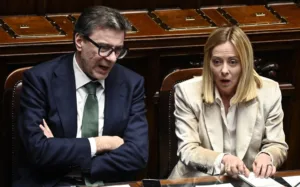
Economy minister Giancarlo Giorgetti said his aim had been “a serious budget” and that “this is a serious budget”. He added that talks with Brussels on the use of flexibility had gone “very well”.
Financial firms are expected to contribute around €5 billion.
Energy companies and the gaming sector are each expected to provide around €700 million.
The main measure for banks and insurers is an increase in the IRES corporate tax rate, rising from 27.5 per cent to 30.5 per cent for banks and from 24 per cent to 27 per cent for insurers.
Smaller and cooperative banks are to benefit from a €90,000 exemption threshold, which Meloni said would minimise or even cancel out the impact on them.
The government also plans to raise the financial transactions (Tobin) tax, doubling the rate on share purchases in larger listed companies from 0.2 per cent to 0.4 per cent.
Meloni said there had been no opportunity this time to reach a prior agreement with the financial sector, which she nevertheless thanked.
Deputy economy minister Maurizio Leo stated that the higher tax burden had been designed so as not to affect banks’ capital ratios.
Meloni added that she did not know whether to expect legal challenges from the affected firms, saying: “Frankly, I hope not.”
On the spending side, the budget aims to ease the tax burden for middle-income earners and the self-employed while increasing resources for the national health service.
Key measures include raising the upper limit of the second IRPEF income-tax band (taxed at 33 per cent) from €50,000 to €55,000, at an estimated cost of €1.2 billion and with a maximum benefit of €500 a year.
The ceiling for the 15 per cent flat-tax regime for the self-employed is set to rise from €85,000 to €100,000.
Other provisions include support for young people, measures for families and additional healthcare funding, such as a voucher for the elderly. The national health fund is set to rise by €3.4 billion to €146.3 billion in 2027.
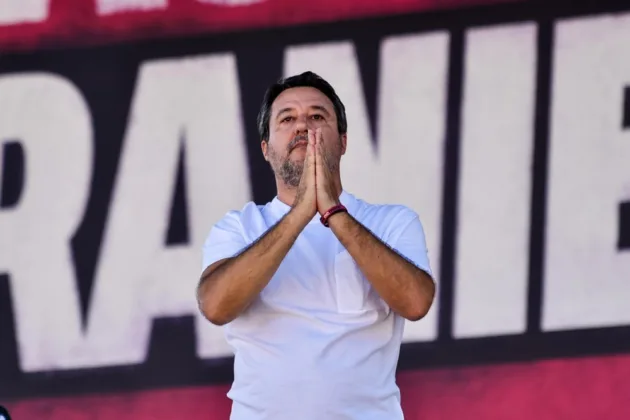
On pensions, the cabinet struck a compromise between Lega leader Matteo Salvini’s push to lower the retirement age to 64 and Giorgetti’s fiscal caution.
Rather than dismantling the 2011 Fornero reforms, the government allocated €850 million to finance a targeted, flexible early-retirement scheme with strict qualifying criteria, to be set by decree in January.
The package also includes a €300 healthcare voucher for pensioners aged 75 and over with incomes below €28,000 a year, at a cost of €1.6 billion. It also includes a demographic initiative that deposits €100 annually into a dedicated pension savings account for every child born from 2027 until adulthood.
Many of the tax reliefs are currently planned only for 2027, leaving decisions on their extension to the next government.
The draft law now moves to parliament for approval, which must come by the end of the year.
The Italian Banking Association (ABI) has previously opposed additional levies on the sector, noting earlier agreements on contributions. Its president, Antonio Patuelli, said in mid-October the new contribution had not been agreed in advance.
Within the governing coalition, Salvini has been among the strongest advocates of higher taxation on banks, while Forza Italia has expressed reservations.
The measures follow earlier contributions from the financial sector in previous budgets and come amid ongoing discussions with the European Commission on the use of flexibility under the EU fiscal framework.
Antonio Misiani, the centre-left Democratic Party’s (PD) economic policy lead, described the package as “an end-of-term mini-budget made up of electoral measures, a huge increase in military spending and IOUs worth billions left for the next government”.
He said each coalition partner has its own “flag” to wave, but “the country will pay the bill”.
Misiani said healthcare funding fell well short of requests from the health minister and regional presidents.
PD Senate group leader Francesco Boccia similarly labelled it an electoral budget whose costs would fall on whoever governs afterwards.
Nicola Fratoianni, leader of Italian Left (Sinistra Italiana), highlighted the “war bill that Italians will have to pay”.
Europa Verde co-leader Angelo Bonelli called it a “war budget” that invests €4.6 billion in weapons. He advocated a “social bill” to reduce energy burdens for vulnerable households.
Italy is already subject to the EU’s Excessive Deficit Procedure (EDP). In September, the national statistics office Istat revised Italy’s 2025 deficit to 3.1 per cent of GDP, above the threshold for leaving the procedure. The Commission is due to confirm Italy’s status in November.
Italian Prime Minister Giorgia Meloni has asked the European Commission for further leeway in the bloc’s fiscal rules, on the day Istat, Italy’s national statistics institute, put Italian inflation at 4.2 per cent, up from 3.3 per cent in August.https://t.co/Blq1kmcTim
— Brussels Signal (@brusselssignal) October 2, 2026