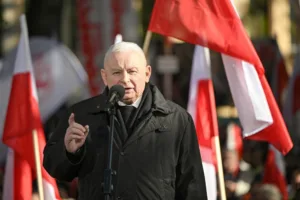


The leader of Poland’s largest opposition party, Law and Justice (PiS), Jarosław Kaczyński has said there is a need for radical change in the EU that may require a coalition of willing countries to sign a treaty between them with a deferred date for introduction. Failing that, he said, they could proceed to activate the article of the present EU Lisbon Treaty that begins the process of leaving the community.
Kaczyński admitted that any change within the EU is a long and drawn-out process that has to be started. He suggested that member states that want change could sign a treaty “of the kind we want, with a deferred date for activation” that would radically constrain the powers of Brussels over the member states.
In order to force that change, Kaczyński believes willing member states may have to use the existing machinery contained in the Lisbon Treaty, such as Article 50, which provides a framework for the process of leaving the EU.
“We have a clause in the EU treaty which determines the process of leaving the EU. It begins with a process of negotiation which could be started.”
Bearing in mind how, during the process of Britain leaving the EU, the timetable envisaged proved too short, Kaczyński acknowledged the problems involved with the course of action he was considering but felt it was worth the risk. The UK triggered Article 50 on March 29, 2017 and the two-year negotiating period it set out had to be extended three times before Britain finally left on January 31, 2020.
“This would be a hard and risky course of action, but things are now at a very low ebb inside the EU and it may be worth applying such methods if others do not bring results.”
The PiS leader made his remarks during an address to the Krynica Forum, held in the spa town of Krynica-Zdrój in southern Poland, on October 28 on the need for EU reforms. He argued that the community’s current structure was holding back economic growth, but that change could be on the way in the politics of several EU member states and that this could be translated into change in Brussels.
He was alluding to the fact that four of the five largest EU countries (Spain, France, Italy and Poland) are due to hold general elections by the end of 2027, in which governments may emerge that favour radical change within the community towards transferring power towards member states and away from EU institutions such as the European Commission, the European Parliament and the European Court of Justice.
Kaczyński pointed to a “window of opportunity” that he believes may be opening in both France and Germany, the EU’s largest and most powerful states, where parties that support change in the EU are beginning to dominate public debate.
“A window of opportunity has now opened for this to change. Nothing has changed yet, but it could. France and Spain could have governments completely different from those they have had so far. Italy’s government could be freed from certain constraints, not to say shackles, and Poland’s government could also change. Germany’s government could change as well, although from our perspective, that is a much more ambiguous prospect,” he said.
Germany’s most popular political party, Alternative for Germany (AfD), which leads national polling with about 28 per cent according to the DAWUM polling aggregate of October 27, is seen by many in Poland as a potential threat to Polish interests and sensitivities because of its unwillingness to discuss Second World War reparations and its desire for closer relations with Russia.
In his speech Kaczyński argued that Europe was falling behind the United States.
“Not so long ago, in terms of GDP, Europe was slightly ahead of the US but now there is a very substantial gap in America’s favour amounting to $10 trillion per annum, a very significant difference,” he said.
World Bank estimates put US output in 2025 at $30.8 trillion against $21.2 trillion for the EU, a gap of roughly $9.5 trillion (€8.2 trillion). On the same figures, the last year in which the EU’s economy was larger than that of the US was 2011.
Kaczyński said that Europe should examine the reasons behind this development and take steps to unlock its economic potential. He argued that the EU’s current political framework was playing a significant role in the problems the continent was experiencing.
“A very substantial proportion of the causes of our malaise are rooted in Europe’s present political structure, the foundation of which is the EU and it is the union which needs to change,” he said.
The PiS leader acknowledged that his view is not held by Europe’s current political elites but felt the situation could soon change, creating conditions for a serious debate about the EU’s future in the coming years if there are changes of government in key states.
In the same speech, according to Polish media reports, Kaczyński described the European Commission as the main source of the EU’s problems and said it should be replaced by the European Council, the body made up of the member states’ heads of government. He also called the current European Parliament a “parody of a parliament” and suggested MEPs could be replaced by deputies delegated from national parliaments.
Kaczyński, who co-founded PiS with his twin brother Lech in 2001 and has chaired it since 2003, supported Poland’s accession to the EU in the 2003 referendum whereas other parts of the Polish right did not.
The reason why Kaczyński and his party supported accession at the time related to their view that Poland needed to be a part of all Western structures and that the accession treaty and the Polish constitution protected the country from any interference from the community on axiomatic issues such as family law.
The Polish Catholic Church, influenced by the Polish Pope John Paul II, likewise supported Polish accession to the EU as it was assured that the EU would not have any say in policies Poland adopted on abortion, same-sex marriage or other cultural matters.
Soon after Poland joined the EU in 2004, though, a debate began over the Lisbon Treaty. The treaty provided mechanisms for EU institutions to sanction member states for being in violation of EU values such as human rights, which those institutions began to interpret as containing rights to abortion and same-sex marriage. It also asserted the supremacy of European law over domestic legislation.
Kaczyński, when he became Polish Prime Minister in July 2006 leading a coalition government with the radical agrarian Self-Defence party and the Catholic nationalist League of Polish Families, agonised together with his brother Lech Kaczyński, who was President at the time, over whether to accept the Lisbon Treaty, which they feared was opening the door to more power for Brussels.
In the end they agreed to approve the Lisbon Treaty as in the early years of membership of the EU Poland did not feel strong enough to “go it alone” in resisting a major treaty and because the country did not want to complicate its relations with Brussels at a time when it was benefiting from substantial EU structural and cohesion funding. The treaty was signed in December 2007 by the incoming government of Donald Tusk, and Lech Kaczyński, who delayed ratification until after Ireland’s second referendum, formally ratified it on October 10, 2009.
Kaczyński’s fears about what the Lisbon Treaty might lead to were realised during his party’s next spell in office (2015-2023), when both the European Commission and the European Court of Justice took issue with the PiS government’s judicial reforms. Brussels also put pressure on Poland over faster action to reduce reliance on coal, as well as attempting to make Poland support the relocation of illegal migrants. In April 2020 the ECJ ruled that Poland, Hungary and the Czech Republic had broken EU law by refusing to take part in the 2015 relocation scheme.
Despite later admitting that Poland had been right to resist illegal migration, when the country stopped the wave of illegal migrants being pushed through on the Polish-Belarusian border, and despite Poland’s support for Ukraine immediately after the invasion of that country by Russia, in 2022 the European Commission froze Poland’s post-pandemic EU funding, worth some €35 billion, tying its release to rule-of-law “milestones”. The money did not begin to flow until 2024, after the change of government in Warsaw.
That decision taken by the EC was seen by PiS as its open backing of the liberal opposition led by Donald Tusk, the man who led Poland’s government (2007-2014) before becoming President of the European Council (2014-2019) and who returned to the post of Prime Minister in December 2023 after a general election on October 15 of that year in which PiS lost its parliamentary majority.
After Karol Nawrocki narrowly won the presidential election on June 1, 2025 with PiS backing, the Polish right feels that it may turn Tusk’s centre-left coalition out in the parliamentary elections due in autumn 2027.
Bearing in mind its fraught relationship with Brussels in its last spell of government, PiS is discussing what strategy to adopt towards the EU institutions should it return to power. Kaczyński’s speech seems to be indicative of a desire for collective action with other countries as a means towards reform, as he realises that Poland on its own cannot resist the Brussels juggernaut.
The political move of admitting that threatening to leave the EU could be used as a tactic seems to be a move towards the voters that have in recent months deserted PiS for the right-wing Confederation of the Polish Crown (KKP), led by MEP Grzegorz Braun, which openly favours Poland leaving the EU. An IBRiS poll for Polsat News published on October 20 put PiS on 19.1 per cent and KKP on 11.4 per cent, behind the governing Civic Coalition (KO) on 27.8 per cent.
Prime Minister Tusk responded on X on October 29, saying Kaczyński had announced that Poland should begin negotiations on the terms of leaving the EU. A “hard fight” was under way, he wrote, and he did not intend to lose it. Several KO MEPs accused the PiS leader of openly talking about “Polexit”.
Such a move, though, could alienate PiS from large parts of the electorate which, while opposing Poland joining the eurozone and EU climate and migration policies, do not wish to see “Polexit” as they like the access to markets, European funds and the free movement that EU membership offers.