








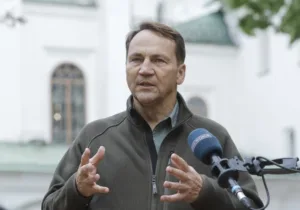

Poland’s opposition Conservatives (PiS) aligned President Karol Nawrocki has said that his country should tackle its demographic crisis by supporting families rather than relying on mass migration.
Speaking at the Poland Future Summit event in Warsaw on June 22 Nawrocki argued that migration had failed to solve demographic challenges in Western Europe but simply created social and economic problems with which these countries are now struggling.
He said both Poland and the rest of Europe were facing a demographic crisis marked by declining birth rates and an inability to replace aging generations.
Nawrocki argued that many Western European countries had responded to demographic decline by turning to immigration, a policy he said had failed to resolve underlying population problems.
“When a demographic crisis emerges, migration pressure follows,” he said.
“Migration pressure in Western Europe has not solved the problem but has brought ghettoisation, integration challenges and social unrest,” he added.
“That is not and will not be the Polish path,” Nawrocki told the gathering. “We will not address the demographic crisis by yielding to migration pressure.”
Instead, he said, Poland should focus on supporting families and creating legal and economic conditions that encourage people to have children.
The President also called on businesses to help employees balance work and family life, while warning against excessive regulation that could hamper economic activity.
He further argued that cultural changes and growing individualism had contributed to falling birth rates across Europe and said the continent was also facing what he described as a “crisis of masculinity”.
Nawrocki noted that Poland recorded about 160,000 more deaths than births last year, a population loss equivalent to a mid-sized city.
“We must make every effort to stop the worsening demographic problem in Poland and across Europe,” Nawrocki said, calling for cooperation among policymakers, businesses and civil society.
The President warned that demographic decline could have serious consequences for economic growth and national security and demanded that politicians and policy makers address the issue.
Nawrocki said one of his first legislative initiatives after taking office last August was a proposal to exempt parents with two or more children from personal income tax and expressed his regret that the measure had failed to be debated by Poland’s parliament in which the centre-left government led by Prime Minister Donald Tusk enjoys a majority.
He also welcomed what he described as broad political support he has received for raising the threshold at which higher income tax rates apply, saying such measures could help create conditions favourable to larger families.
“Given the consensus in parliament, I do not understand why the government is not taking up this initiative,” he said, pointing to the Tusk government as the reason.
The legislation Nawrocki was referring to has been blocked by Tusk’s Civic Coalition (KO) and the Left party, despite the fact that the centrist Poland 2050 and the centre-right Polish People’s Party (PSL) support the measure.
Those two parties together with the opposition PiS and Confederation parties would have a majority in Parliament to approve such legislation but it has been blocked by Włodzimierz Czarzasty, the Speaker of Parliament as well as the leader of the Left party.
His remarks have come at a time when Polish policy makers and planners are alarmed at forecasts coming from the country’s own central statistics agency (GUS).
The agency forecasts that the current record low birth rates are set to continue with calculations showing that Poland’s population could fall to under 30 million down from Poland’s current population level of 37.4 million.
In recent years, Poland’s fertility rate, the average number of children that are born to a woman over her lifetime, has been markedly below the assumptions used in previous projections on the size of the population.
Between 2000 and 2017, the fertility rate fluctuated between 1.22 (in 2003) and 1.45 (in 2017) and in subsequent years, it declined steadily, reaching 1.1 in 2024, the lowest level ever recorded in Poland and one of the lowest levels in the world.
Poland’s worsening demographic situation has been at the centre of public debate for years, with various governments trying to address the issue.
However, a range of state incentives such as the introduction of universal child benefit which amounts to €200 per child per month and recently renewed state funding for IVF treatment have failed to make any impact on the continuing demographic slide.
Analysts say that economic insecurity, limited access to affordable housing, job insecurity (millions of Poles are self-employed or on zero hour contracts) and women wanting and in many cases having to go out to work are major contributory factors to the decline.
The inflow of over a million Ukrainians and hundreds of thousands of migrants from Asia has partly softened the decline in the population. Poland has for the past few years been recording some of the highest migration inflows in the EU but GUS does not believe that in the long term it can do enough to avert a major demographic decline.
A report from the Polish Economic Institute (PIE) in 2025 warned that by 2035, the number of workers in the country could decrease by 2.1 million (12.6 per cent of the current workforce).
This decline will have far-reaching implications for key sectors, including education, healthcare, industry, and agriculture. If this trend continues, the Polish economy could experience a 6-8 per cent drop in GDP, according to PIE’s projections.
The most significant losses are expected in industry, where the workforce could shrink by 11 percent, and in education and healthcare, which are forecast to see declines of 29 per cent and 23 per cent, respectively. These sectors are particularly vulnerable because younger generations entering the labour market will not be sufficient to replace the workers exiting due to retirement.
Experts point to the fact that many of the migrants may leave Poland when the job situation changes as a result of either economic downturns or technological changes such as the introduction of robotisation and Artificial Intelligence.
There is growing political consensus in Poland over the country avoiding the western experience of rapid migration from culturally divergent sources.
PiS and Confederation parties are both now categorically opposed to mass migration, even though PiS when in office presided over a significant inflow of labour from foreign countries.
That inflow has actually been reduced under the present centre-left Tusk government and illegal migration has been effectively stopped at the Polish border with Belarus by Poland refusing to take any asylum claims and by fortifications preventing illegal entry.
The problem with the issue of demographic decline is that its economic and social impact is still some years away and therefore does not figure in short and medium term electoral calculations of the country’s political parties.
President Nawrocki’s stance is unlikely to change the logic of electoral politics as the 2027 parliamentary elections come into view.