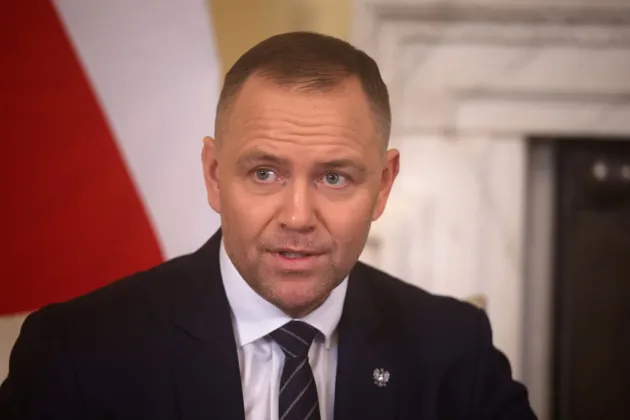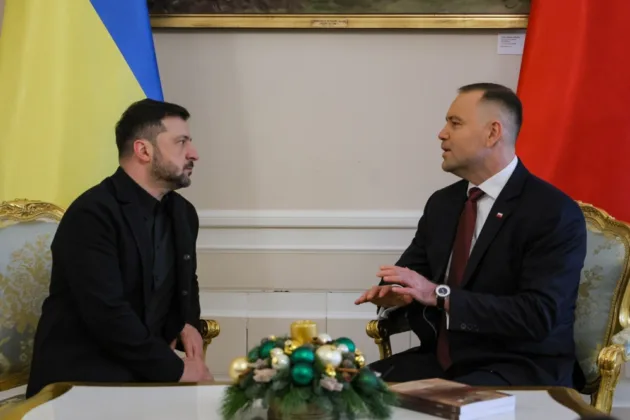





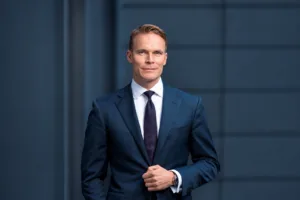
Polish President Karol Nawrocki rescinded a top Polish honour given to Ukrainian President Volodymyr Zelensky in retaliation against Ukraine’s head of state honouring the nationalist Ukrainian insurgent army (UPA) which was responsible for ethnic cleansing of Poles.
In doing so Nawrocki warned Ukraine that its cult of nationalist leaders would block the country’s accession to the EU.
Zelensky immediately sent back the Polish Order of the White Eagle and was later joined by other Ukrainian present and past politicians sending back their honours from Poland as relations between Poland and Ukraine sank to their lowest level for decades.
Polish President Karol Nawrocki decided on June 19 to rescind the Polish order of the White Eagle granted to Zelensky by the previous Polish President Andrzej Duda as thanks for Ukraine’s effort in resisting Russia.
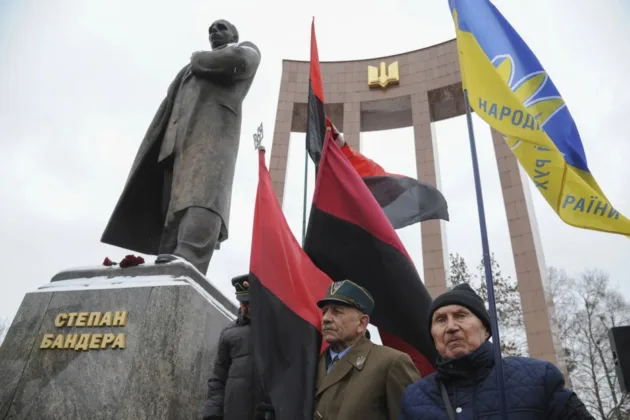
Nawrocki’s action came in protest at Zelensky’s decision of May 26 to name a crack unit of the Ukrainian forces in honour of the Ukrainian Liberation Army (UPA)) which was responsible for leading the ethnic cleansing of Poles in western Ukraine that led to the Volhynia massacre during the Second World War in which over 100,000 civilian Poles were brutally slaughtered.
Ukrainians view UPA as a liberation army against the USSR whereas Poles see it as an anti-Polish force and one which collaborated with the German Nazis to fight the Soviets.
The Ukrainian authorities claim that it was their soldiers who requested the title of their unit to honour the UPA had anti-Russian rather than anti-Polish intent.
Tensions over the wartime killings have periodically strained relations between Warsaw and Kyiv, despite Poland’s strong political and military support for Ukraine since Russia’s full-scale invasion in 2022.
Poland has officially recognised the massacres as a genocide but Ukraine rejects that interpretation and argues that the massacres took place in the context of long-standing anti-Ukrainian policies by the pre-war Polish state and that Polish partisan units massacred Ukrainian civilians during the war.
The Polish President had announced at the end of May that he was considering removing Zelensky’s honour, describing Kyiv’s decision as glorification of “bandits and murderers from the UPA”.
That led to some moves by the Ukrainian administration to make moves to defuse the situation. The head of Zelensky’s office, Kyrylo Budanov, visited Poland for talks with Nawrocki’s staff and the Polish government in an effort to find a solution.
However, there was no diplomatic breakthrough, with Poland insisting that Ukraine must rename the unit, something Kyiv has so far been unwilling to do and therefore Nawrocki decided to announce his decision to rescind the honour granted to Zelensky.
“Facts are not subject to negotiation; they do not change with political circumstances or necessities,” said Nawrocki in his announcement. “The facts are that at least 100,000 Polish citizens were murdered by the UPA.”
“They were not soldiers on the battlefield. They were defenceless civilians. They were murdered brutally and savagely,” said the Polish president, who is an academic historian by training and previously headed Poland’s state Institute of National Remembrance (IPN).
“That is why the Ukrainian authorities’ decision to glorify the UPA is not only outrageous. It is also incomprehensible and deeply disappointing. It hurts not only our historical memory. It also undermines the trust built up over the years. It strikes at the very foundation of reconciliation.”
However, Nawrocki added that the decision was not directed against the Ukrainian people and does not change Poland’s strategic security policy.
“I want to emphasize that this decision is not against the Ukrainian nation. It does not change the strategic direction of Poland’s security policy. We have supported and continue to support Ukraine, because we know that Russian aggression poses a threat to Poland and all of Europe,” he said.
Nawrocki then warned Ukraine that its “path toward European structures also requires a willingness to honestly confront the difficult chapters of its own history.”
He said: “A united Europe was built on the rejection of totalitarianism and the cult of violence. For those who do not understand this, there can be no place in the European Union, and Poland will certainly not allow it.”
Ukraine on June 15 opened the first phase of accession talks with the European Union, marking a key step in Kiev’s long-term effort to join the bloc as it continues to defend itself against Russia’s invasion.
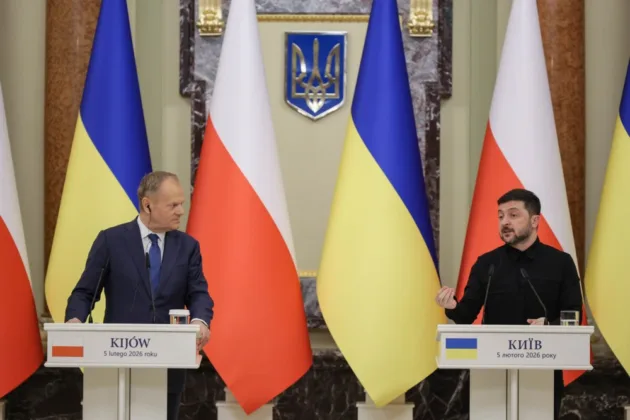
Polish Prime Minister Donald Tusk, who met Zelensky in Brussels on June 18 and was told by the Ukrainian President that it was not the intention of Ukraine to offend Poles, criticized Nawrocki’s decision.
“The conflict between Poland and Ukraine delights Putin and shocks our allies. Both President Zelensky and Nawrocki should be engaged in cooling emotions rather than escalating them. The frontline is somewhere else”, said Tusk in an allusion that Poland and Ukraine were allies against Russia.
However, the Polish PM, who leads the country’s centre-left government did not block Nawrocki’s decision by refusing to counter-sign it, feeling that since most Poles are outraged by Zelensky’s actions he should not be blocking the President’s retaliatory measure, even if he has reservations about it. Nawrocki is allied to the opposition Conservatives (PiS).
Polish government sources have said that Nawrocki’s move risked deepening tensions between Poland and Ukraine just days before a major conference on Ukraine’s reconstruction is due to take place in the northern city of Gdańsk.
Zelensky in any case preempted Tusk blocking of Nawrocki’s decision by posting a photograph of himself sending a parcel to Nawrocki with the order of the White Eagle inside and stated that “Ukraine remained open to all formats for engaging with Poland in order to avoid conflicting interpretations of our difficult past history.”
But he made clear that he was offended by Nawrocki’s action.
“The Polish President yesterday emphasized that the Order of the White Eagle was no ordinary honour but a symbol of the highest trust and close ties with Poland and its citizens. Poland has in the past awarded this honour to Russia’s Catherine the Great, Benito Mussolini and German Chancellor Gerhard Schroeder, but who are we Ukrainians to quarrel with that.”
Zelensky also said that when he had been awarded the honour in 2023 by Polish President Andrzej Duda he interpreted the honour as being one for Ukraine and its army rather than just himself.
Three past Ukrainian presidents; Leonid Kuchma, Victor Yushchenko and Petro Poroshenko also returned their Polish honours in protest at Nawrocki’s decision.
Reacting to the decision, Ukraine’s Foreign Minister Andrii Sybiha said stripping Zelensky of the honour was “a strategic mistake” by Nawrocki, “from which only Moscow will benefit”.
Sybiha added that, in response to the announcement, he would also return to Warsaw the Commander’s Cross with the Star of the Order of Merit of the Republic of Poland, another high Polish honour he received in October 2022.
“It’s not about decorations, but about attitude. We have always advocated an approach based on mutual respect — even when it comes to difficult and sensitive issues. This means respecting each other’s decisions even when we disagree with them,” he added in a post on social media.
According to Polish geopolitics expert Marek Budzisz, Ukraine is not overly concerned about Poland’s hostility with regard to past history and that it does not believe that Poland is likely to block its EU accession.
“The Ukrainians believe that when push comes to shove Poland will do as the US and Berlin tell it to.”
However, this may be wishful thinking. Polish politicians of all parties have said that they would not approve swift Ukrainian accession to the EU if the country continued to glorify its nationalists.
Poland is also concerned that too quick an accession of Ukraine into the EU would be a threat to Polish interests with regard to agriculture, road haulage and distribution of future EU funds.
The calling of relations is also feared to have implications for the large Ukrainian minority of over a million who reside in Poland. Tensions have already arisen over Ukrainians access to Polish welfare benefits and the health system and about young Ukrainian men engaging in criminal gangs in Poland rather than fighting for their country against the Russians.
The honeymoon in relations which occurred after the Russian invasion with Ukrainians being welcomed into Polish homes and Poland giving huge military and humanitarian aid to Ukraine lasted only until 2023.
Disputes over history and economic interests and resentment about allegedly privileged treatment of Ukrainians in Poland has effectively put a handbrake on the reconciliation.