







United States President Donald Trump has declared the Strait of Hormuz “open” and announced that Washington will collect a 20 per cent charge on all cargo crossing the strategic waterway, positioning the US as its self-appointed “guardian”.
“The Hormuz Strait is OPEN, and will remain OPEN, with or without Iran,” Trump wrote on his Truth Social platform on July 13, saying Washington was reinstating a blockade aimed only at Iranian ships and their customers.
He said the US would be reimbursed at a rate of 20 per cent on all cargo shipped to cover the cost of securing the route. US Central Command said the blockade of Iranian ports would resume on July 14.
The strait carries about a fifth of the world’s seaborne oil, and crude prices rose after the announcement. Iran had already declared the passage closed as the standoff sharpened. The war began in late February when the United States and Israel launched a joint assault on Iran, and shipping through Hormuz has been disrupted for much of the period since.
Earlier, in a call to Fox News, Trump said the country would “probably run it”, describing the US as the strait’s guardian and claiming Iran had walked away from a settlement.
The move drew an immediate rebuff from Brussels. The European Union, which relies on Hormuz for much of its energy, insisted the waterway stay open and toll-free, laying bare how far its dependence outstrips its ability to shape events in the Gulf.
Tehran has rejected the move. A spokesman for the Khatam al-Anbiya Central Headquarters, a joint command of Iran’s armed forces, said the country would not allow Washington to “interfere in the management” of the strait, the state news agency IRNA reported.
Iran’s forces would respond severely to any disruption of merchant and tanker traffic outside routes it had designated, the spokesman said. The command also warned that logistical support for the American military would be treated as an act against Iranian sovereignty.
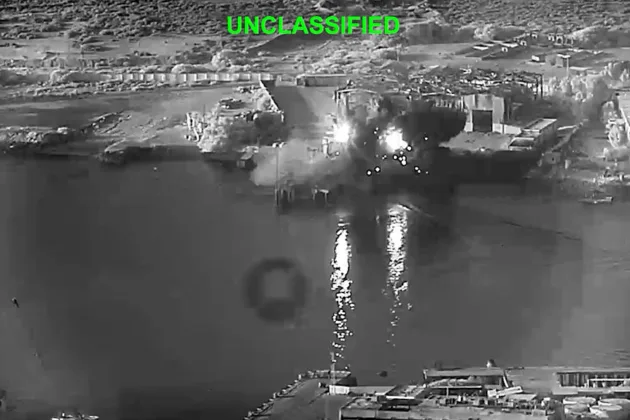
The exchange followed renewed American strikes. CENTCOM said it hit more than 80 targets across Iran on July 7 in response to attacks on commercial vessels, striking air-defence systems, coastal radar and Revolutionary Guard boats. A further round on July 11 followed an Iranian attack on the Cyprus-flagged container ship GFS Galaxy.
BRUSSELS DEMANDS A TOLL-FREE STRAIT
Brussels has pushed back, though only with words. The bloc’s foreign policy chief Kaja Kallas said the strait had to stay open to shipping and free of charges, hours after Trump’s announcement.
“Before the war, the Strait of Hormuz was open to shipping without tolls,” Kallas told reporters after a meeting of EU foreign ministers in Brussels. She said navigation had to be unimpeded and that Iran must never obtain a nuclear weapon.
Kallas said Iranian attacks on commercial shipping breached international law and the memorandum of understanding underpinning a fragile ceasefire. She condemned Iranian strikes on Gulf states and warned that the region was caught in a dangerous cycle of attack and counterattack.
The high representative also pointed to the EU’s Red Sea naval mission, Aspides, launched in early 2024 to protect merchant shipping from Houthi attacks, as a continuing contribution to maritime security. She said she would travel to the region to inspect it.
The charge drew objection beyond Europe. The United Nations’ International Maritime Organization opposed transit fees for the strait, and maritime regulators, along with some of Trump’s own administration, have said such levies breach international law.
EUROPE’S LIMITED LEVERAGE
The EU depends on Hormuz for a substantial share of its energy imports, yet has no naval force in the Gulf capable of enforcing the free navigation its ministers demand. Aspides operates in the Red Sea, and member states including France and Germany have hesitated to commit warships to the strait itself.
The bloc welcomed the US-Iran framework agreed in June and has repeatedly called for a toll-free reopening of the waterway. European Commission President Ursula von der Leyen, European Council President António Costa and Kallas each backed that deal, which Trump and Iranian President Masoud Pezeshkian signed on June 17 before it unravelled.
The truce has broken down repeatedly since, each pause strained by clashes over the strait.
Critics on both sides question whether Washington can deliver what it now charges for. David Goldwyn, a former US State Department energy envoy, called the levy “quite an extortionate level” and doubted the US could guarantee safe passage after weeks of disrupted traffic. Tanker movements had slowed to a trickle as the fighting resumed, undercutting any promise of protection.
Gulf capitals have also resisted any settlement that hands control of the waterway to a single power. Majed al-Ansari, an adviser to Qatar’s prime minister, said there would be “no agreed deal that hands over the Strait of Hormuz”.
The confrontation leaves European governments, among those most exposed to the closure, watching a chokepoint on which their economies depend become the prize in a contest between Washington and Tehran, with the bloc able to issue statements but little else.