




State-owned Électricité de France (EDF) has taken three nuclear reactors offline and cut output at several others as a third heatwave of the summer has pushed French river temperatures beyond their legal cooling limits.
The reactors — Golfech Unit 2, Bugey Unit 3 and Chooz Unit 2 — have a combined capacity of about 3,650 megawatts (MW), close to 6 per cent of France’s roughly 61 gigawatts (GW) of nuclear power. They sit on the Garonne in southwestern France, the Rhône near Lyon and the Meuse near the Belgian border.
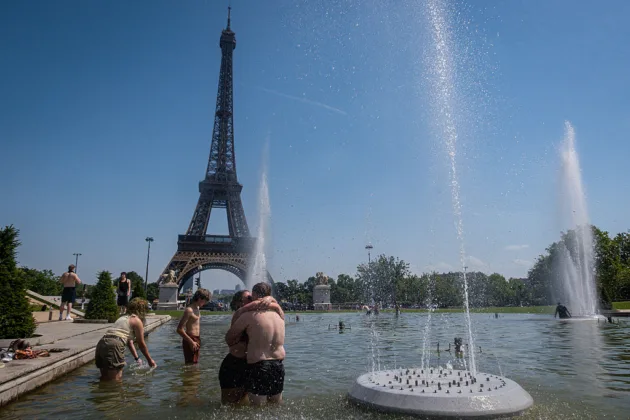
France placed most of its departments under a red heat alert as temperatures topped 40°C, the hottest spell of a summer that has already brought two earlier heatwaves.
EDF said the shutdowns were an environmental measure to avoid returning overly warm water to rivers already heated by the weather, not a response to any operating fault. It said the reactors could keep running in high temperatures and that the discharge limits existed “to protect aquatic flora and fauna”.
French law caps how warm the water leaving a plant may be, to shield fish and other river life. At Golfech, the Garonne must stay below 28°C once cooling water is returned. EDF tracks river temperatures continuously and trims output as the ceiling nears, stopping a reactor outright if the water keeps warming.
France’s nuclear safety regulator granted the Bugey plant on the Rhône a temporary exemption, valid until July 20, to safeguard electricity supply. The measure limited the warming allowed between the water entering and leaving the plant to 1°C.
A further eight reactors, most of them on the Rhône, have run at reduced rates rather than shutting down altogether.
Nuclear power has supplied about 65 to 70 per cent of French electricity in recent years, and grid operator RTE said the country had enough capacity to meet demand. By July 13 the curtailments had trimmed output by about 6.4 GW, though France remained a net exporter, sending more than 10 GW to its neighbours. The only country feeding power the other way was Spain, where strong solar and wind output supported the flow northwards. Analysts said the lost nuclear generation, combined with weaker hydropower in the dry conditions, would keep spot electricity prices firmer across the region.
EDF said that since 2000, hot water and low river flows had cost the fleet an average of 0.3 per cent of its yearly output. The company disclosed earlier in 2026 that it would spend €8.7 billion over 15 years to adapt its plants to a warming climate. One option under study is to cool the water drawn off from existing cooling towers before it is discharged, a system already running at the Civaux plant.
A REGULATORY LIMIT, NOT A TECHNICAL ONE
The constraint stems from France’s reliance on river water for cooling and from national discharge rules, rather than from the reactors themselves. In neighbouring Spain, where summers run hotter, reactors have kept operating through the same heatwave.
Spanish industry body Foro Nuclear said the country’s plants were built for high heat, using cooling towers, seawater or closed-loop reservoirs so that warmed water is not tipped straight back into a river. Ascó, Cofrentes and Trillo draw on rivers but cool the water in towers first, while Vandellós II runs on the Mediterranean. Almaraz relies on a purpose-built reservoir that works as a closed loop, independent of any river’s flow or temperature.
Spain’s seven reactors, which supply about a fifth of national electricity, did not have to cut output during the heat, the body said.
THE US DESERT
The same pattern holds across the Atlantic. Arizona’s Palo Verde plant, the largest in the United States, runs in desert heat on recycled wastewater and cooling towers, with no river to answer to. It has been the country’s biggest single power producer of any kind since 1992, serving about four million people and drawing up to 26 billion gallons of treated effluent from nearby cities each year rather than any natural waterway.
France has faced the constraint before. Golfech, Bugey and Nogent-sur-Seine were curtailed during the June heatwave, and in the 2003 heatwave the fleet briefly lost more than 6 GW, close to a tenth of its capacity at the time. EDF has warned that the average annual losses could climb well above 1 per cent of output by 2035 unless its plants are adapted.
The French shutdowns therefore reflect a cooling design and a regulatory choice rather than any inability of nuclear plants to work in the heat. The same reactors keep running through hotter summers in Spain and the US southwest, where operators built for the heat rather than around it.