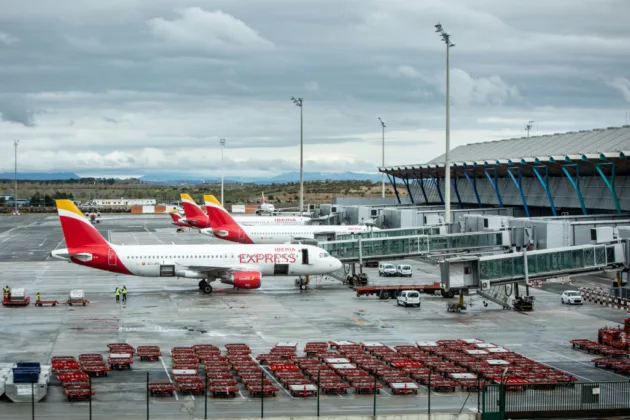











Travellers landing at Italian airports have faced new checkpoints erected across the country’s major aviation hubs, forcing passengers arriving on flights from Spain into separate lanes.
The physical divide is the first tangible result of the Meloni government’s decision to suspend Schengen free movement with Spain for the month of August.
On August 3-4, 2026, social media photos published by passengers began to show the new layout in action, including at Rome Fiumicino Airport and Venice Marco Polo Airport.
This setup filters internal EU arrivals into dual streams, channelling travellers who have just landed on flights coming from Spain towards specific border checkpoints, while directing passengers arriving from other EU flights into separate lanes.
Italy triggered the emergency border mechanism following the migration crisis in Spain’s North African enclave of Ceuta. After an estimated 72,000 migrants crossed from Morocco into Spanish territory over a matter of days, according to figures given by Spanish interior minister Fernando Grande-Marlaska on August 4, 2026, Prime Minister Giorgia Meloni defended the move on social media on July 31, 2026, as an “extraordinary measure” required to safeguard national security and prevent repercussions for Italy.
The selective internal border controls officially went into effect on August 1, 2026.
Because the two Mediterranean nations share no land border, the Italian Interior Ministry, under interior minister Matteo Piantedosi, is executing the security operation entirely at air and sea frontiers.
Rather than systematic immigration passport queues for all travellers, the Interior Ministry clarified that airport police are conducting “targeted and selective” random checks specifically aimed at verifying that non-EU nationals hold the documents required to circulate within the Schengen area.
Italy officially submitted its mandatory notification to the European Commission on August 3, 2026, two days after the checks had begun, maintaining that these “temporary internal border controls” will persist until August 31, 2026, with the option of renewal.
The Commission has yet to deliver its assessment. Home affairs commissioner Magnus Brunner said the measure had to be proportionate and temporary, adding that no migrant from Ceuta had entered the Schengen area.
On the ground, hub operators have assured passengers that flights are running normally despite the additional border controls. Aeroporti di Roma advised travellers to carry identity documents valid for travel abroad and said schedules were unchanged.
At Venice Marco Polo, arrivals from Spain were routed through the non-Schengen area on August 3, 2026, leaving some passengers waiting up to an hour and a half for their luggage, according to Corriere del Veneto.