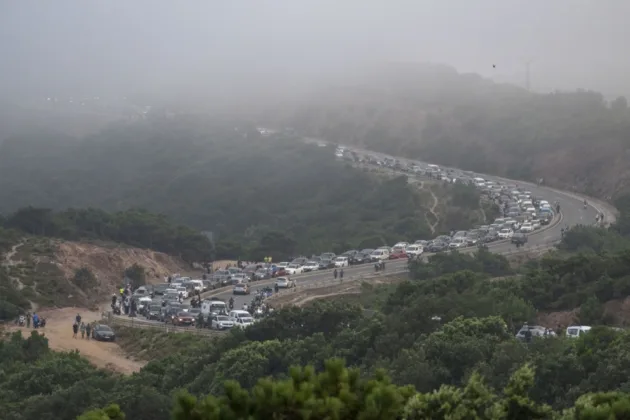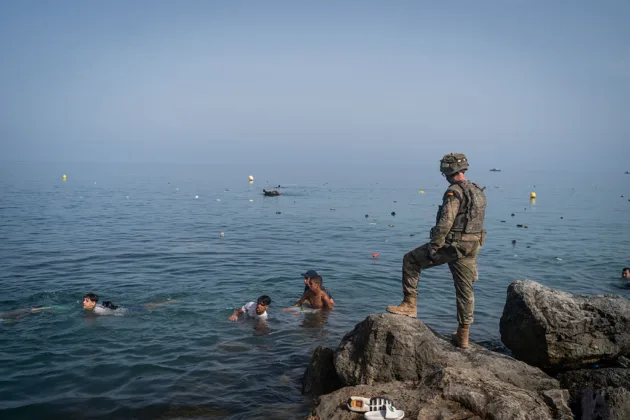






The brief but spectacular arrival of an estimated 80,000 Moroccans swimming past the breakwater into Spain at Ceuta on July 30 and 31, like Caesar swimming across Alexandria harbour after his famous encounter with Cleopatra who was conducted into his presence rolled up in a carpet, raises some interesting points about Europe’s immigration problems. The amphibious landing was conducted almost entirely by healthy and respectably, if lightly, dressed young men. There were very few females and no appearance of desperation or penury. It was a stark contrast with the endless marches of ragamuffins towards the US southern border in the Biden era.
The Spanish authorities, both local and central, responded quickly and professionally. Shopkeepers shuttered their establishments at once and there was no place for the invaders to pillage or eat, or even get a drink of water. Reinforcements arrived with commendable haste, and venerable visitors to Spain could recall the uncompromising efficiency of General Franco’s “grey guards”. Within a few days most of the spontaneous visitors had been rounded up, given a hot meal and a cool drink and returned to Morocco. The Spanish Government has put the number sent back at 73,000 and said about 2,500 remained in the enclave. The Ceuta government disputes that and estimates between 8,000 and 11,000 are still in the city, which its president Juan Vivas has called an untenable situation. At least 72 people died in the attempt, most of them drowned.
Spain’s tedious and fundamentally unfeasible premier, the left-wing poseur Pedro Sánchez, who has conducted a tiresome masquerade as Europe’s great friend and champion of the dispossessed migrant and refugee, put in an appearance in the rearguard of the police after they had brought the unscheduled visitation to an end. He had controversially approved the regularisation of some 500,000 mostly Latin American migrants in January 2026, but this was not remotely like former German chancellor Angela Merkel hurling open the borders of Germany to a million destitute and not easily assimilable people from the Middle East.
Like most of Europe, Spain has a naturally declining population but reasonable hopes for economic growth. Thus, it has a constant requirement for additions to the workforce. The astute response of the Spanish Government has been to facilitate immigration from Hispanic America. This is especially appealing after the current US administration’s closing of the southern border of that country. Such arrivals can apply for Spanish nationality after two years of legal residence, against 10 years for most other nationalities. They are almost all Spanish-speaking Roman Catholics and assimilation is even simpler than that of the British and Irish in the United States, Canada and Australia.
In fact, the European Union, very belatedly, is responding effectively to the hazards of porous borders. Frontex, the European Border and Coast Guard Agency, recorded almost 178,000 unauthorised entries into the EU in 2025, a fall of 26 per cent on the previous year. This is not an excessive strain on the combined population of over 400 million and does represent a serious effort by the entire entity to pull up its socks. This is not a number large enough to put excessive strain on costs for the citizens of modest income in the European countries and there should be an appreciable decline in racial tensions as a result of it.
Ironically, the principal reasons that the United Kingdom narrowly voted to depart the European Union were the undemocratic structures of European government and its inability to deal with immigration. A blizzard of bureaucratic directives from Brussels, in the name of an “ever closer Union”, was going to subsume the institutions that the British had gradually built up since the Magna Carta of 1215, even as the British blamed Brussels for an indigestible flow of unskilled immigration. Now that the sceptred isle of the United Kingdom is on its own and despite its glorious maritime traditions which permitted it to say when it wished that “the continent is isolated”, because of the strength of the Royal Navy, illegal immigration has risen. It is no longer possible to recruit the French and Belgians and Dutch to assist in restricting the number of migrants leaving those countries for British shores. And the Royal Navy, which held the sceptre of the seas for 400 years from the time of Henry VIII to the rise to pre-eminence of America, is unable to contain the armada of rafts and rowboats that continuously delivers human flotsam and jetsam to Britain’s shores. Frontex counted nearly 59,000 attempted Channel crossings in the first 10 months of 2025, 3 per cent more than a year earlier.
The good news is that immigration-based abrasions should steadily moderate. Though it is distressing, as Britain installs Andy Burnham as its seventh prime minister in 10 years amidst statements of intent that give no comfort whatever that standards of government there will rise, to contemplate, as was discussed in this place, the unprecedented current lack of aptitude of the British people for self-government. The fact that Europe is getting on top of this problem of uncontrollable flows of population that bear no resemblance to traditional immigration, where newcomers help build a new nationality, is a cause for relief. But the continued floundering of Great Britain, which for centuries was the most stable and most respected government of any important country, is a source of unease for the entire world.