






The centre-left government led by Prime Minister Donald Tusk has avoided publishing a defence agreement reached by the German and Polish defence ministers and the text of that agreement was only published six weeks later by the Germans.
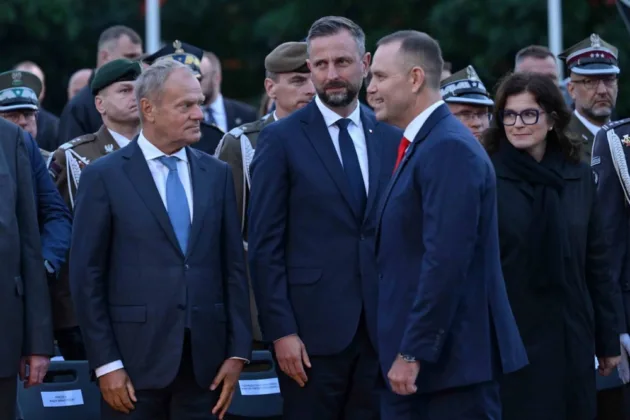
On June 17, 2026, Polish Deputy Prime Minister and defence minister Władysław Kosiniak-Kamysz together with German defence minister Boris Pistorius signed a new bilateral defence agreement in Warsaw aimed at strengthening military cooperation between the two countries, replacing a framework agreement concluded in June 2011.
According to Poland’s Ministry of National Defence, the agreement “will constitute the legal framework defining the new, updated principles of cooperation between the parties in defence matters”. After the signing ceremony, Pistorius said the document opened a new chapter in cooperation and friendship between the two countries.
Sources close to the Tusk government made no secret of the fact that they had kept the agreement at ministerial level rather than raising it to a treaty in order to avoid the President blocking it.
The fact that the agreement was signed at ministerial level rather than as a treaty meant that it did not have to be ratified by the right-wing opposition allied President Karol Nawrocki nor by parliament.
As it is, the President’s Chancellery has claimed that the text of the agreement had not been consulted with the Polish head of state.
According to the President’s aides “the status of the agreement was deliberately downgraded, from an international treaty to an intergovernmental agreement, in order to create at least a weak pretext for claiming that the President did not have to be informed about it in detail”.
Nawrocki had already complained about the text of defence agreements signed by the Tusk government with France and the United Kingdom but did not block them.
Given the fact that the party that supported Nawrocki’s presidential bid, the Conservatives (PiS) have for years been suspicious of agreements with Germany and has criticised Tusk for being far too accommodating to Poland’s western neighbour, the government feared that Nawrocki would come out against the defence agreement with the Germans.
The text of the agreement finally surfaced not in Poland but on the pages of the German Federal Law Gazette on July 29, six weeks after the agreement had been officially signed. The Polish government did not reveal its contents after it was signed.
Asked when it would do so, the defence ministry told the conservative portal Niezależna that the text would appear in Poland’s official gazette Monitor Polski only once the agreement entered into force, and that approval by the Council of Ministers was still under way. No date has been given.
Sebastian Meitz, an expert from the centre-right think tank Sobieski Institute, told the defence portal Defence24 that in his opinion the central focus of the agreement related to German and not Polish priorities.
According to Meitz the most concrete commitment in the agreement refers to developing logistics infrastructure on Polish territory to serve as support facilities for the German brigade being formed in Lithuania.
He also notes that the agreement’s joint investments in military and civilian infrastructure for the rapid deployment of troops and heavy equipment to NATO’s eastern flank concern only infrastructure located on Polish and not German territory.
In parts of the agreement concerning interoperability, joint training and military exercises as well as cooperation with the European Space Component Command, Poland is only being allowed to join Bundeswehr Space Command structures and no joint Polish-German structure is being developed.
Similarly, in other sectors the agreement fails to give Poland hope of bridging the capability gap with Germany with regard to technology, production and supply chains.
The document fails to provide any mechanism guaranteeing a balanced distribution of benefits for both sides. Meitz asked why it contained not even a general provision on a minimum share for Polish industry, on locating production in Poland or on technology transfer, adding that he did not regard the omission as accidental.
In the digitalisation sphere in which Poland is acknowledged to be one of the best in NATO the agreement is vague with no priorities set, and does not say who would set them or on what criteria.
There is also no mention of any German support for Polish attempts to participate in NATO’s nuclear sharing programme, in which Germany has participated for decades. Meitz said such a clause would have been an example of something that strengthened Polish interests in a tangible way.
As for financial responsibilities each party is expected to bear the costs related to its own commitments. Since those are heavily skewed towards Poland it is Germany’s eastern neighbour who may have to foot a lion’s share of the bill.
“In my opinion a careful reading of this agreement shows that it is hard to speak of a real partnership,” Meitz concluded.
The agreement will not improve strained relations between the opposition and its aligned President and the government, but Tusk has shown no signs that he wishes to have any common ground with either on any issue.
Tusk is angling for an electoral pact with the centre-right Polish People’s Party (PSL), a small party with nationwide structures which is led by Kosiniak-Kamysz and is Tusk’s Civic Coalition’s (KO) partner in the centre-left administration currently in power in Poland.
The PSL is an ally of Tusk’s KO in the European Parliament’s largest grouping, the European People’s Party, and between 2007 and 2015 was the junior partner in governments led by his Civic Platform (PO).
In order to attract the centre-right PSL into its electoral coalition Tusk and the KO have put out feelers on Kosiniak-Kamysz becoming Prime Minister in the spring of 2027, but the PSL have so far treated such gambits with suspicion.
Tusk, one of the PO’s founders is not known for gladly giving up power over either his party or the government.
But his relationship with Kosiniak-Kamysz is a good one. Tusk was happy about his performance as labour minister in his last government and is equally happy about the PSL leader’s stint at the ministry of defence.
Tusk has always seen the defence ministry as one of the key portfolios of state alongside finance, interior and foreign affairs, all ministries his KO controls.
Kosiniak-Kamysz has also proved his worth in establishing a good relationship with US Secretary of War Pete Hegseth and other Pentagon officials. An important asset since Tusk himself is persona non grata for the current Trump administration after he called the US President a Russian asset.
Moreover, Kosiniak-Kamysz has attempted to establish good relations with both former president Andrzej Duda and Nawrocki without damaging his close relationship with Tusk.
This was evident this year when he backed Tusk’s move for Poland to participate in the EU’s SAFE defence loan programme while at the same time expressing readiness to consider an additional finance option from the resources generated by Poland’s central bank.
In the final analysis Kosiniak-Kamysz has proved himself to be loyal to Tusk and has manoeuvred in such a way that when there are disagreements between his and Tusk’s party on issues such as abortion, LGBT rights or state level appointments he has never been the face of such disputes.