








Most European Union member states have backed a significant cut in the staff costs of the EU institutions in the bloc’s next long-term budget, according to a paper drawn up by the Irish presidency of the Council of the European Union.
The document found broad support for trimming administrative spending while governments continue to argue over the overall size of the 2028-2034 Multiannual Financial Framework (MFF). Officials’ salaries and the upkeep of buildings were identified as the most probable areas for reductions.
The European Commission has proposed spending almost €2 trillion over the seven years, of which €118 billion, or roughly 6 per cent, would go on administration.
That package includes about 2,500 additional officials across the institutions, a plan opposed by around a third of member states. Several governments have questioned why Brussels should expand its workforce while they are cutting their own civil services at home.
The Irish presidency, which is chairing the negotiations until the end of the year, has acknowledged that administration is one of the few areas where agreement on savings looks within reach.
Beyond that, member states remain divided. A group led by Germany, whose ambassador warned that Berlin’s net contribution could rise by around 80 per cent, wants hundreds of billions of euros stripped from the Commission figure. German Chancellor Friedrich Merz has described the proposal as “unacceptable and unbalanced”.
Italy and Poland are pressing in the opposite direction, seeking more money for farmers and for poorer regions. Sixteen southern and eastern member states formed a bloc before the European Council of June 18-19 to defend cohesion and agricultural spending, which the Commission plan would fold into national and regional partnership plans.
The Commission package is worth about 1.26 per cent of the bloc’s combined gross national income. Roughly €66 billion of it would have to come from new EU-wide revenue streams, or “own resources”, the strand of the talks where progress has been slowest.
A presidency note circulated to ambassadors on September 8 said the vast majority of capitals were willing to engage on a package of new own resources, and recorded broad support for cutting the share of customs duties that member states keep to cover collection costs from 25 per cent to 10 per cent.
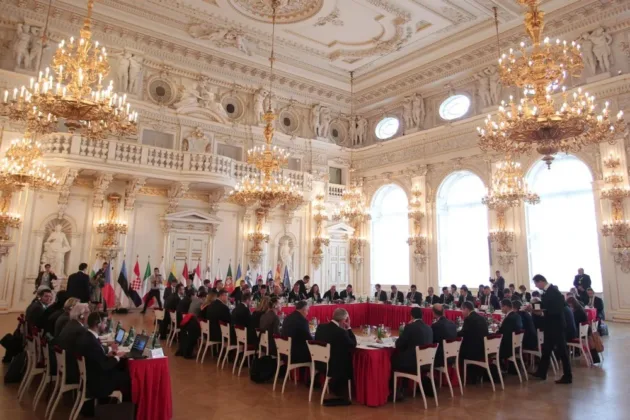
An informal General Affairs Council held in Dublin on September 3-4 produced no notable movement, with ministers restating familiar national positions.
Irish Minister of State for European Affairs Thomas Byrne told his counterparts that the presidency was considering tabling its own “negotiating box”, the draft text setting out spending ceilings and allocations, as early as the first week of October. Ministers meet again in Brussels on September 22, and EU leaders on October 15.
The Cyprus presidency put forward the first negotiating box carrying figures on June 11, cutting the overall package by about 2 per cent to some €1.73 trillion in constant prices. That was still well short of what net contributors have demanded.
The European Parliament has moved the other way, demanding a €2.2 trillion framework in its negotiating position. Any final deal needs unanimity among the 27 governments and the consent of MEPs.
Dublin is aiming for political agreement before the end of 2026. Without one, the sectoral legislation needed to put the budget into effect, some 22 files in all, would slip into 2027, and payments due to beneficiaries from January 2028 could be delayed.
Pay at the institutions has been a recurring source of friction. EU staff received their seventh salary rise since 2022 in March 2025, under a method that adjusts remuneration each year in line with inflation in Belgium and Luxembourg and with pay decisions in a sample of national civil services.
The formula is set out in the Staff Regulations and leaves governments little room for discretion once the figures are in. Changing it means reopening the Staff Regulations themselves, as ministers did in 2013.
There was no interim adjustment in the first half of 2026 because inflation did not reach the trigger threshold, according to Union Syndicale, one of the main staff unions. The annual update, due at the end of the year and backdated to July 1, is expected to exceed 3 per cent. Pension contributions rose from 13.1 per cent to 14.1 per cent of basic salary on July 1.
The last overhaul of the Staff Regulations, agreed alongside the 2014-2020 budget, was estimated to have saved around €4.3 billion in administrative costs over that framework. A freeze on salaries and pensions in 2013 and 2014, together with limited adjustments in 2011 and 2012, accounted for a further €3 billion or so, and about €500 million a year thereafter.
Union Syndicale has told members that previous rounds of budget cuts show staff are usually the first to carry the cost, and has urged them to follow the MFF talks closely.