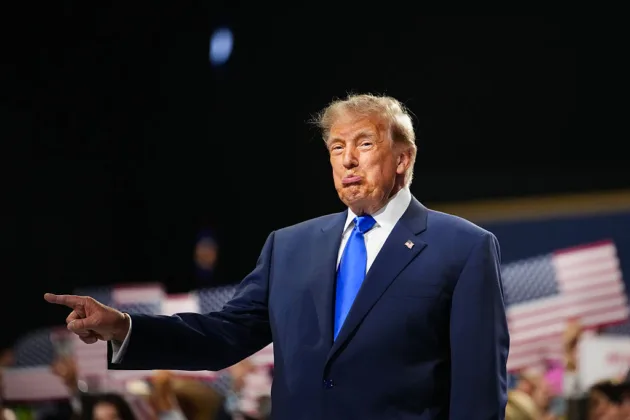






US President Donald Trump has ordered his administration to strip Canadian products out of the federal civil procurement system, signing a presidential memorandum on September 16, the day the European Union offered Ottawa a place at its side.
The document instructs the director of the Office of Management and Budget (OMB), Russell Vought, and United States Trade Representative (USTR) Jamieson Greer to identify Canadian-origin items in federal civil contracting. They are to take every step allowed by law to remove them or make them unavailable for purchase.
Both are to work with the Federal Acquisition Regulatory Council. Vought was also told to point departments and agencies towards domestic alternatives to Canadian imports and to report back on progress.
The White House said the measure answered Canadian steps that had denied American firms access to federal and provincial procurement markets, pointing to Ottawa’s “Buy Canadian” policy and to restrictions applied by Canadian provinces.
Greer, for his part, is to keep monitoring how Canada treats US-origin goods in its own government contracting.
The memorandum follows an instruction issued on September 8 to the General Services Administration (GSA) to take Canadian products off its Multiple Award Schedules, the government-wide contracting programme that handles more than $50 billion (€42.5 billion) a year.
Trump has said Canadian items on those schedules are worth more than $50 billion annually. Eric Miller, president of the Rideau Potomac Strategy Group, put average US federal purchases of Canadian goods at about $1.6 billion (€1.4 billion) a year since 2021, based on published spending data.
Washington imposed 50 per cent tariffs on roughly $20 billion (€17 billion) of Canadian goods under Section 338 of the Tariff Act of 1930 on August 22.
Canada retaliated on September 8 with duties of 15, 25 and 50 per cent on steel and aluminium, dairy, appliances, farm machinery, pulp and paper, plastics and electronics.
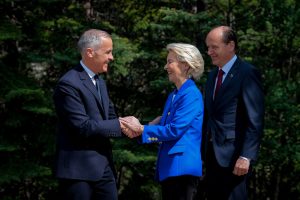
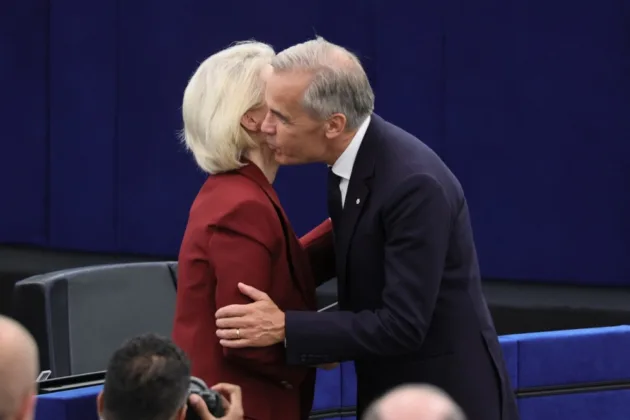
The signature came hours after von der Leyen used her State of the Union address to propose making Canada the first associate member of the European Union, an offer that drew a standing ovation from MEPs with Carney sitting in the chamber.
Speaking in Charlotte, North Carolina, Trump called the prospect a possible “hostile act” and threatened further tariffs on the bloc.
Carney was due to address the European Parliament in Strasbourg on September 17. He has ruled out membership and said Canada wanted a “unique alliance” with the EU, with a Canada-EU summit set for Montreal on October 29-30.
About 70 per cent of Canadian exports go to the United States, which leaves Ottawa heavily exposed to the tariffs and has pushed it to look for partners elsewhere.